Name the charge carriers of electric current in:
- Silver foil.
- Hydrogen discharge tube.
- Germanium semiconductor.
- Wire made of alloy nichrome.
- Superconductor.
Download our app for free and get started
- Charge carriers in silver foil are free electrons.
- Charge carriers in hydrogen discharge tube are electrons $(e^–)$ and positive hydrogen ions $(H^+).$
- Charge carriers in germanium semiconductor are electrons $(e^–)$ and holes $(o^+).$
- Charge carriers in nichrome wire are electrons.
- Charge carriers in superconductor are electrons.

Download our appand get started for free
Experience the future of education. Simply download our apps or reach out to us for more information. Let's shape the future of learning together!No signup needed.*
Similar Questions
- 1View SolutionHow many time constants will elapse before the power delivered by a battery drops to half of its maximum value in an RC circuit?
- 2A potentiometer wire of length 1.0 m has a resistance of l5 $\Omega$. It is connected to a 5 V battery in series with a resistance of 5 $\Omega$ Determine the emf of the primary cell which gives a balance point at 60 cm.View Solution
- 3View SolutionA cylindrical metallic wire is stretched to increase its length by 10%. Calculate the percentage increase in its resistance.
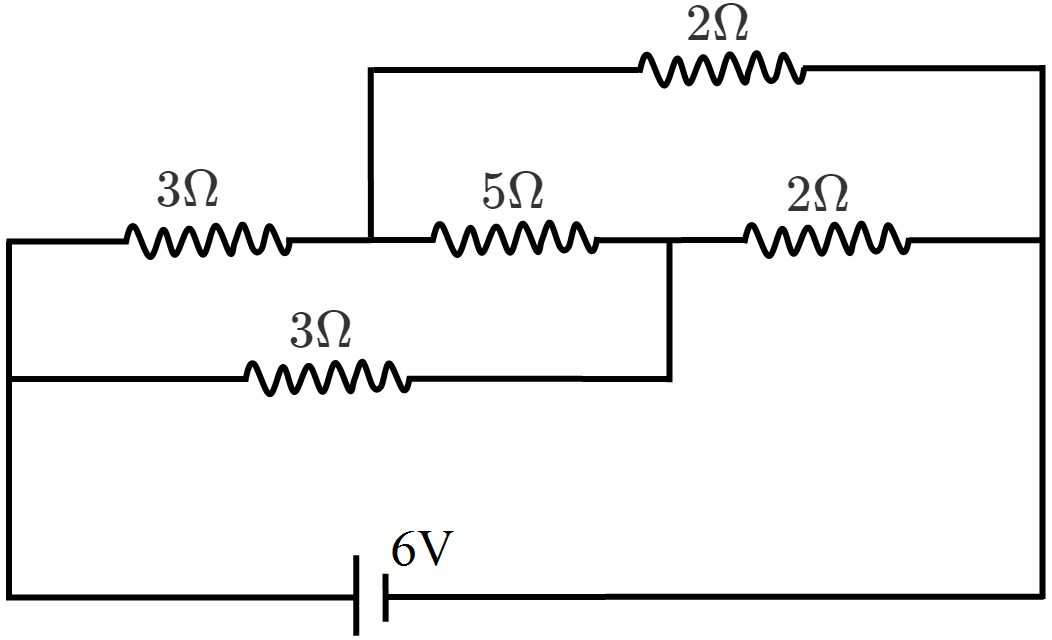
- 4View SolutionCalculate the current drawn from the battery in the given network shown here. State Kirchhoff’s loop law and name the law on which it is based.
- 5An electric toaster uses nichrome for its heating element. When a negligibly small current passes through it, its resistance at room temperature $\left(27.0^{\circ} C \right)$ is found to be $75.3 \Omega$. When the toaster is connected to a $230 V$ supply, the current settles, after a few seconds, to a steady value of $2.68 A$. What is the steady temperature of the nichrome element? The temperature coefficient of resistance of nichrome averaged over the temperature range involved, is $1.70 \times 10^{-4}{ }^{\circ} C ^{-1}$.View Solution
- 6In the figure a long uniform potentiometer wire $AB$ is having a constant potential gradient along its length. The null points for the two primary cells of emfs $\varepsilon_{1}$ and $\varepsilon_{2}$View Solution
connected in the manner shown are obtained at a distance of $120 \ cm $ and $300 \ cm$ from the end $A$.
Find $(i) \varepsilon_{1} / \varepsilon_{2}$ and $(ii)$ position of null point for the cell $\varepsilon_{1}$. How is the sensitivity of a potentiometer increased?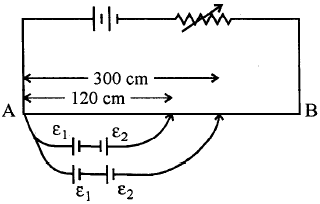
Using Kirchoffs rules determine the value of unknown resistance $R$ in the circuit so that no current flows through 4 $\Omega$ resistance. Also find the potential difference between $A$ and $D.$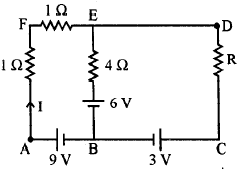
- 7View SolutionElectrons are continuously in motion within a conductor but there is no current in it unless some source of potential is applied across its ends. Give reason.
- 8View SolutionA heater coil is cut in two parts and only one of them is used in the heater. What is the ratio of the heat produced by this half coil to that by the original coil if the voltage applied is the same?
- 9What are the advantages of the null$-$point method in a Wheatstone bridge? What additional measurements would be required to calculate $R_{unknown}$ by any other method?View Solution
- 10The number density of free electrons in a copper conductor estimated in Example $3.1$ is $8.5 \times 10^{28}m^{-3}.$ How long does an electron take to drift from one end of a wire $3.0 m$ long to its other end? The area of cross$-$section of the wire is $2.0 \times 10^{-6} m^2$ and it is carrying a current of $3.0 A.$View Solution