Question
For the reaction, 2A(g) + B(g) → 2D(g)$\Delta\text{U}^\ominus=-10.5\text{kJ} \ \text{and} \ \Delta\text{S}^\ominus=-44.1\text{kJ}^{-1}.$
Calculate $\Delta\text{G}^\ominus$ for the reaction, and predict whether the reaction may occur spontaneously.
Answer

For the given reaction, $2 A_{( g )}+ B _{( g )} \rightarrow 2 D _{( g )} \Delta ng _{ g }=2-(3)$
$=-1$ mole Substituting the value of $\Delta U ^{\ominus}$ in the expression of $\Delta H : \Delta H ^{\ominus}=\Delta U ^{\ominus}+\Delta ng _{ g } RT$
$=(-10.5 kJ)-(-1)\left(8.314 \times 10^{-3} kJ K ^{-1} mol^{-1}\right)(298 K)=-10.5 kJ-2.48 kJ \Delta G ^{\ominus}=+0.16 kJ$
Since $\Delta G ^{\ominus}$ for the reaction is positive, the reaction will not occur spontaneously.

Need a full question paper?

Generate a complete, print-ready paper with questions like this in minutes — across 16+ boards, with answer keys.

Start Generating Free

Similar questions

Calculate the atomic mass (average) of chlorine using the following data:
 
% Natural Abundance
Molar Mass
${ }^{35} \mathrm{Cl}$
75.77
34.9689
${ }^{37} \mathrm{Cl}$
24.23
36.9659
Give reasons why hydrogen resembles alkali metals?
Explain the difference between reversible and irreversible processes.
  1. State Henry's Law.
  2. Assign reason for the following:
  1. A solution of $NH_4Cl$ in water shows pH less than 7.
  2. In qualitative analysis $NH_4Cl$ is added before adding $NH_4OH$ for testing $Fe^{3+}$ or $AP^{3+}$ ions.
  1. Consider the reaction:
$\text{N}_2(\text{g})+3\text{H}_2(\text{g})\rightleftharpoons2\text{NH}_3+\text{Heat}$
Indicate the direction in which the equilibrium will shift when:
  1. Temperature is increased.
  2. Pressure is increased.
For the reaction: $\text{N}_2(\text{g})+3\text{H}_2(\text{g})\rightleftharpoons2\text{NH}_3(\text{g})$at 400K, $K_p = 41$. Find the value of $K_p$ for each of the following reactions at the same temperature.
  1. $\text{2NH}_3(\text{g})\rightleftharpoons\text{N}_2(\text{g})+3\text{H}_2(\text{g})$
  2. $\frac{1}{2}\text{Na}(\text{g})+\frac{3}{2}\text{H}_2(\text{g})\rightleftharpoons\text{NH}_3(\text{g})$
  3. $2\text{N}_2(\text{g})+6\text{H}_2(\text{g})\rightleftharpoons4\text{NH}_3(\text{g})$
The ionization constant of nitrous acid is $4.5 \times 10^{–4}$. Calculate the pH of $0.04M$ sodium nitrite solution and also its degree of hydrolysis.
One mole of $H_2O$ and one mole of CO are taken in 10L vessel and heated to 725K. At equilibrium 40% of water (by mass) reacts with CO according to the equation,
$\text{H}_2\text{O (g) + CO (g)}\rightleftharpoons\text{H}_2\text{ (g) + CO}_2\text{ (g)}$
Calculate the equilibrium constant for the reaction.
The reaction of cyanamide, $NH _2 CN ( s )$, with dioxygen was carried out in a bomb calorimeter, and $\Delta U$ was found to be $-742.7 kJ mol ^{-1}$ at 298 K . Calculate enthalpy change for the reaction at 298 K .
$NH_2 CN(g)+\frac{3}{2} O_2(g) \longrightarrow N_2(g)+CO_2(g)+H_2 O(l)$
At $0°C$, the density of a certain oxide of a gas at $2$ bar is same as that of dinitrogen at $5$ bar. What is the molecular mass of the oxide?
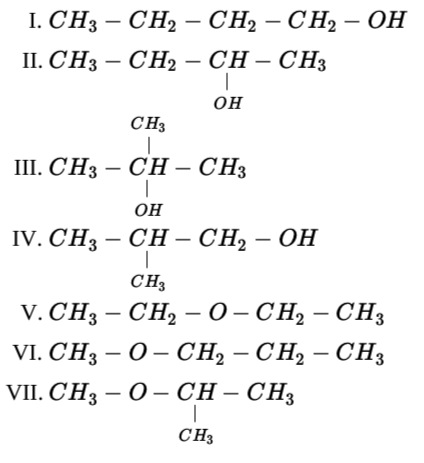
1. Identify the pairs of compounds which are functional group isomers.
Image
2. Explain, how is the electronegativity of carbon atoms related to their state of hybridization in an organic compound.