MCQ
For the reaction :

$NH_3{_{(g)}}\ \rightleftharpoons \ \frac {1}{2} {N_2}_{(g)} + \frac {3}{2} {H_2}_{(g)}$ ; $K_P$

The degree of dissociation $(\alpha )$ of $NH_3$ is related to total equilibrium pressure $(P^o )$ as 

  • $\alpha  = {\left( {1 + \frac{{3\sqrt 3 {P^o}}}{{4{K_P}}}\,} \right)^{ - \frac{1}{2}}}$
  • B
    $\alpha  = {\left( {1 + \frac{{3\sqrt 3 {P^o}}}{{4{K_P}}}\,} \right)^{\frac{1}{2}}}$
  • C
    $\alpha  = {\left( {1 + \frac{{3{P_0}}}{{4{K_P}}}\,} \right)^{\frac{1}{2}}}$
  • D
    $\alpha  = {\left( {1 + \frac{{3{P_0}}}{{4{K_P}}}\,} \right)^{ - \frac{1}{2}}}$

Answer

Correct option: A.
$\alpha  = {\left( {1 + \frac{{3\sqrt 3 {P^o}}}{{4{K_P}}}\,} \right)^{ - \frac{1}{2}}}$
a
$\mathrm{NH}_{3} \rightleftharpoons \frac{1}{2} \mathrm{N}_{2}+\frac{3}{2} \mathrm{H}_{2}$

Eq. $\quad(1-\alpha) \quad \frac{\alpha}{2} \quad \frac{3 \alpha}{2}$

$K_{p}=\frac{\left(\frac{\alpha}{2}\right)^{\frac{1}{2}}\left(\frac{3 \alpha}{2}\right)^{\frac{3}{2}}}{(1-\alpha)} \cdot \frac{p^{o}}{(1+\alpha)}$

Solving:

$\alpha=\left(1+\frac{3 \sqrt{3} \mathrm{p}^{\circ}}{4 \mathrm{K}_{\mathrm{p}}}\right)^{-\frac{1}{2}}$

Need a full question paper?

Generate a complete, print-ready paper with questions like this in minutes — across 16+ boards, with answer keys.

Start Generating Free

Similar questions

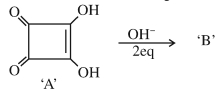
Correct statements for the given reaction are :

$A$. Compound ' $B$ ' is aromatic

$B$. The completion of above reaction is very slow

$C$. '$A$' shows tautomerism

$D$. The bond lengths $C - C$ in compound $B$ are found to be same

Choose the correct answer from the options given below :

The $IUPAC$ name of the following compound is

$\begin{array}{*{20}{c}}
  {^{C{H_3}}} \\ 
  {_H} 
\end{array}\begin{array}{*{20}{c}}
  {{\text{ }}\backslash {\text{ }}} \\ 
  / 
\end{array}\mathop C\limits^{} {\mkern 1mu}  = \mathop C\limits^{} {\mkern 1mu} \begin{array}{*{20}{c}}
  / \\ 
  {{\text{ }}\backslash {\text{ }}} 
\end{array}_{\mathop C\limits^{} {\kern 1pt}  \equiv \mathop C\limits^{} {\kern 1pt}  - \mathop C\limits^{} {\kern 1pt} {H_2}\mathop C\limits^{} {\kern 1pt} {H_3}}^H{\mkern 1mu} $

The molarity of $1 \mathrm{~L}$ orthophosphoric acid $\left(\mathrm{H}_3 \mathrm{PO}_4\right)$ having $70 \%$ purity by weight (specific gravity $\left.1.54 \mathrm{~g} \mathrm{~cm}^{-3}\right)$ is_____$\quad \mathrm{M}$.

(Molar mass of $\mathrm{H}_3 \mathrm{PO}_4=98 \mathrm{~g} \mathrm{~mol}^{-1}$ )

Oxidation number of $P$ in $Mg_2P_2O_7$ is
The most common oxidation state of an element is $-2.$  The number of electrons present in its outermost shell is
$C{H_2} = C{H_2}   \xrightarrow[KOH / H_2o ]{KMnO_4} \mathop {}\limits_{} X$ . Product ‘$X$’ in above reaction is
When mass is enclosed in a system and no transfer of material and energy is allowed in or out, it's $ ........ $ will never change.
The set of quantum numbers not applicable for an electron in an atom is
The linear combination of atomic orbitals to form molecular orbitals takes place only when the combining atomic orbitals

$A$. have the same energy

$B$. have the minimum overlap

$C$. have same symmetry about the molecular axis

$D$. have different symmetry about the molecular axis

Choose the most appropriate from the options given below:

$1, 2-$Dichloroethene shows