Question
For the same objective, find the ratio of the least separation between two points to be distinguished by a microscope for light of 5000A and electrons accelerated through 100V used as the illuminating substance.

Answer

Resolving power of a microscope $=\frac{2\sin\beta}{1.22\lambda}$ where $\mu$ is refractive index of the medium, $\lambda$ is the wavelength of light and $\beta$ is the angle subtended by the objective at the object.
Now, $\frac{1}{\text{d}}=\frac{2\sin\beta}{1.22\lambda}$
$\Rightarrow\ \text{d}_\text{min}=\frac{1.22\lambda}{2\sin\beta}$
For the light of wavelength 5000A,
$\text{d}_\text{min}=\frac{1.22\times5000\times10^{-10}}{2\sin\beta}\Big[\because\ 1\text{A}=10^{-10}\text{m}\Big]\ .....(\text{i})$
Now, the de-Broglie wavelenght is given by $\lambda=\frac{12.27}{\sqrt{\text{V}}}$
Substituting V = 100 in $\lambda=\frac{12.27}{\sqrt{\text{V}}}$, we get
$\frac{12.27}{\sqrt{100}}=1.227\times10^{-10}\text{m}$
$\therefore\ \text{d}'_\text{min}=\frac{1.22\times1.227\times10^{-10}}{2\sin\beta}$
Ratio of the least separation
$\frac{\text{d}_\text{min}}{\text{d}'_\text{min}}=\frac{\frac{1.22\times5000\times10^{-10}}{2\sin\beta}}{\frac{1.22\times1.227\times10^{-10}}{2\sin\beta}}$
$=\frac{5000}{1.227}$
$=4075.$

Need a full question paper?

Generate a complete, print-ready paper with questions like this in minutes — across 16+ boards, with answer keys.
Start Generating Free

Similar questions

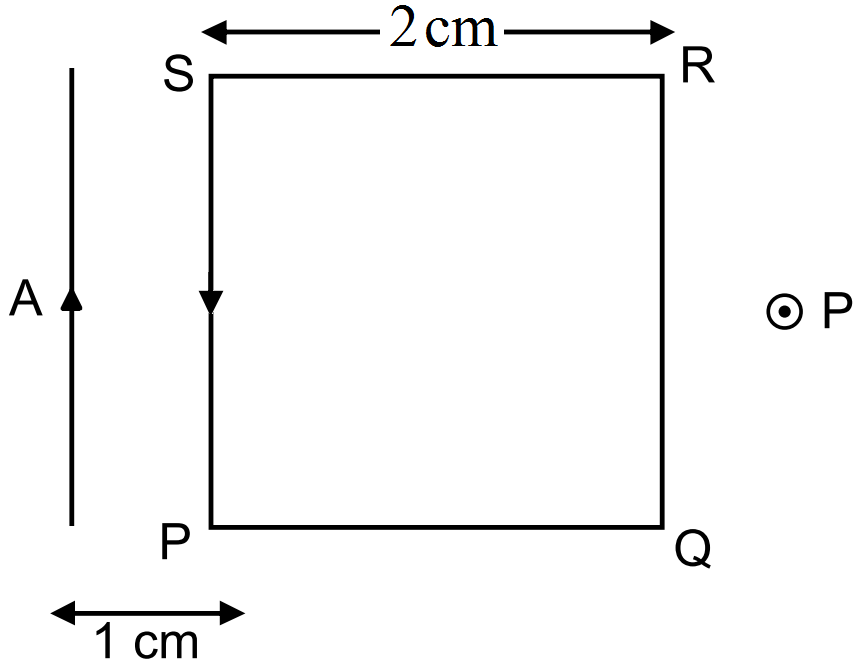
A square loop PQRS carrying a current of 6.0A is placed near a long wire carrying 10A as shown in figure.

  1. Show that the magnetic force acting on the part PQ is equal and opposite to that on the part RS. 
  2. Find the magnetic force on the square loop.

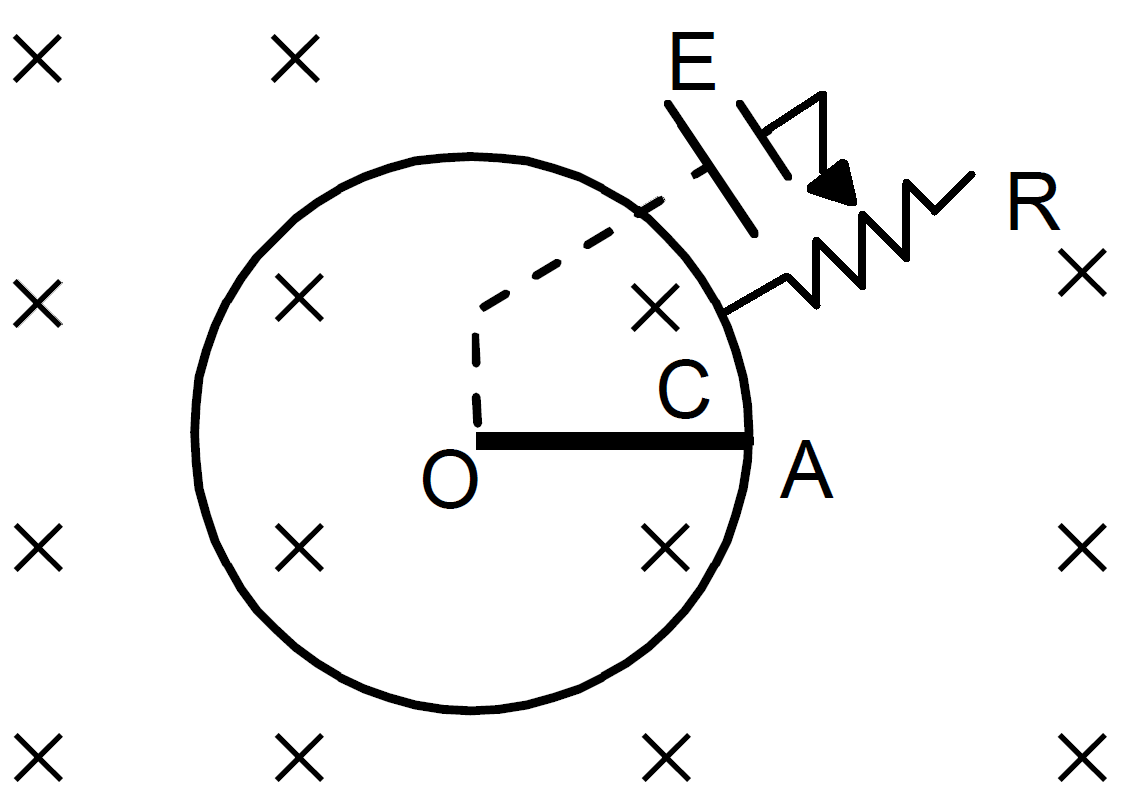
Figure shows a situation similar to the previous problem. All parameters are the same except that a battery of emf $\in$ and a variable resistance R are connected between O and C. The connecting wires have zero resistance. No external force is applied on the rod (except gravity, forces by the magnetic field and by the pivot). In what way should the resistance R be changed so that the rod may rotate with uniform angular velocity in the clockwise direction? Express your answer in terms of the given quantities and the angle $\theta$ made by the rod OA with the horizontal.

Consider a non-conducting plate of radius r and mass m that has a charge q distributed uniformly over it. The plate is rotated about its axis with an angular speed $\omega.$ Show that the magnetic moment $\mu$ and the angular momentum of the plate are related as $\mu=\frac{\text{q}}{2\text{m}}\text{l}.$
A uniform rod of mass m and length l is struck at an end by a force F perpendicular to the rod for a short time interval t. Calculate:
  1. The speed of the centre of mass.
  2. The angular speed of the rod about the centre of mass.
  3. The kinetic energy of the rod.
  4. The angular momentum of the rod about the centre of mass after the force has stopped to act. Assume that t is so small that the rod does not appreciably change its direction while the force acts.
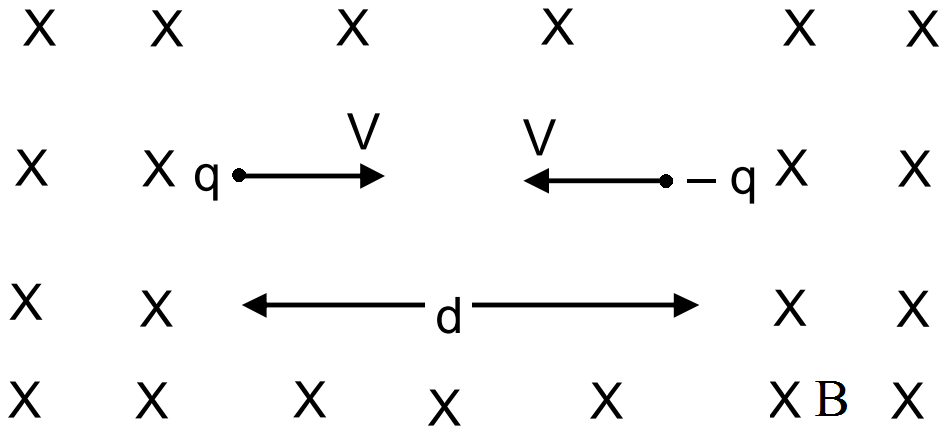
Two particles, each with mass m are placed at a separation d in a uniform magnetic field B, as shown in the figure. They have opposite charges of equal magnitude q. At time t = 0, the particles are projected towards each other, each with a speed v. Suppose the Coulomb force between the charges is switched off.
  1. Find the maximum value vm of the projection speed, so that the two particles do not collide.
  2. What would be the minimum and maximum separation between the particles if $\text{v}=\text{v}_{\text{m}}\sqrt{2}?$
  3. At what instant will a collision occur between the particles if v = 2vm?
  4. Suppose v = 2vm and the collision between the particles is completely inelastic. Describe the motion after the collision.

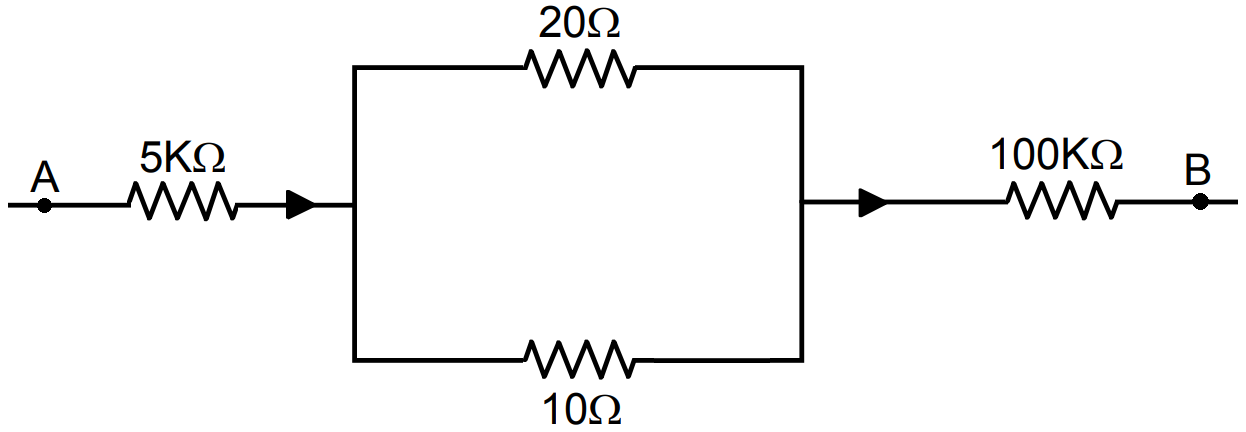
Figure. shows a part of a circuit. If a current of 12mA exists in the $5\text{k}\Omega$ resistor, find the currents in the other three resistors. What is the potential difference between the points A and B?

A wave travelling on a string, at a speed of 10m/s causes each particle of the string to oscillate with a time period of 20ms.
  1. What is the wavelength of the wave?
  2. If the displacement of a particle is 1.5mm at a certain instant, what will be the displacement of a particle 10cm away from it at the same instant?
A block of mass M is kept on a rough horizontal surface. The coefficient of static friction between the block and the surface is $\mu.$ The block is to be pulled by applying a force to it. What minimum force is needed to slide the block? In which direction should this force act?
What is dispersion of light? Explain its cause. Deviation of red colour is minimum white that for violet colour is minimum due to dispersion by prism. Explain it. Draw a diagram for dispersion.