Question
For two statements are given-one labelled Assertion (A) and the other labelled Reason (R). Select the correct answer to these questions from the codes (a), (b), (c) and (d) as given below.
  1. Both A and R are true, and R is the correct explanation of A.
  2. Both A and R are true, but R is not the correct explanation of A.
  3. A is true but R is false.
  4. A is false and R is also false.
Assertion (A): For charge to be in equilibrium, sum of the forces on charge due to rest of the two charges must be zero.
Reason (R): A charge is lying at the centre of the line joining two similar charges each which are fixed. The system will be in equilibrium if that charge is one fourth of the similar charges.
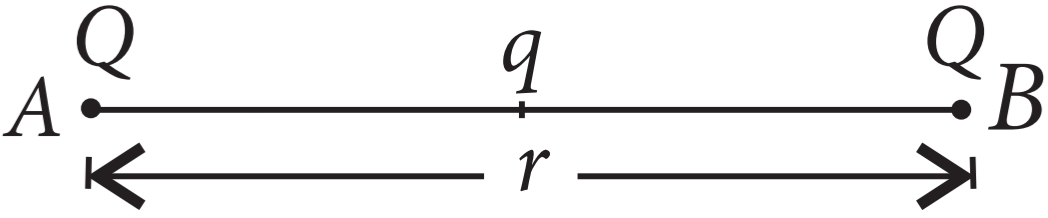
Answer

  1. A is true but R is false.
Explanation:
According to Coulomb's law, $\text{F}=\text{k}\frac{\text{Q}_1\text{Q}_2}{\text{r}^2}.$
The force on q due to A,
$\text{F}_\text{A}=\frac{1}{4\pi\epsilon_0}\cdot\frac{\text{Qq}}{(\frac{\text{r}}{2})^2}$ to the right

Due to B,
$\text{F}_\text{B}=\frac{1}{4\pi\epsilon_0}\cdot\frac{\text{Qq}}{(\frac{\text{r}}{2})^2}$ to the right
$\therefore$ Their sum is zero whether q is $+\frac{\text{Q}}{4}$or $-\frac{\text{Q}}{4}$ or any other value.
Therefore, it is not true that the third charge has to be $\frac{\text{Q}}{4}$ only. It can be any value.

Need a full question paper?

Generate a complete, print-ready paper with questions like this in minutes — across 16+ boards, with answer keys.

Start Generating Free

Similar questions

For question, statements are given-one labelled Assertion (A) and the other labelled Reason (R). Select the correct answer to these questions from the codes (a) (b) (c) and (d) as given below.
  1. Both A and R are true, and R is the correct explanation of A.
  2. Both A and R are true, but R is NOT the correct explanation of A.
  3. A is true, but R is false.
  4. A is false and R is also false.
Assertion (A): A fission reaction can be more easily controlled than a fission reaction.
Reason (R): The percentage of mass converted to energy in a fission reaction is 0.1% whereas in a fission reaction it is 0.4%
For question two statements are given-one labelled Assertion (A) and the other labelled Reason (R). Select the correct answer to these questions front the codes (a), (b), (c) and (d) as given below.
  1. Both A and R are true and R is the correct explanation of A.
  2. Both A and R are true but R is NOT the correct explanation of A.
  3. A is true but R is false.
  4. A is false and R is also false.
Assertion (A): A photon has no rest mass, yet it carries definite momentum.
Reason (R): Momentum of photon is due to its energy and hence its equivalent mass.
For two statements are given-one labelled Assertion (A) and the other labelled Reason (R). Select the correct answer to these questions from the codes (a), (b), (c) and (d) as given below.
  1. Both A and R are true, and R is the correct explanation of A.
  2. Both A and R are true, but R is not the correct explanation of A.
  3. A is true, but R is false.
  4. A is false, and R is also false.
Assertion (A): Capacity of a parallel plate capacitor increases when distance between the plates is decreased.
Reason (R): Capacitance of capacitor is inversely proportional to distance between them.
For two statements are given-one labelled Assertion (A) and the other labelled Reason (R). Select the correct answer to these questions from the codes (a), (b), (c) and (d) as given below.
  1. Both A and R are true, and R is the correct explanation of A.
  2. Both A and R are true, but R is not the correct explanation of A.
  3. A is true, but R is false.
  4. A is false, and R is also false.
Assertion (A): A capacitor is connected to a battery. If we move its plate further apart, work will be done against the electrostatic attraction between the plates, and the energy of the capacitor gets decreased.
Reason (R): The energy stored in capacitor is dissipated in the form of heat energy.
For question, statements are given-one labelled Assertion (A) and the other labelled Reason (R). Select the correct answer to these questions from the codes (a) (b) (c) and (d) as given below.
  1. Both A and R are true, and R is the correct explanation of A.
  2. Both A and R are true, but R is NOT the correct explanation of A.
  3. A is true, but R is false.
  4. A is false and R is also false.
Assertion (A): The nuclear force becomes weak if the nucleus contains too many protons compared to neutrons.
Reason (R): The electrostatic forces weaken the nuclear force.
Two statements are given-one labelled Assertion(A) and the other labelled Reason (R). Select the correct answer to these questions from the codes(a), (b), (c) and (d) as given below.
  1. Both A and R are true and R is the correct explanation of A.
  2. Both A and R are true but R is NOT the correct explanation of A.
  3. A is true but R is false.
  4. A is false and R is also false.
Assertion (A): Magnetic moment of an atom is due to both, the orbital motion and spin motion of every electron.
Reason (R): A charged particle produces a magnetic field. 
Two statements are given-one labelled Assertion (A) and the other labelled Reason (R). Select the correct answer to these questions from the codes (a), (b), (c) and (d) as given below.
  1. Both A and R are true and R is the correct explanation of A.
  2. Both A and R are true but R is not the correct explanation of A.
  3. A is true but R is false.
  4. A is false and R is also false.
Assertion: Microscope magnifies the image.
Reason: Angular magnification for image is more than object in microscope.
Assertion : For a charged particle moving from point P to point Q, the net work done by an electrostatic field on the particle is independent of the path connecting point P to point Q.
Reason : The net work done by a conservative force on an object moving along a closed loop is zero.
For two statements are given-one labelled Assertion (A) and the other labelled Reason (R). Select the correct answer to these questions from the codes (a), (b), (c) and (d) as given below.
  1. Both A and R are true, and R is the correct explanation of A.
  2. Both A and R are true, but R is not the correct explanation of A.
  3. A is true, but R is false.
  4. A is false, and R is also false.
Assertion (A): Increasing the charge on the plates of a capacitor means increasing the capacitance.
Reason (R): Capacitance is directly proportional to charge.
Assertion (A): Transformers are used only in alternating current sources, not in direct current.
Reasons (R): Only a.c. can be stepped up or down by means of transformers.