MCQ
For two vectors A and B,$ |\text{A} + \text{B}| = |\text{A} - \text{B}|$ is always true when
  • A
    $|\text{A}|=|\text{B}|\neq0$
  • B
    $\text{A}\bot\text{B}$
  • C
    $|\text{A}|=|\text{B}|\neq0$ and A and B are parallel or anti parallel
  • D
    when either $|\text{A}|$ or $|\text{B}|$ is zero.

Answer

  1. Magnitude of particle velocity (speed) remains constant.
  1. Direction of acceleration keeps changing as particle moves.

Explanation:

According to the problem, $|\vec{\text{A}}+\vec{\text{B}}|=|\vec{\text{A}}-\vec{\text{B}}|$

$\Rightarrow\ \sqrt{|\vec{\text{A}}|^2+|\vec{\text{B}}|^2+2|\vec{\text{A}}||\vec{\text{B}}|\cos\theta}\\=\sqrt{|\vec{\text{A}}|^2+|\vec{\text{B}}|^2-2|\vec{\text{A}}||\vec{\text{B}}|\cos\theta}$

$\Rightarrow\ |\vec{\text{A}}|^2+|\vec{\text{B}}|^2+2|\vec{\text{A}}||\vec{\text{B}}|\cos\theta\\=|\vec{\text{A}}|^2+|\vec{\text{B}}|^2-2|\vec{\text{A}}||\vec{\text{B}}|\cos\theta$

$\Rightarrow\ 4|\vec{\text{A}}||\vec{\text{B}}|\cos\theta=0$

$\Rightarrow\ |\vec{\text{A}}||\vec{\text{B}}|\cos\theta=0$

$|\vec{\text{A}}|=0\text{ or }|\vec{\text{B}}|=0\text{ or }\cos\theta=0$

i.e. $\theta=90^\circ$

When $\theta=90^\circ,$ we can say that $\vec{\text{A}}\bot\vec{\text{B}}.$

Hence options (b) and (d) are correct.
Need a full question paper?

Generate a complete, print-ready paper with questions like this in minutes — across 16+ boards, with answer keys.

Start Generating Free

Similar questions

A particle moves along a straight line in such a way that it’s acceleration is increasing at the rate of $2 m/s^3$. It’s initial acceleration and velocity were $0,$ the distance covered by it in $t = 3$ second is  ........ $m$
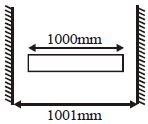
$A$ rod of length $1000\, mm$ and coefficient of linear expansion $a = 10^{-4}$ per degree is placed symmetrically between fixed walls separated by $1001\, mm$. The Young’s modulus of the rod is $10^{11} N/m^2$. If the temperature is increased by $20^o C$, then the stress developed in the rod is ........... $MPa$
Which of the following graphs represents the motion of a planet moving about the sun
A body of weight $200 \mathrm{~N}$ is suspended form a tree branch thought a chain of mass $10 \mathrm{~kg}$. The branch pulls the chain by a force equal to (if $g=10 \mathrm{~m} / \mathrm{s}^2$ ):
Equivalent resistance of two resistors $\text{R}_1=100\pm312$ and $\text{R}_2=200\pm4\Omega$ in series is:
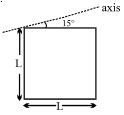
A square plate of mass $M$ and edge $L$ is shown in figure. The moment of inertia of the plate about the axis in the plane of plate passing through one of its vertex making an angle $15^o$ from horizontal is. 
Which of the following types of motion can be used for describing the motion of a car on a straight road?
A $1.0\, kg$ ball drops vertically into a floor from a height of $25\, cm$. If rebounds to a height of $4\ cm$. The coefficient of restitution for the collision is
The moment of inertia of a disc of mass M and radius R about an axis, which is tangential to circumference of disc and parallel to its diameter is:
Which one of the following represents the displacement time graph of two objects A and B moving with zero relative speed?