MCQ 11 Mark
$|\lambda\text{A}|=\lambda|\text{A}|,\ \text{if}$
- A$\lambda>0$
- B$\lambda<0$
- C$\lambda=0$
- D$\lambda\neq0$
Answer
View full question & answer→- $\lambda>0$
50 questions · timed · auto-graded
Explanation:
Given
$\vec{\text{A}}=\hat{\text{i}}+\hat{\text{j}}$$\vec{\text{B}}=\hat{\text{i}}-\hat{\text{j}}$
$\vec{\text{A}}.\vec{\text{B}}=|\text{A}||\text{B}|\cos\theta$
$\cos\theta=\frac{\vec{\text{A}}.\vec{\text{B}}}{|\text{A}||\text{B}|}$
$=\frac{(\hat{\text{i}}+\hat{\text{j}}).(\hat{\text{i}}-\hat{\text{j}})}{\sqrt{1^2+1^2}\times\sqrt{1^2+(-1)^2}}=\frac{1-1}{2}=0$
$\Rightarrow\cos\theta=\cos90$
$\therefore\theta=90^\circ.$ Hence, verifies the option (b).
Explanation:
projectile is fired at $\theta=15^\circ,\ \text{R} = 50\text{m}$
$\text{R}=\frac{\text{u}^2\sin2\theta}{\text{g}}$
$50=\frac{\text{u}^2\sin2\times15^\circ}{\text{g}}\Rightarrow\text{u}^2=50\text{g}\times2$
$\text{u}^2=100\text{g}$
Now $\theta = 45^\circ,\ \text{u}^2=100\text{g}$
$\therefore\ \text{R}=\frac{\text{u}^2\sin2\theta}{\text{g}}=\frac{100\text{g}\times\sin2\times45^\circ}{\text{g}}$
$\Rightarrow\ \text{R}=100\text{m}$
So, this verifies option (c).
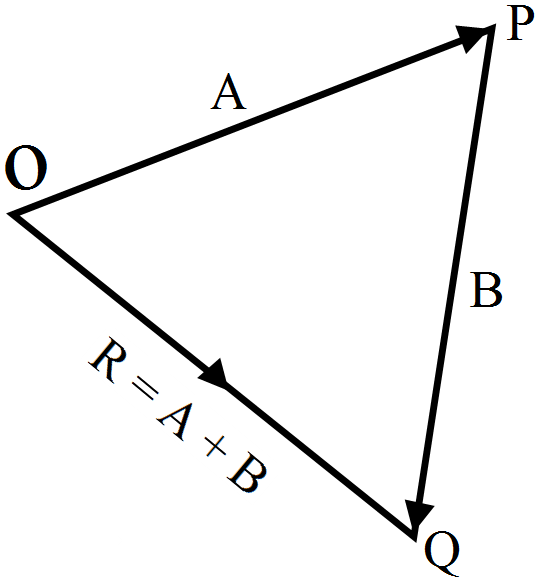
Explanation:
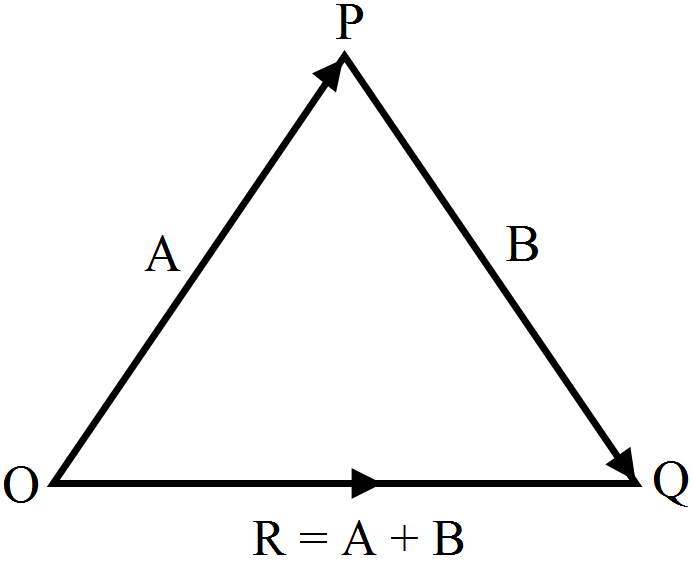
Explanation:
The angle described at the centre by the length of second hand of a watch in 15 second
$=90^\circ=\frac{\pi}{2}$ radians Figure.
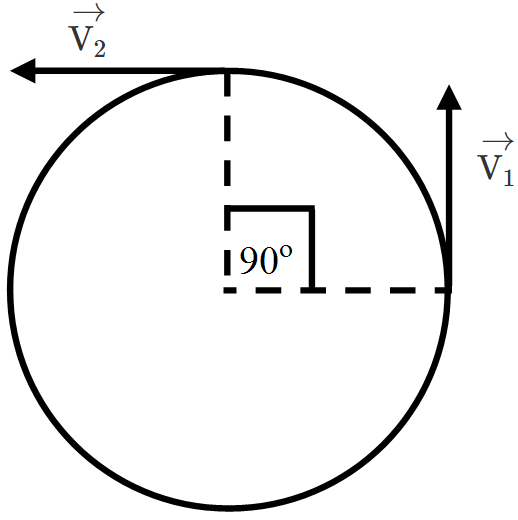
Linear speed
$\text{v}=\text{r}\omega=\frac{\text{r}\theta}{\text{t}}$$=\frac{1\times\big(\frac{\pi}{2}\big)}{15}=\frac{\pi}{30}\text{cm s}^{-1}$
Magnitude of change in velocity in 15 sec;
$|\Delta\vec{\text{v}}|=|\vec{\text{v}}_2-\vec{\text{v}}_1|=\sqrt{\text{v}^2_2-\text{v}_1^2}$
$=\sqrt{\text{v}^2+\text{v}^2}=\sqrt{2}\text{v}$
$=\sqrt{2}\frac{\pi}{30}=\frac{2\pi}{30\sqrt{2}}$
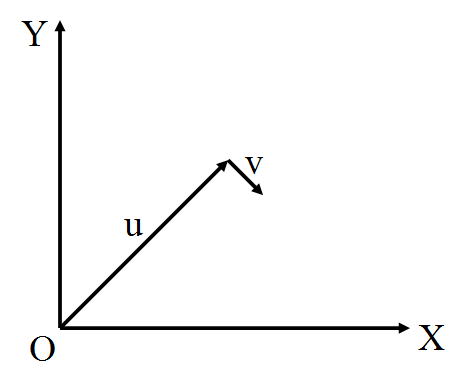
Main concept used: Sign of a, b, p and q are the sign of their resolving components in the XY direction.
Explanation: Components along X and Y axis of the vector $\vec{\text{u}}$ are both +X and Y direction, so a, b are positive.
Now if we resolve$\vec{\text{v}}$ its X component is in +ve X direction but Y component will be in -ve Y direction. Hence, a, b and p are positive but q is negative. Verifies option (b).
Explanation:
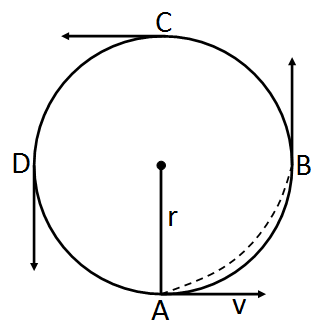
While a particle is in uniform circular motion. Then the following statements are true.
Important point: In uniform circular motion, magnitude of linear velocity and centripetal acceleration is constant but direction changes continuously.
Explanation:
Speed (Instantaneous Speed): The magnitude of the velocity at any instant of time is known as Instantaneous Speed or simply speed at that instant of time. It is denoted by v.
Quantitatively: Speed = distance/ time
Mathematically, it is the time rate at which distance is being travelled by the particle.
Hence, Total distance travelled = Path length = (speed) × time taken
Important point: We should be very carefull with the fact that speed is related with total distance covered not with displacement.
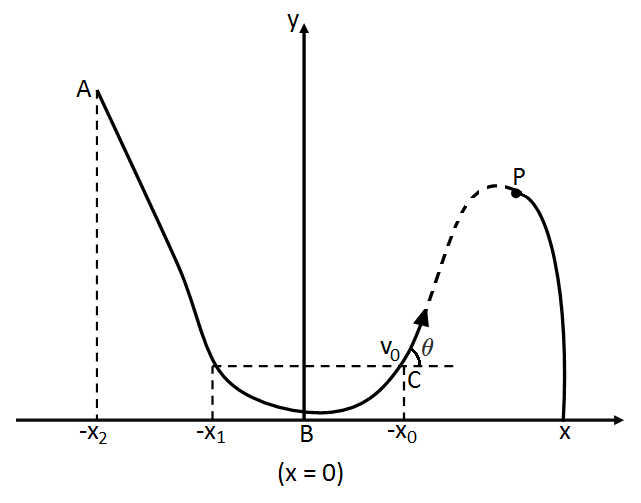
Explanation:
In such type of problems, we have to observe the nature of track that if there is a friction or not, as friction is not present in this track, total energy of the particle will remain constant throughout the journey.
According to the problem, the path traversed by the particle on a frictionless track is parabolic, is given by the equation y = x2, thus total energy (KE + PE) will be same throughout the journey.
Hence, total energy at A = total energy at P
At B the particle is having only KE but at P some KE is converted to PE.
So, (KE)B > (KE)P
Total energy at A = PE = Total energy at B = KE = Total energy at P = PE + KE
The potential energy at A is converted to KE and PE at P, hence (PE)P < (PE)A
Hence, (Height)P < (Height)A
As, Height of P < Height of A
Hence, path length AB > path length BP
Hence, time of travel from A to B ≠ Time of travel from B to P.
Explanation:
When the man is at rest with respect to the ground, the rain comes to him at an angle 30° with the vertical. This is the direction of the velocity of raindrops with respect to the ground.
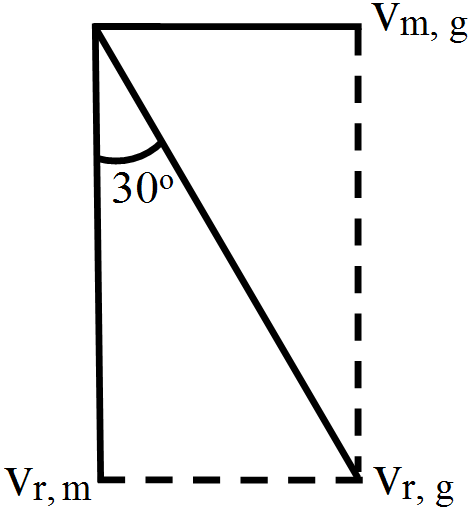
Here, Vr,g = Velocity of the rain with respect to the ground
Vm,g = Velocity of the man with respect to the ground
and Vr,m = Velocity of the rain with respect to the man.
Here, Vm,g = 10 kmh-1
$\text{V}_{\text{r, g}}=\frac{10}{\sin30^\circ}=20\text{kmh}^{-1}$
Explanation:
As, centripetal acceleration is given as, $\text{a}_\text{c}=\frac{\text{v}^2}{\text{r}}$
For the first body of mass m1, $\text{a}_{\text{c}_1}=\frac{\text{v}_1^2}{\text{r}_1}$
For the second body of mass m2, $\text{a}_{\text{c}_2}=\frac{\text{v}_2^2}{\text{r}_2}$
Also time to complete one revolution by both body is same.
Hence, $\frac{2\pi\text{r}_1}{\text{v}_1}=\frac{2\pi\text{r}_2}{\text{v}_2}$
$\Rightarrow\ \frac{\text{v}_1}{\text{v}_2}=\frac{\text{r}_1}{\text{r}_2}\dots(\text{i})$
i.e.,
$\text{a}_{\text{c}_1}:\text{a}_{\text{c}_2}=\frac{\text{v}_1^2}{\text{r}_1}\times\frac{\text{r}_2}{\text{v}^2_2}$ [from eq. (i)]$=\frac{\text{r}_1^2}{\text{r}_2^2}\times\frac{\text{r}_2}{\text{r}_1}=\frac{\text{r}_1}{\text{r}_2}=\text{r}_1:\text{r}_2$
Explanation:
This motion is two dimensional and given that instantaneous speed v0 is positive constant. Acceleration is defined as the rate of change of velocity (instantaneous speed), hence it will also be in the plane of motion.
Explanation:
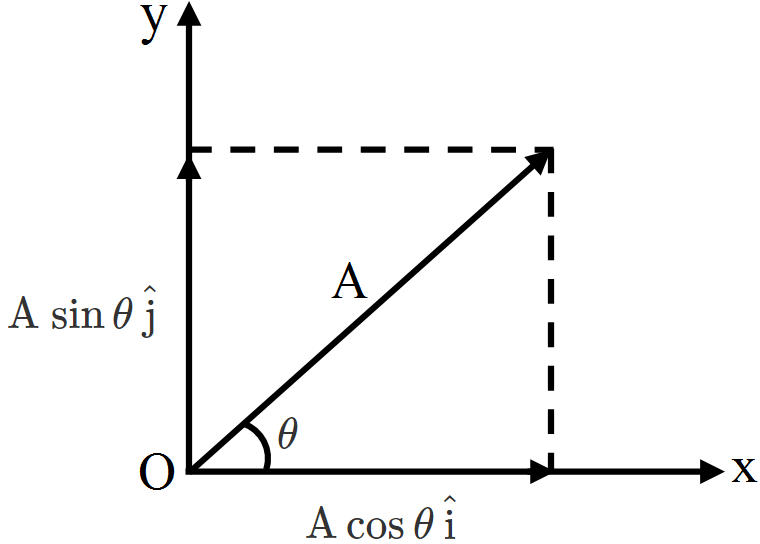
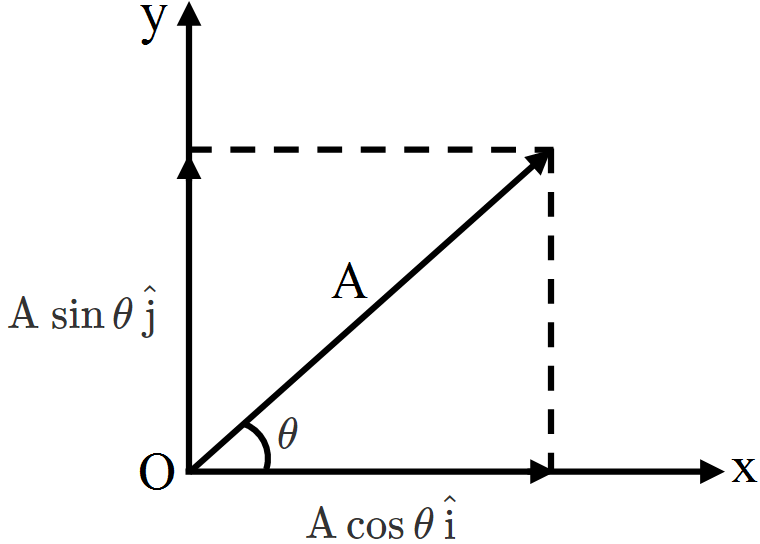
Consider a vector $\vec{\text{R}}$ in X-Y plane as shown in figure. If we draw orthogonal vectors $\vec{\text{R}}_{\text{x}}$ and $\vec{\text{R}}_{\text{y}}$ along x and y axes respectively, by law of vector addition, $\vec{\text{R}}=\vec{\text{R}}_{\text{x}}+\vec{\text{R}}_{\text{y}}$
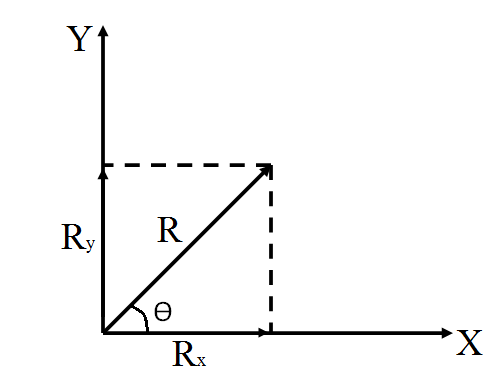
The magnitude of component of r along X-axis
$\text{r}_\text{x}=|\text{r}|\cos\theta$
$(\text{r}_\text{x})_{\text{maximum}}=|\text{r}|(\cos\theta)_{\text{maximum}}$
$\text{r}_\text{x}=|\text{r}|\cos\theta$
$=|\text{r}|\cos0^\circ=|\text{r}|$ $(\because\cos\theta$ is maximum if $\theta=0^\circ)$
As $\theta=0^\circ,$
r is along positive x-axis.
Explanation:
The x-component of the resultant vector can never be greater than the sum of the magnitude of the vectors.
Explanation:
At the highest point of the angular projection, the velocity of projectile has only horizontal component velocity $=\text{u}\cos\theta=10\cos60^\circ=5\text{ms}^{-1}.$
Explanation:
The five forces inclined equally acting on the particle can be represented by the five sides of a pentagon taken in the same order. Hence, their resultant is zero.
Explanation:
When a body is projected at an angle with the horizontal with initial velocity u, then the horizontal range R of projectile is $\text{R}=\frac{\text{u}^2\sin2\theta}{\text{g}}.$
Clearly, for maximum horizontal range $\sin2\theta=1$ or $2\theta=90^\circ$ or $\theta=45^\circ.$
Hence, in order to achieve maximum range, the body should be projected at 45°.
In this case $\text{R}_\text{max}=\frac{\text{u}^2}{\text{g}}$
Hence, ranges of A and C are less than that of B.
Explanation:
Given u = 60ms-1
$\therefore$ maximum height, $\text{H}=\frac{\text{u}^2\sin^2\theta}{2\text{g}}$
$\Rightarrow\ 30=\frac{(60)^2\sin^2\theta}{2\text{g}}$
$\Rightarrow\ \sin^2\theta=\frac{30\times2\text{g}}{60\times60}=\frac{10}{60}$
$\Rightarrow\ \sin\theta=\frac{1}{\sqrt{6}}$
Explanation:
$|\vec{\text{A}}+\vec{\text{B}}|=|\vec{\text{A}}|$
Applying dot product,
$|\vec{\text{A}}+\vec{\text{B}}|.|\vec{\text{A}}+\vec{\text{B}}|=|\vec{\text{A}}|.|\vec{\text{A}}|$
$\Rightarrow\ |\vec{\text{A}}|^2+2\vec{\text{A}}.\vec{\text{B}}+|\vec{\text{B}}|^2=|\text{A}|^2$
$\Rightarrow\ |\vec{\text{B}}|^2=-2\vec{\text{A}}.\vec{\text{B}}$
$\Rightarrow\ |\vec{\text{B}}|=0$
Therefore, option (a) is correct.
Explanation:
$\Rightarrow\ \text{H}_1>\text{H}_2$
$\Rightarrow\ \frac{\text{v}^2_0\sin^2\theta_1}{2\text{g}}>\frac{\text{v}^2_0\sin^2\theta_2}{2\text{g}}$
$\Rightarrow\ \sin^2\theta_1>\sin^2\theta_2$
$\Rightarrow\ \sin^2\theta_1-\sin^2\theta_2>0$
$\Rightarrow\ (\sin\theta_1-\sin\theta_2)(\sin\theta_1+\sin\theta_2)>0$
Thus, either $\sin\theta_1+\sin\theta_2>0$
$\Rightarrow\ \sin\theta_1-\sin\theta_2>0$
$\Rightarrow\ \sin\theta_1>\sin\theta_2\text{ or }\theta_1>\theta_2$
Hence option (a) is correct.
Thus, $\text{T}_1=\frac{2\text{v}_0\sin\theta_1}{\text{g}}$ and $\text{T}_2=\frac{2\text{v}_0\sin\theta_2}{\text{g}}$
(Here, T1 = Time of flight of first particle and T2 = Time of flight of second particle).
As, $\sin\theta_1>\sin\theta_2$
Thus, $\text{T}_1>\text{T}_2$
Hence option (b) is correct.
Range of first particle $=\text{R}_1=\frac{\text{u}^2_0\sin2\theta_1}{\text{g}}$
Range of second particle $=\text{R}_2=\frac{\text{u}^2_0\sin2\theta_2}{\text{g}}$
Given, $\sin\theta_1>\sin\theta_2$
$\Rightarrow\ \sin2\theta_1>\sin2\theta_2$
$\Rightarrow\ \frac{\text{R}_1}{\text{R}_2}=\frac{\sin2\theta_1}{\sin2\theta_2}>1$
$\Rightarrow\ \text{R}_1>\text{R}_2$
But if $\theta_1+\theta_2=90^\circ,$ then $\text{R}_1=\text{R}_2$
Hence option (c) is incorrect.
Important points about time of flight: For complementary angles of projection $\theta\text{ and }90^\circ-\theta.$
$\Rightarrow\ \frac{\text{T}_1}{\text{T}_2}=\tan\theta$
$\Rightarrow\ \text{T}_1\text{T}_2=\frac{2\text{R}}{\text{g}}$
Explanation:
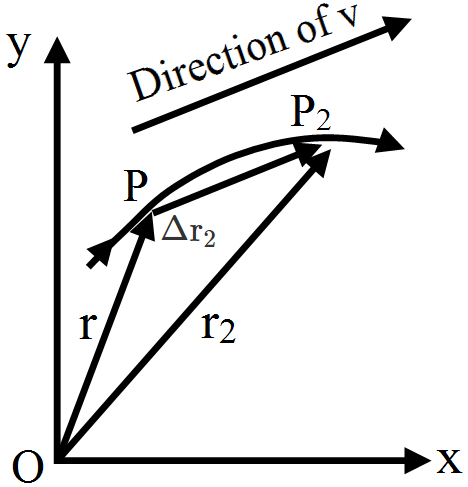
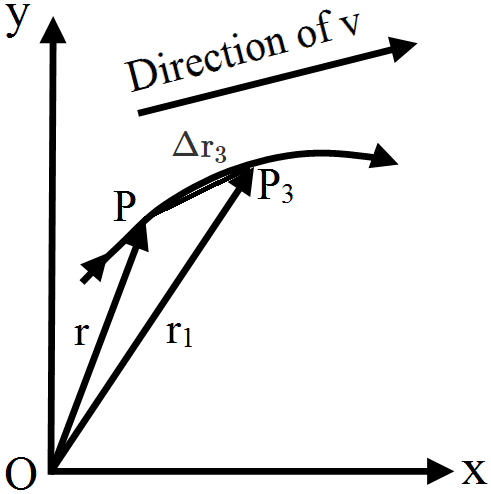
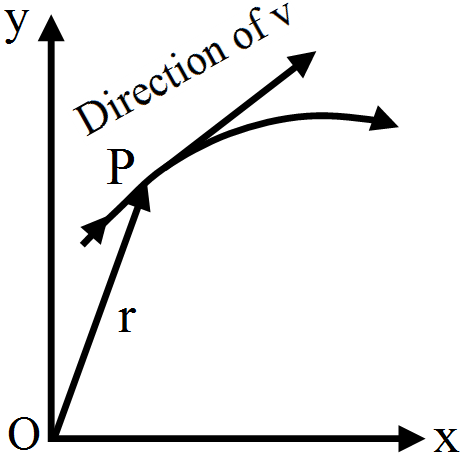
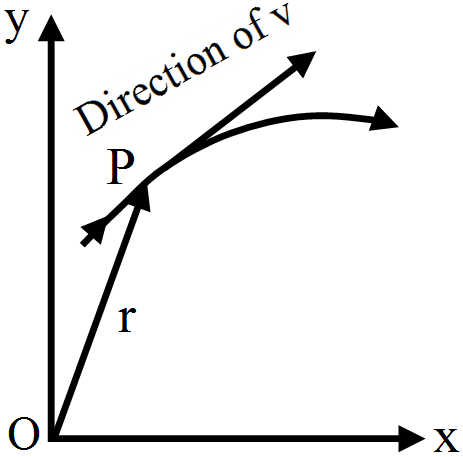
When an object covers a displacement $\Delta\text{r}$ in time $\Delta\text{t},$ its average velocity is given by $\vec{\text{v}}_\text{avg}=\frac{\overrightarrow{\Delta\text{r}}}{\Delta\text{t}}=\frac{\text{r}_2-\text{r}_1}{\text{t}_2-\text{t}_1}$ where r1 and r2 are position vectors corresponding to time t1 and t2.
If the velocity of an object changes from v1 to v2 in time $\Delta\text{t},$ average acceleration is given by
$\text{a}_\text{av}=\frac{\Delta\text{v}}{\Delta\text{t}}=\frac{\text{v}_2-\text{v}_1}{\text{t}_2-\text{t}_1}$
But, when acceleration is non-uniform,
$\text{v}_\text{av}\neq\frac{\text{v}_1+\text{v}_2}{2}$
Option (c) is similar to the relation $\vec{\text{r}}=\frac{1}2\text{at}^2$ which is not correct if initial velocity is given.
So (b) and (d) are the correct relations for the uniform acceleration.
Explanation:
$\vec{\text{A}}+\vec{\text{B}}+\vec{\text{C}}=0$
So $\vec{\text{A}},\ \vec{\text{B}}$ and $\vec{\text{C}}$ are in a plane and can be represented bt the three sides of a triangle taken in order.
$\vec{\text{B}}\times\vec{\text{A}}+\vec{\text{B}}\times\vec{\text{B}}+\vec{\text{B}}\times\vec{\text{C}}=0$
$\vec{\text{B}}\times\vec{\text{A}}+0+\vec{\text{B}}\times\vec{\text{C}}=0$
$\vec{\text{B}}\times\vec{\text{A}}=-\vec{\text{B}}\times\vec{\text{C}}$
$\vec{\text{A}}\times\vec{\text{B}}=\vec{\text{B}}\times\vec{\text{C}}\ \dots(\text{i})$
Or $(\vec{\text{A}}\times\vec{\text{B}})\times\vec{\text{C}}=(\vec{\text{B}}\times\vec{\text{C}})\times\vec{\text{C}}$
$\therefore$ It cannot be zero
$\vec{\text{B}}\times\vec{\text{C}}$ will be zero if $\vec{\text{B}}\times\vec{\text{C}}$ are parallel or antiparallel.
i.e, $(\vec{\text{A}}\times\vec{\text{B}})\times\vec{\text{C}}=[\text{BC}\sin0^\circ]\times\vec{\text{C}}$
$(\vec{\text{A}}\times\vec{\text{B}})\times\vec{\text{C}}=0$ only if $\vec{\text{B}}||\vec{\text{C}}$
Hence option (a) is verified.
$(\vec{\text{A}}\times\vec{\text{B}}).\vec{\text{C}}=(\vec{\text{B}}\times\vec{\text{C}}).\vec{\text{C}}$
if $\vec{\text{B}}||\vec{\text{C}}$
$\vec{\text{B}}\times\vec{\text{C}}=\text{BC}\sin0^\circ=0$
$\therefore\ (\vec{\text{A}}\times\vec{\text{B}}).\vec{\text{C}}=0\text{ IF }\vec{\text{B}}||\vec{\text{C}}$
So option (b) is not verified.
The direction of x is perpendicular to both planes containing A and B.
$(\vec{\text{A}}\times\vec{\text{B}})\times\vec{\text{C}}=\vec{\text{X}}\times\vec{\text{C}}=\vec{\text{Y}}$
The direction of $\vec{\text{Y}}$ is perpendicular to the plane of $\vec{\text{X}}\text{ and }\vec{\text{C}}$ which again become in the plane of $\vec{\text{A}},\ \vec{\text{B}},\ \vec{\text{C}}$ but perpendicular to the plane of $\vec{\text{X}}\text{ and }\vec{\text{C}}.$ Hence option (c) is also verified.
It shows that angle between $\vec{\text{A}}\text{ and }\vec{\text{B}}$ is 90°
$=|\text{A}||\text{B}||\text{C}|\cos\theta\neq|\text{A}||\text{B}||\text{C}|$
$(\vec{\text{A}}\times\vec{\text{B}}).\vec{\text{C}}=|\text{A}||\text{B}||\text{C}|\cos\theta$
Does not verified option (d).
Explanation:
We know that impulse J = F. $\Delta\text{t}=\Delta\text{p},$ where F is force, At is time duration and Ap is change in momentum. As $\Delta\text{p}$ is a vector quantity, hence impulse is also a vector quantity. Sometimes area can also be treated as vector direction of area vector is perpendicular to its plane.
Explanation:
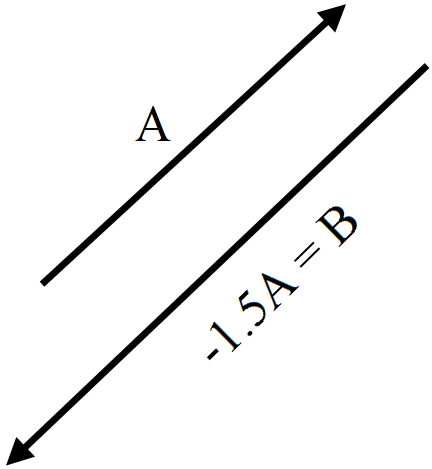
Multiplying a vector A by a negative number $\lambda$ gives a vector $\lambda\text{A},$ whose directions opposite to the direction of A and it's magnitude is $-\lambda$ times |A|.
Explanation:
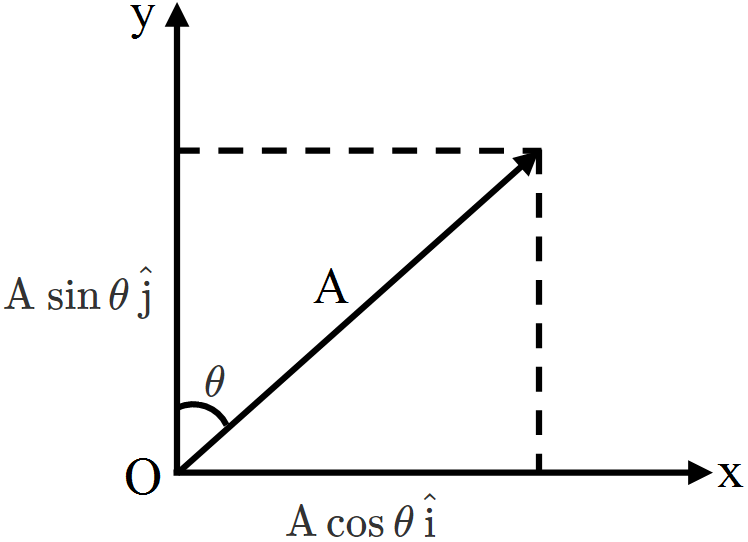
As $\vec{\text{A}}=2\hat{\text{i}}+2\hat{\text{j}},$ therefore Ax = 2 and Ay = 3. If $\theta$ is the angle which $\vec{\text{A}}$ encloses with y-axis, then.
$\tan\theta=\frac{\text{A}_\text{x}}{\text{A}_\text{y}}=\frac{2}{3}$ or $\theta=\tan^{-1}\Big(\frac{2}{3}\Big)$
Explanation:
Here, (0.5)2 + (0.8)2 + (c)2 = 1
or $\text{c}=\sqrt{0.11}$