Question
For which condition, the average velocity will be equal to the instantaneous velocity?

Answer

When a body moves with a uniform velocity, then $V_{av} = V_{ist}$

Need a full question paper?

Generate a complete, print-ready paper with questions like this in minutes — across 16+ boards, with answer keys.
Start Generating Free

Similar questions

Choose the correct alternative: Acceleration due to gravity is independent of mass of the earth/ mass of the body.
Give the relationship between light year and metre.
What is the effect of gravity on pressure?
Write any use of the dimensional equation.
What will be the time period of oscillation, if the length of a second pendulum is one third?
A wire is replaced by another wire of same length and material but of twice diameter.
  1. What will be the effect on the increase in its length under a given load?
  2. What will be the effect on the maximum load which it can bear?
Write Poisson's formula for the rate of fluid flow in a capillary.
Suppose a charge $+Q_1$ is given to the positive plate and a charge $-Q_2$ to the negative plate of a capacitor. What is the ''charge on the capacitor''?
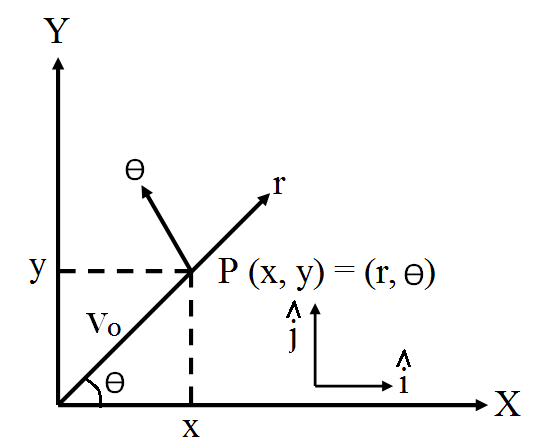
Motion in two dimensions, in a plane can be studied by expressing position, velocity and acceleration as vectors in Cartesian co-ordinates $\text{A}=\text{A}_\text{x}\hat{\text{i}}+\text{A}_\text{y}\hat{\text{j}}$ where $\hat{\text{i}}$ and $\hat{\text{j}}$ are unit vector along x and y directions, respectively and $A_x$ and $A_y$ are corresponding components of A Fig. Motion can also be studied by expressing vectors in circular polar co-ordinates as $\text{A}=\text{A}_\text{r}\hat{\text{r}}+\text{A}_\theta\hat{\theta}$ where $\hat{\text{r}}=\frac{\text{r}}{\text{r}}=\cos\theta\hat{\text{i}}+\sin\theta\hat{\text{j}}$ and $\hat{\theta}=-\sin\theta\hat{\text{i}}+\cos\theta\hat{\text{j}}$ are unit vectors along direction in which ‘r’ and ‘$\theta$’ are increasing.
  1. Express $\hat{\text{i}}$ and $\hat{\text{j}}$ in terms of $\hat{\text{r}}$ and $\hat{\theta}$.
  2. Show that both $\hat{\text{r}}$ and $\hat{\theta}$ are unit vectors and are perpendicular to each other.
  3. Show that $\frac{\text{d}}{\text{dt}}(\hat{\text{r}})=\omega\hat{\theta}$ where $\omega=\frac{\text{d}\theta}{\text{dt}}$ and $\frac{\text{d}}{\text{dt}}(\hat{\text{r}})=-\omega\hat{\text{r}}$
  4. For a particle moving along a spiral given by $\text{r}=\text{a}\theta\hat{\text{r}}$ , where a = 1 (unit), find dimensions of ‘a’.
  5. Find velocity and acceleration in polar vector represention for particle moving along spiral described in (d) above.
Is air a material medium? Name two characteristics of the material medium necessary for the onward propagation of momentum and energy.