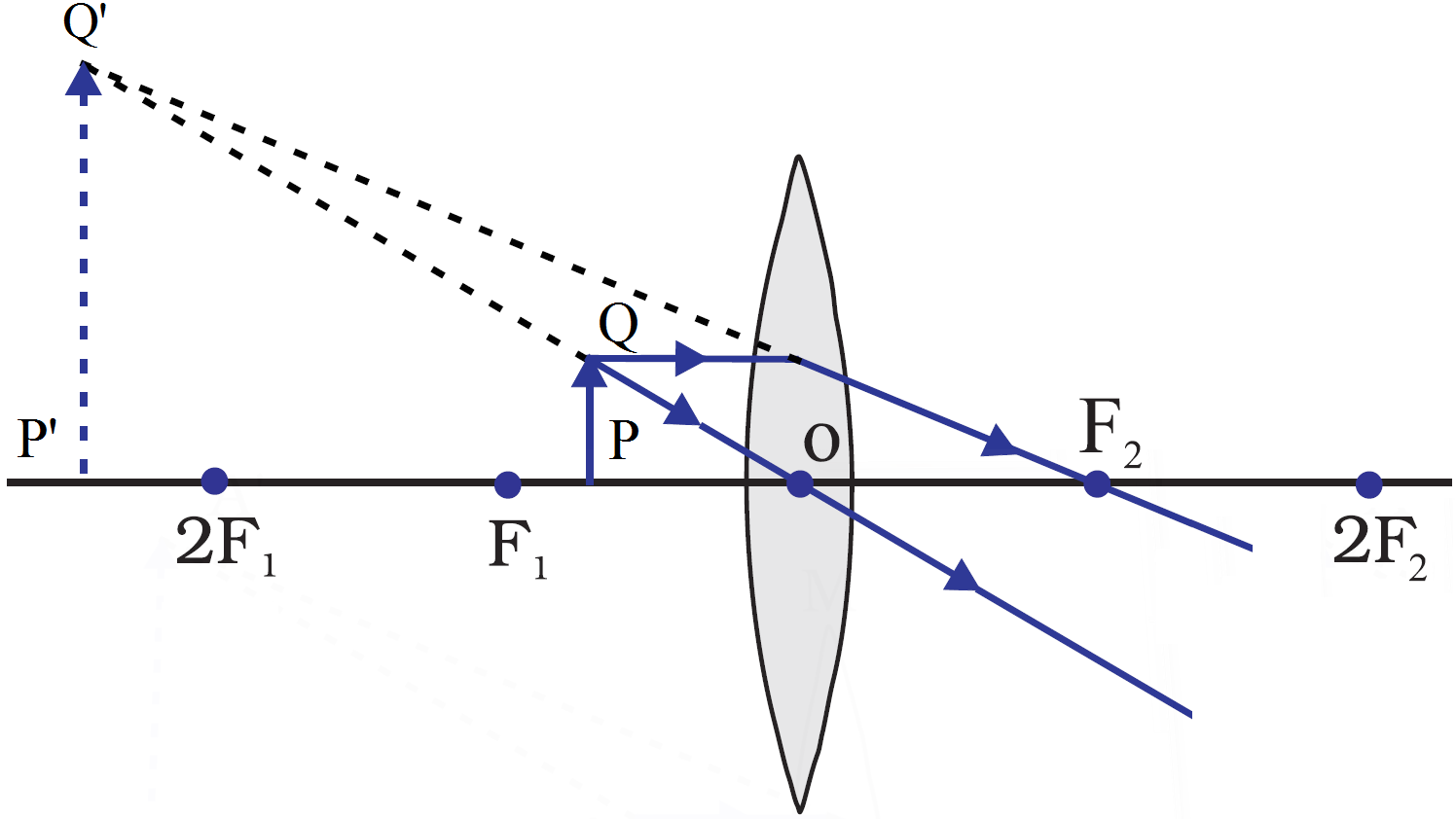
For which position of the object does a convex lens form a virtual and erect image? Explain with the help of a ray diagram.
CBSE OUTSIDE DELHI - SET 1 2009
Download our app for free and get startedPlay store
Such an image is formed when the object lies between the optical centre and the principal focus. Consider two rays one moving parallel to the principal axis and the other passing through the optical centre. After refraction the two rays seem to meet on the same side as that of the object. Thus, the image lies on the same side as that of the object. The image is virtual, erect and magnified. The ray diagram is as shown.
art

Download our app
and get started for free

Experience the future of education. Simply download our apps or reach out to us for more information. Let's shape the future of learning together!No signup needed.*

Similar Questions

  • 1
    The refractive index of glass with respect to air is $\frac{3}{2}$ and refractive index of water with respect to air is $\frac{4}{3}$ . What will be the refractive index of water with respect to glass?
    View Solution
  • 2
    1. Draw a diagram to show how a converging lens focusses parallel rays of light?
    2. How would you alter the above diagram to show how a converging lens can produce a beam of parallel rays of light.
    View Solution
  • 3
    A 4 cm tall object is placed perpendicular to the principal axis of a convex lens of focal length 24 cm. The distance of the object from the lens is 16 cm. Find the position, size and nature of the image formed, using the lens formula.
    View Solution
  • 4
    Calculate the image distance for an object of height 12mm at a distance of 0.20m from a concave lens of focal length 0.30 m, and state the nature and size of the image.
    View Solution
  • 5
    Two lenses A and B have focal lengths of +20cm and, -10cm, respectively.
    1. What is the nature of lens A and lens B?
    2. What is the power of lens A and lens B?
    3. What is the power of combination if lenses A and B are held close together?
    View Solution
  • 6
    The radius of curvature of a concave mirror is 50cm. Where should an object be placed in the mirror, so as to form its image at infinity? Justify your answer.
    View Solution
  • 7
    How is the refractive index of a medium related to the speed of light? Obtain an expression for refractive index of a medium with respect to another in terms of speed of light in these two media?
    View Solution
  • 8
    Which mirror is used as a torch reflector? Draw a labelled diagram to show how a torch reflector can be used to produce a parallel beam of light. Where is the bulb placed in relation to the torch reflector?
    View Solution
  • 9
    Draw labelled ray diagrams to show the formation of images in cases (i) and (ii)above (The diagrams may not be according to scale).
    View Solution
  • 10
    A man sits in an optician's chair looking into plane mirror which is 2m away from him and views the image of a chart which faces the mirror and is 50cm behind his head. How far away from his eyes does the chart appear to be?
    View Solution