MCQ
Forbidden gap in a pure conductor is:
- A0 eV
- B0.7 eV
- C1.1 eV
- D6 eV
Explanation:
Forbidden band gap is the group of energy levels that cannot be occupied by the electrons, these energies lies in between conduction band and valence band. In pure conductors, electrons are loosely bound to the nucleus hence, can detach easily at room temperature also.
A large number of free electrons thus, available are conduction electrons. The energy level of these electrons corresponds to the conduction level, hence valence level and conduction level are overlapped.
Due to this, there is no forbidden band gap present in between conduction band and valence band hence, for metals the forbidden band gap is 0 eV.
Generate a complete, print-ready paper with questions like this in minutes — across 16+ boards, with answer keys.
Magnetic permeability is maximum for
|
(a) Diamagnetic substance |
(b) Paramagnetic substance |
|
(c) Ferromagnetic substance |
(d) All of these |
Ten electrons are equally spaced and fixed around a circle of radius R. Relative to V = 0 at infinity, the electrostatic potential V and the electric field E at the centre C are
|
(a) V ≠ 0 and |
(b) V ≠ 0 and |
(c) V = 0 and |
(d) V = 0 and |
The particles which can be added to the nucleus of an atom without changing its chemical properties are called
|
(a) Electrons |
(b) Protons |
(c) Neutrons |
(d) None of the above |
An electron beam is moving between two parallel plates having electric field 1.125  . A magnetic field 3
  is also applied so that beam of electrons do not deflect. The velocity of the electron is
|
(a) 4225 m/s |
(b) 3750 m/s |
(c) 2750 m/s |
(d) 3200 m/s |
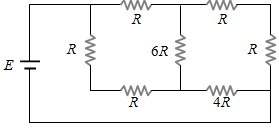
A battery of internal resistance 4W is connected to the network of resistances as shown. In order to give the maximum power to the network, the value of R (in Ω) should be
|
(a) 4/9 |
(b) 8/9 |
(c) 2 |
(d) 18 |
An electric line of force in the xy plane is given by equation  . A particle with unit positive charge, initially at rest at the point x = 1, y = 0 in the xy plane
|
(a) Not move at all |
|
(b) Will move along straight line |
|
(c) Will move along the circular line of force |
|
(d) Information is insufficient to draw any conclusion |
Two identical parallel plate capacitors are connected in series to a battery of 100 V. A dielectric slab of dielectric constant 4.0 is inserted between the plates of second capacitor. The potential difference across the capacitors will now be respectively
|
(a) 50 V, 50 V |
(b) 80 V, 20 V |
(c) 20 V, 80 V |
(d) 75 V, 25 V |


