Question
Formation of enzyme-substrate complex (ES) is the first step in catalysed reactions. Describe the other steps till the formation of product.
Answer

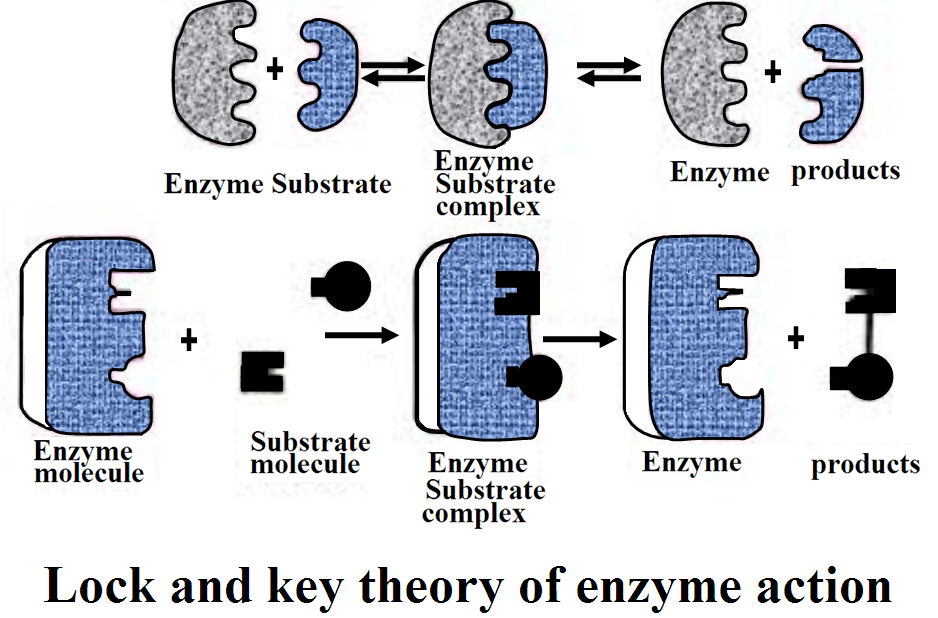
Each enzyme has an active site. The active sites of enzymes have a specific conformation for attracting and holding substrate. Both enzyme and substrate molecules have specific geometrical shapes. In the region of active sites the surface configuration of the enzyme is such as to allow the particular substrate molecules to be held over it. The contact is such that the substrate molecules or reactants come together causing the chemical change. It is similar to the system of lock and key. Just as a lock can be opened by its specific key, a substrate molecule can be acted upon by a particular enzyme. After coming in contact with the active site of the enzyme, the substrate molecules or reactants form a complex called enzyme-substrate complex. The active site of enzyme is now in close proximity with the substrate and break its chemical bonds and a new enzyme product complex is formed. The products are soon time so that an enzyme-product complex is also formed. However, the products are soon released and the freed enzyme is able to bind more substrate molecules.
$\text{Enzyme }+\text{substrate}\rightleftharpoons\text{Enzyme }-\text{Substrate Complex}$
$\text{Enzyme }-\text{Substrate Complex }\rightleftharpoons\text{Enzyme }-\text{Products Complex}$
$\text{Enzyme }-\text{Product Complex }\rightleftharpoons\text{ Enzyme + Product}$
Thus we see that the chemical reactants do not cause any alteration in the composition or physiology of the enzyme. The same enzyme molecule can be used again and again. Hence, enzymes are required in very small concentrations.
Upper series – Breakdown reaction Lower series – Biosynthetic reaction.

Need a full question paper?

Generate a complete, print-ready paper with questions like this in minutes — across 16+ boards, with answer keys.
Start Generating Free