Four charges $2C, -3C, -4C$ and $5C$ respectively are placed at all the corners of a square. Which of the following statements is true for the point of intersection of the diagonals ?
Easy
Download our app for free and get started
Potential is a scalar quantity but electric field is a vector quantity

Download our appand get started for free
Experience the future of education. Simply download our apps or reach out to us for more information. Let's shape the future of learning together!No signup needed.*
Similar Questions
- 1A parallel plate capacitor with area $200\,cm^2$ and separation between the plates $1.5\,cm$, is connected across a battery of $emf$ $V$. If the force of attraction between the plates is $25\times10^{-6}\,N$, the value of $V$ is approximately........$V$ $\left( {{\varepsilon _0} = 8.85 \times {{10}^{ - 12}}\,\frac{{{C^2}}}{{N{m^2}}}} \right)$View Solution
- 2A body of capacity $4\,\mu \,F$ is charged to $80\,V$ and another body of capacity $6\,\mu \,F$ is charged to $30\,V$. When they are connected the energy lost by $4\,\mu \,F$ capacitor is.......$mJ$View Solution
- 3A point charge of magnitude $+ 1\,\mu C$ is fixed at $(0, 0, 0) $. An isolated uncharged spherical conductor, is fixed with its center at $(4, 0, 0).$ The potential and the induced electric field at the centre of the sphere isView Solution
- 4The radius of a soap bubble whose potential is $16\,V$ is doubled. The new potential of the bubble will be.....$V$View Solution
- 5A particle has a mass $400$ times than that of the electron and charge is double than that of a electron. It is accelerated by $5\,V$ of potential difference. Initially the particle was at rest, then its final kinetic energy will be......$eV$View Solution
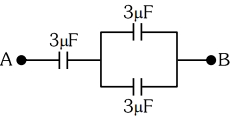
- 6The equivalent capacitance of the system shown in the following circuit is $...........\mu F$View Solution
- 7The distance between the two plates of a parallel plate capacitor is doubled and the area of each plate is halved. If $C$ is its initial capacitance, its final capacitance is equal toView Solution
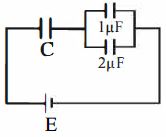
- 8In the given circuit, charge $Q_2$ on the $2\ μF$ capacitor changes as $C$ is varied from $1\ μF$ to $3\ μF$. $Q_2$ as a function of '$C$' is given properly by: (figures are drawn schematically and are not to scale)View Solution
- 9A charge is spread non-uniformly on the surface of a hollow sphere of radius $R$, such that the charge density is given by $\sigma=\sigma_0(1-\sin \theta)$, where $\theta$ is the usual polar angle. The potential at the centre of the sphere isView Solution
- 10What will be the capacity of a parallel-plate capacitor when the half of parallel space between the plates is filled by a material of dielectric constant ${\varepsilon _r}$ ? Assume that the capacity of the capacitor in air is $C$View Solution