Four charges $2C, -3C, -4C$ and $5C$ respectively are placed at all the corners of a square. Which of the following statements is true for the point of intersection of the diagonals ?
Easy


Download our appand get started for free
Experience the future of education. Simply download our apps or reach out to us for more information. Let's shape the future of learning together!No signup needed.*
Similar Questions
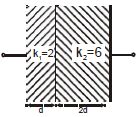
- 1View SolutionA parallel plate capacitor has two layers of dielectrics as shown in fig. This capacitor is connected across a battery, then the ratio of potential difference across the dielectric layers is
- 2A $30\,\mu F$ capacitor is charged by a constant current of $30\, mA$. If the capacitor is initially uncharged, how long does it take for the potential difference to reach $400\, V$.....$s$View Solution
- 3A capacitor of capacitance $10\, mF$ is connected to a battery of emf $2\,V.$ It is found that it takes $50\, ms$ for the charge on the capacitor to become $12.6 \,mC.$ Then the resistance of the circuit is :.......$\, k \Omega$ (Take $1/e = 0.37$):-View Solution
- 4View SolutionTwo identical conductors of copper and aluminium are placed in an identical electric fields. The magnitude of induced charge in the aluminium will be
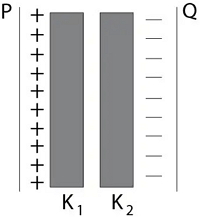
- 5Two thin dielectric slabs of dielectric constants $K_1$ and $K_2$ $(K_1 < K_2)$ are inserted between plates of a parallel plate capacitor, as shown in the figure. The variation of electric field $E$ between the plates with distance $d$ as measured from plate $P$ is correctly shown byView Solution
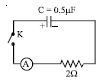
- 6A charged capacitor is allowed to discharge through a resistor by closing the key at the instant $t =0$. At the instant $t = (ln \,4) $ $\mu s$, the reading of the ammeter falls half the initial value. The resistance of the ammeter is equal toView Solution
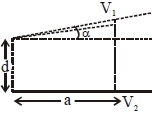
- 7A capacitor is made of two square plates each of side $a$ making a very small angle $\alpha$ between them, as shown in figure. The capacitance will be close toView Solution
- 8An electron enters between two horizontal plates separated by $2\,mm$ and having a potential difference of $1000\,V$. The force on electron isView Solution
- 9The potential due to an electrostatic charge distribution is $V(r)=\frac{q e^{-\alpha e r}}{4 \pi \varepsilon_{0} r}$, where $\alpha$ is positive. The net charge within a sphere centred at the origin and of radius $1/ \alpha$ isView Solution
- 10$N$ identical spherical drops charged to the same potential $V$ are combined to form a big drop. The potential of the new drop will beView Solution