A capacitor of capacitance $10\, mF$ is connected to a battery of emf $2\,V.$ It is found that it takes $50\, ms$ for the charge on the capacitor to become $12.6 \,mC.$ Then the resistance of the circuit is :.......$\, k \Omega$ (Take $1/e = 0.37$):-
Medium
Download our app for free and get started
Charge at steady steady state ${{\rm{q}}_0} = 20\mu {\rm{C}}$
${\rm{q}} = {{\rm{q}}_0}\left( {1 - {{\rm{e}}^{{\rm{t/}}\tau }}} \right)$
${\rm{q}} = 12.6 = 20\left( {1 - {{\rm{e}}^{ - 50 \times {{10}^{ - 3{\rm{/}}\tau }}}}} \right)$
and $\tau = RC = 50 \times {10^{ - 3}} \Rightarrow R = 5\,{\rm{K}}\Omega $

Download our appand get started for free
Experience the future of education. Simply download our apps or reach out to us for more information. Let's shape the future of learning together!No signup needed.*
Similar Questions
- 1The condensers of capacity ${C_1}$ and ${C_2}$ are connected in parallel, then the equivalent capacitance isView Solution
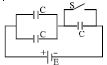
- 2In the circuit shown, each capacitor has a capacitance $C$. The emf of the cell is $E$. If the switch $S$ is closedView Solution
- 3Between the plates of a parallel plate condenser, a plate of thickness ${t_1}$ and dielectric constant ${k_1}$ is placed. In the rest of the space, there is another plate of thickness ${t_2}$ and dielectric constant ${k_2}$. The potential difference across the condenser will beView Solution
- 4A proton and an anti-proton come close to each other in vacuum such that the distance between them is $10 \,cm$. Consider the potential energy to be zero at infinity. The velocity at this distance will be ........... $\,m / s$View Solution
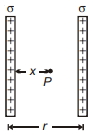
- 5For two infinitely long charged parallel sheets, the electric field at $P$ will beView Solution
- 6The plates of a capacitor are charged to a potential difference of $320 \, volts$ and are then connected across a resistor. The potential difference across the capacitor decays exponentially with time. After $1 $ second the potential difference between the plates of the capacitor is $240 \, volts$, then after $2$ and $3$ seconds the potential difference between the plates will beView Solution
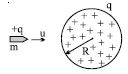
- 7A bullet of mass $m$ and charge $q$ is fired towards a solid uniformly charged sphere of radius $R$ and total charge $+ q$. If it strikes the surface of sphere with speed $u$, find the minimum speed $u$ so that it can penetrate through the sphere. (Neglect all resistance forces or friction acting on bullet except electrostatic forces)View Solution
- 8An electric charge ${10^{ - 3}}\,\mu \,C$ is placed at the origin $(0, 0)$ of $X -Y$ co-ordinate system. Two points $A$ and $B$ are situated at $\left( {\sqrt {2\,} \,,\,\,\sqrt 2 } \right)$ and $(2, 0)$ respectively. The potential difference between the points $A$ and $B$ will be......$volt$View Solution
- 9The capacitance of a spherical condenser is $1\,\mu F$. If the spacing between the two spheres is $1\,mm$, then the radius of the outer sphere isView Solution
- 10Two hollow conducting spheres of radii $R_{1}$ and $R_{2}$ $\left(R_{1}>>R_{2}\right)$ have equal charges. The potential would be:View Solution