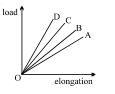
Four identical rods are stretched by same force. Maximum extension is produced in
Medium


Download our appand get started for free
Experience the future of education. Simply download our apps or reach out to us for more information. Let's shape the future of learning together!No signup needed.*
Similar Questions
- 1The force required to stretch a wire of crosssection $1 cm ^{2}$ to double its length will be ........ $ \times 10^{7}\,N$View Solution
(Given Yong's modulus of the wire $=2 \times 10^{11}\,N / m ^{2}$ )
- 2Given : $\sigma$ is the compressibility of water, $\rho$ is the density of water and $K$ is the bulk modulus of water. What is the energy density of water at the bottom of a lake $‘h’$ metre deep ?View Solution
- 3A wire $2m$ in length suspended vertically stretches by $10\ mm$ when mass of $10 \ kg$ is attached to the lower end. The elastic potential energy gain by the wire is .$..... J (t$ake $g=10\ m / s ^2 )$View Solution
- 4For a given material, the Young's modulus is $2.4$ times that of rigidity modulus. Its Poisson's ratio isView Solution
- 5View SolutionThe load versus strain graph for four wires of the same material is shown in the figure. The thickest wire is represented by the line
- 6Consider two wires of same material having their ratio of radii to be $2: 1$. If these two wires are stretched by equal force, then the ratio of stress produced in them isView Solution
- 7A square aluminium (shear modulus is $25 \times 10^{9}\,Nm ^{-2}$ ) slab of side $60\,cm$ and thickness $15\,cm$ is subjected to a shearing force (on its narrow face) of $18.0 \times 10^{4}\,N$. The lower edge is riveted to the floor. The displacement of the upper edge is $.......\mu\,m$.View Solution
- 8A brass rod of cross-sectional area $1\,c{m^2}$ and length $0.2\, m$ is compressed lengthwise by a weight of $5\, kg$. If Young's modulus of elasticity of brass is $1 \times {10^{11}}\,N/{m^2}$ and $g = 10\,m/{\sec ^2}$, then increase in the energy of the rod will beView Solution
- 9Two rods of different materials having coefficients of linear expansion ${\alpha _1},\,{\alpha _2}$ and Young's moduli ${Y_1}$ and ${Y_2}$ respectively are fixed between two rigid massive walls. The rods are heated such that they undergo the same increase in temperature. There is no bending of rods. If ${\alpha _1}:{\alpha _2} = 2:3$, the thermal stresses developed in the two rods are equally provided ${Y_1}:{Y_2}$ is equal toView Solution
- 10The ratio of two specific heats of gas ${C_p}/{C_v}$ for argon is $1.6$ and for hydrogen is $1.4$. Adiabatic elasticity of argon at pressure $P$ is $E.$ Adiabatic elasticity of hydrogen will also be equal to $E$ at the pressureView Solution