MCQ
Four mole of hydrogen, two mole of helium and one mole of water vapour form an ideal gas mixture. What is the molar specific heat at constant pressure of mixture?
  • A
    $\frac{16}{7} R$
  • B
    $\frac{7}{16} R$
  • C
    $R$
  • $\frac{23}{7} R$

Answer

Correct option: D.
$\frac{23}{7} R$
d
(d)

$C _{ v } \text { for hydrogen }=\frac{5}{2} R$

$C _{ v } \text { for helium }=\frac{3 R }{2}$

$C _{ v } \text { for water vapour }=\frac{6 R }{2}=3 R$

$\therefore \quad\left( C _{ v }\right)_{\text {mix }}$

$\quad=\frac{4 \times \frac{5}{2} R +2 \times \frac{3}{2} R +1 \times 3 R }{4+2+1}=\frac{16}{7} R$

$\therefore C _{ p }= C _{ v }+ R$

$C _{ p }=\frac{16}{7} R + R \text { or } \quad C _{ p }=\frac{23}{7} R$

Need a full question paper?

Generate a complete, print-ready paper with questions like this in minutes — across 16+ boards, with answer keys.
Start Generating Free

Similar questions

A constant force acts on a body. Which of the following correctly represents the variation of the power $P$ developed with time $t$?
A body is whirled in a horizontal circle of radius $20 \,cm$. It has angular velocity of $10\, rad/s$. What is its linear velocity at any point on circular path ....... $m/s$
If an average person jogs, he produces $14.5 \times 103\ \text{cal/ min.}$ This is removed by the evaporation of sweat. The amount of sweat evaporated per minute $($assuming $1\ kg$ requires $580 \times 103\ \text{cal}$ for evaparation$)$ is
Two bodies at different temperatures are mixed in a calorimeter. Which of the following quantities remains conserved?
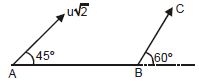
A particle is projected from a point $A$ with velocity $u\sqrt 2$ at an angle of $45^o$ with horizontal as shown in fig. It strikes the plane $BC$ at right angles. The velocity of the particle at the time of collision is
According to first law of thermodynamics:
The fundamental frequency of a closed organ pipe is equal to the first overtone frequency of an open organ pipe. If length of the open pipe is $60 \mathrm{~cm}$, the length of the closed pipe will be :
A simple harmonic motion is represented by $y\, = 5\,(\sin \,3\pi t\, + \,\sqrt 3 \,\cos \,3\pi t)\,cm$ The amplitude and time period of the motion are
A $20 \,g$ bullet whose specific heat is $5000 \,J kg ^{\circ} C$ and moving at $2000 \,m / s$ plunges into a $1.0 \,kg$ block of wax whose specific heat is $3000 \,J kg ^{\circ} C$. Both bullet and wax are at $25^{\circ} C$ and assume that $(i)$ the bullet comes to rest in the wax and $(ii)$ all its kinetic energy goes into heating the wax. Thermal temperature of the wax $\left(\right.$ in $\left.^{\circ} C \right)$ is close to
A neutron star with magnetic moment of magnitude $m$ is spinning with angular velocity $\omega$ about its magnetic axis. The electromagnetic power $P$ radiated by it is given by $\mu_{0}^{x} m^{y} \omega^{z} c^{u}$, where $\mu_{0}$ and $c$ are the permeability and speed of light in free space, respectively. Then,