MCQ
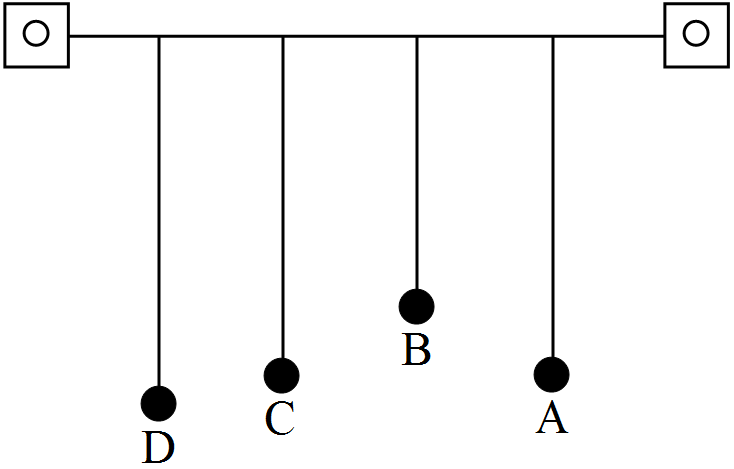
Four pendulums A, B, C and D are suspended from the same elastic support as shown in Fig A and C are of the same length, while B is smaller than A and D is larger than A. If A is given a transverse displacement,
  • A
    D will vibrate with maximum amplitude.
  • B
    C will vibrate with maximum amplitude.
  • C
    B will vibrate with maximum amplitude.
  • D
    All the four will oscillate with equal amplitude.
Answer

  1. C will vibrate with maximum amplitude.

Explanation:

Here A is given a transverse displacement. Through the elastic support the disturbance is transferred to all the pendulums.

A and C are having same length, hence they will be in resonance, because of their time period of oscillation. Since length of pendulums A and C is same and $\text{T}=2\pi\sqrt{\frac{\text{L}}{\text{g}}}$ hence their time period is same and they will have frequency of vibration. Due to it, a resonance will take place and the pendulum C will vibrate with maximum amplitude.

Need a full question paper?

Generate a complete, print-ready paper with questions like this in minutes — across 16+ boards, with answer keys.

Start Generating Free

Similar questions

A standing wave is established in single loop. At $t = 0$ , $K.E.$  of string is zero. Choose the correct option 
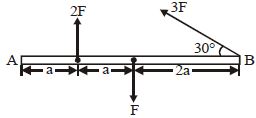
Three forces $F,\,2F$ and $3F$ act on a rod $AB$ which is pivoted at $A$. The anticlockwise moment of forces $F,\,2F$ and $3F$ about the pivot are respectively
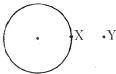
A motorcyclist going around a circular track of radius $50\  m$ with a speed of $25\ m/s$ ,  is  at a point $X$. A static siren at $Y$ is emitting sound of frequency $n$. How many times (approximately) in an hour will the motor cyclist hear the sound of actual frequency $Y$ ?
We have three beakers A, B and C containing three different liquids. They are stirred vigorously and placed on a table. Then, liquid which is:
stationary source is emitting sound at a fixed frequency $f_0$, which is reflected by two cars approaching the source. The difference between the frequencies of sound reflected from the cars is $1.2\%$ of $f_0$. What is the difference in the speeds of the cars (in $km$ per hour) to the nearest integer ..... $km/hr$ ? The cars are moving at constant speeds much smaller than the speed of sound which is $330$ $ms^{-1}$.
Two identical coherent sound sources $R$ and $S$ with frequency $f$ are $5 \,m$ apart. An observer standing equidistant from the source and at a perpendicular distance of $12 \,m$ from the line $R S$ hears maximum sound intensity.When he moves parallel to $R S$, the sound intensity varies and is a minimum when he comes directly in front of one of the two sources. Then, a possible value of $f$ is close to ............ $Hz$ (the speed of sound is $330 \,m / s$ )
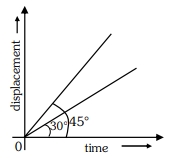
The displacement-time graphs of two moving particles make angles of $30^{\circ}$ and $45^{\circ}$ with the $x$-axis as shown in the figure. The ratio of their respective velocity is :
The plot that depicts the behavior of the mean free time $t$ (time between two successive collisions) for the molecules of an ideal gas, as a function of temperature $(T)$, qualitatively, is (Graphs are schematic and not drawn to scale)
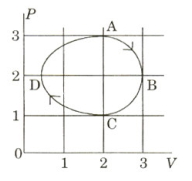
The figure shows the $P-V$ plot of an ideal gas taken through a cycle $ABCDA$. The part $ABC$ is a semi-circle and $CDA$ is half of an ellipse. Then,

$(A)$ the process during the path $\mathrm{A} \rightarrow \mathrm{B}$ is isothermal

$(B)$ heat flows out of the gas during the path $\mathrm{B} \rightarrow \mathrm{C} \rightarrow \mathrm{D}$

$(C)$ work done during the path $\mathrm{A} \rightarrow \mathrm{B} \rightarrow \mathrm{C}$ is zero

$(D)$ positive work is done by the gas in the cycle $ABCDA$

The figure shows the velocity and the acceleration of a point like body at the initial moment of its motion. The direction and the absolute value of the acceleration remain constant. Find the time when the speed becomes minimum.........$s$ (Given : $a = 4\, m/s^2, v_0 = 40\, m/s, \phi =143^o$)