- Aa = 0.7x
- Ba = -200x2
- Ca = -10x
- Da = 100x3
- a = -10x
Explanation:
In SHM, acceleration a is related to displacement by the relation of the form a = -kx, which is for relation (c).
50 questions · self-marked practice — reveal the answer and mark yourself.
Explanation:
In SHM, acceleration a is related to displacement by the relation of the form a = -kx, which is for relation (c).
Exlanation:
SHM could be related to uniform circular motion. The projection of uniform circular motion on a diameter of the circle follows simple harmonic motion.
Explanation:
The motion of planets and satellites are repetitive and repeats itself after a fixed interval of time. These type of motions are known as periodic motion.
Explanation:
S.H.M. is one which is bounded within well defined limits, periodic and oscillatory. The first four equations represent S.H.M. but the fifth equation does not represent S.H.M.
Explanation:
In S.H.M., the maximum P.E. is at the extreme position and maximum K.E. is at the mean position.
Explanation:
Potential energy, $\text{U = kx}^3$
Force, $\text{F}=\frac{-\text{dU}}{\text{dx}}=-3\text{kx}^2$
max. force $=\text{F}_{\text{max}}-3\text{kx}^2=-\text{m}\omega^2\text{a}$
$\omega^2=\frac{3\text{ka}^2}{\text{ma}}=\frac{3\text{ka}}{\text{m}}$
$\frac{4\pi^2}{\text{T}^2}=\frac{3\text{ka}}{\text{m}}$
$\text{T}^2\propto\frac{1}{\text{a}}$
$\text{T}\propto\frac{1}{\sqrt{\text{a}}}$
Explanation:
$\frac{\text{A}}{2}=\text{A}\sin\omega\text{T}_1$
$\sin\omega\text{T}_1=\frac{1}2{}=\sin\frac{\pi}{6}$
$\text{T}_1=\frac{\pi}{6\omega}$
$\sin\omega(\text{T}_1+\text{T}_2)=1=\sin\frac{\pi}{2}$
$\omega(\text{T}_1+\text{T}_2)=\frac{\pi}{2}$
$\text{T}_1+\text{T}_2=\frac{\pi}{2\omega}$
$\text{T}_2=\frac{\pi}{2\omega}-\frac{\pi}{6\omega}=\frac{2\pi}{6\omega}=2\text{T}_1$
So, $\text{T}_1<\text{T}_2$
Explanation:
Frequency of kinetic energy or potential energy is double than that of particle executing S.H.M.
Explanation:
All sine and cosine functions of t are simple harmonic in nature.
Hence the motion is simple harmonic motion.
A simple harmonic motion is always periodic.
$\text{Time period}=\text{T}'=\frac{2\pi}{\omega'}$
hence the motion is simple harmonic with time period $\frac{2\pi}{\omega}.$
Explanation:
F = -kx
Exlanation:
In SHM, force varies in magnitude as well as in direction. As, for the particle executing SHM, the force subjected to it is always proportional to the displacement of the particle and is directed towards the mean position.
Explanation:
Max speed $\text{v}_{\text{m}}=\text{r}\omega=\text{r}.2\pi\text{v}$
Max speed $\text{v}=\frac{\text{v}_{\text{m}}}{2\pi\text{r}}=\frac{31.4}{2\times3.14\times5}=1\text{Hz}$

Explanation:
Exlanation:
In SHM, potential energy depends on its elastic behaviour and kinetic energy on its inertial behavior. In case of mass m oscillating on spring. KE is due to motion of m and PE is due to stretching of spring.
Explanation:

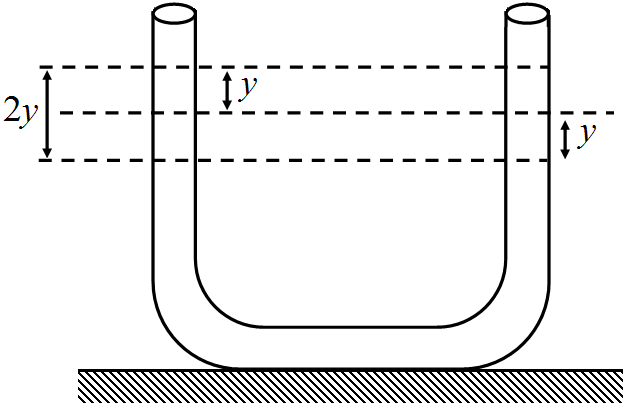
Restoring Force F = Weight of liquid column of height 2y
$\Rightarrow\text{FF}=-(\text{A}\times2\text{y}\times\rho)\times\text{g}=-2\text{A}\rho\text{gy}$
$\Rightarrow\text{F}\propto-\text{y}$
Motion is SHM with force constant
$\text{K}=2\text{A}\rho\text{g}$
$\Rightarrow\text{Time period}\text{T}=2\pi\sqrt{\frac{\text{m}}{\text{k}}}$
$=2\pi\sqrt{\frac{\text{A}\times2\text{h}\times\rho}{2\text{A}\rho\text{g}}}=2\pi\sqrt{\frac{\text{h}}{\text{g}}}$
Which is independent of the density of the liquid.
Explanation:
When damping force is small, the resonance peak becomes taller and narrower.

Explanation:
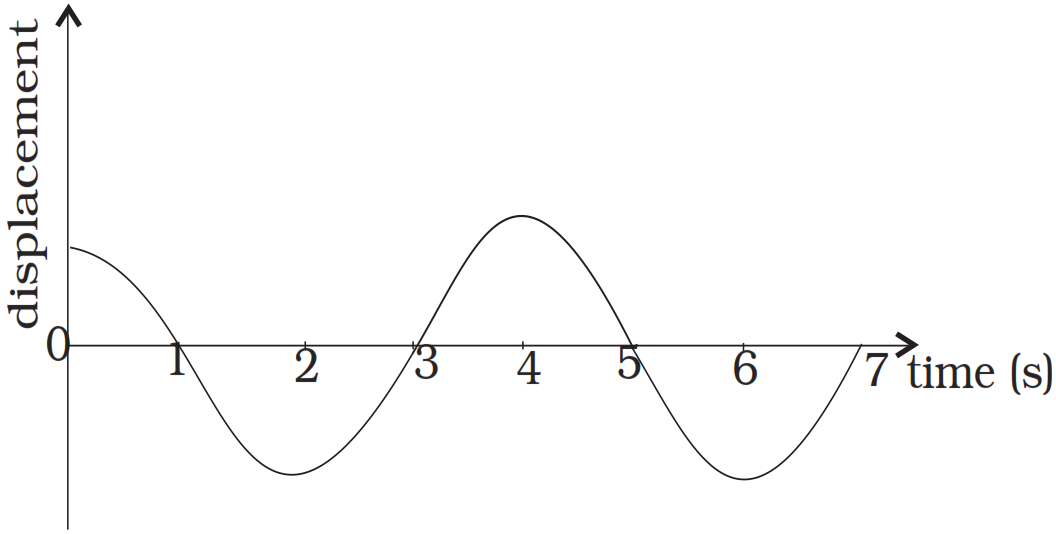
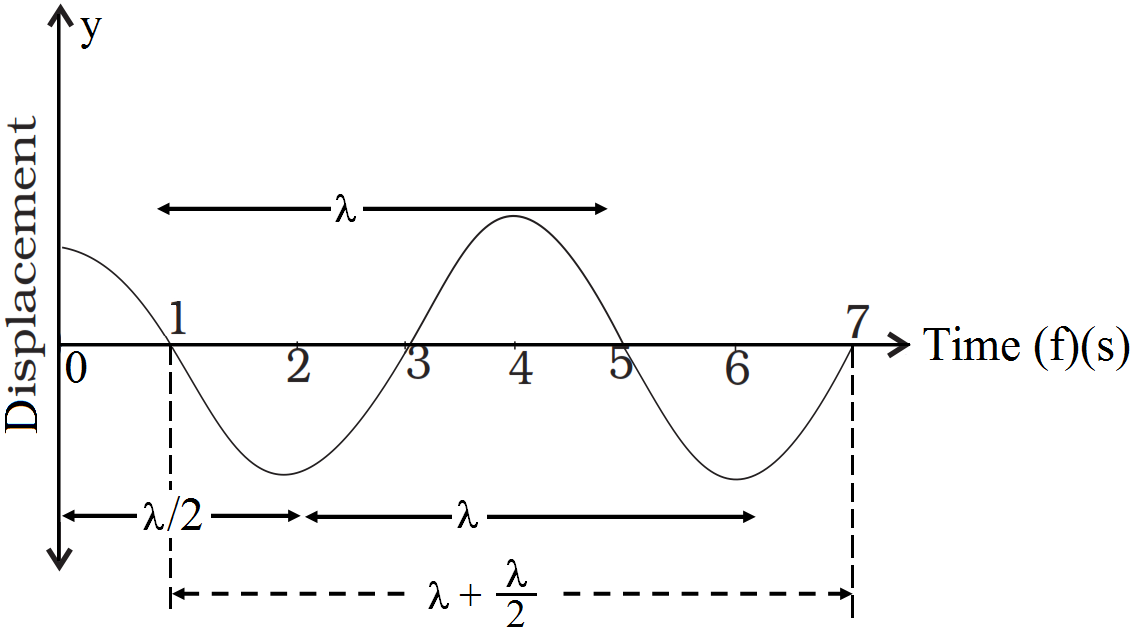
Two particles are said to be in same phases if the mode of vibration is same i.e, their distance will be $\text{n}\lambda(/\text{n}=1,2,3...)$
Distance between particles at t = 0 and t = 2 is $\frac{\lambda}{2}.$
So, articles are not in same phase.

As from figure the particles at t = 2 sec are at distance $\lambda$, so are in same phase.
Particles at t = 1, t = 7 are the distance $\lambda+\frac{\lambda}{2}=\frac{3\lambda}{2}$ so are not in phase.
Particles at t = 1 and 5sec are at distance = $\lambda$ so are in same phase.
Explanation:
As the water slowly leakes out, centre of gravity of water and sphere falls down from the centre of sphere. Due to which length of simple pendulum (l) increases. This continues till half of the sphere is emptied. After that as water leakes out, the length of simple pendulum (l) decreases.
Explanation:
Let us write the equation for the SHM $\text{x}=\text{a}\sin(\omega\text{t}+\phi)$
Clearly, it is a periodic motion as it involves sine function.
Let us find velocity of the particle, $\text{v}=\frac{\text{dx}}{\text{dt}}=\frac{\text{d}}{\text{dt}}(\text{a}\sin(\omega\text{t}+6\phi))$
Velocity is also periodic because it is a cosine function.
Now let us find acceleration, $\text{A}=\frac{\text{dv}}{\text{dt}}=\frac{\text{d}^2\text{x}}{\text{dt}^2}=-\text{a}\omega^2\sin(\omega\text{t}+\phi)$
The acceleration is a sine function, hence cannot be constant.
$\Rightarrow\text{A}=-(\omega^2\text{a})\sin(\omega\text{t}+\phi)=-\omega^2\text{x}$
Force, F = mass × acceleration.
$=\text{mA}=-\text{m}\omega^2\text{x}$
Hence, force acting is directly proportional to displacement from the mean position and opposite to it.
Explanation:
As $\text{T}=2\pi\sqrt{\frac{\text{l}}{\text{g}}}$ (where l is the length ofthe oscillating liquid column in each limb), it is independent of the density of the liquid.
Explanation:
The height of fall of pendulum, $\text{h = l}(1-\cos\theta)$ and $\text{v}=\sqrt{2\text{gh}}$

Explanation:

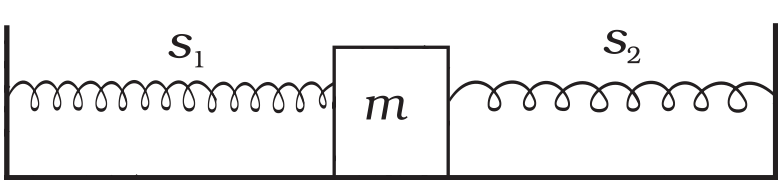
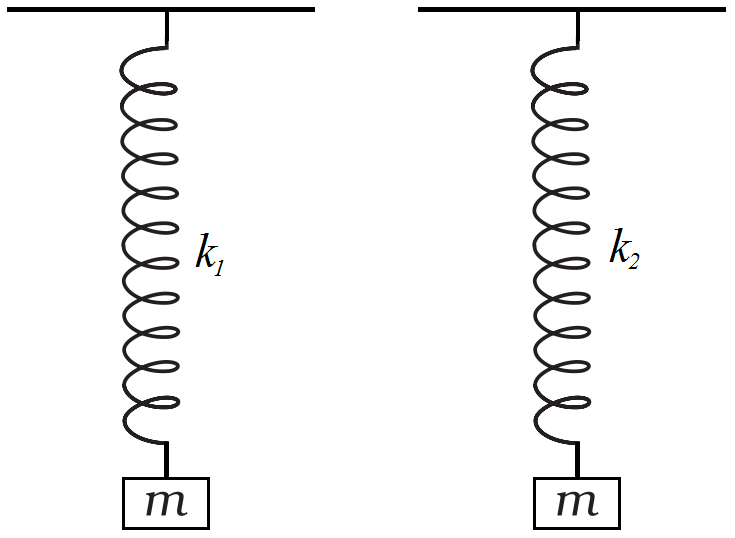
When the mass is connected to the two springs individually.
$\text{v}_1=\frac{1}{2\pi}\sqrt{\frac{\text{k}_1}{\text{m}}}\ ...(1)$
$\text{v}_2=\frac{1}{2\pi}\sqrt{\frac{\text{k}_2}{\text{m}}}\ ...(2)$
Now, the block is connected with two springs considered as parallel.
Here equivalent spring constant $\text{K}_\text{eq}=\text{K}_1+\text{K}_2$
Time period of oscillation of the spring block-system is
$\text{T}=2\pi\sqrt{\frac{\text{m}}{\text{k}_\text{eq}}}=2\pi\sqrt{\frac{\text{m}}{\text{k}_1+\text{k}_2}}$
Hence frequency,
$\text{v}=\frac{1}{\text{T}}=\frac{1}{2\pi}\times\sqrt{\frac{\text{k}_1+\text{k}_2}{\text{m}}}\ ...(3)$
$\text{v}=\frac{1}{2\pi}\Big[\frac{\text{k}_1}{\text{m}}+\frac{\text{k}_2}{\text{m}}\Big]^{\frac{1}{2}}$
From Eq. (i) $\frac{\text{k}_1}{\text{m}}=4\pi^2\text{v}_1^2$ and from Eq.(ii) $\frac{\text{k}_2}{\text{m}}=4\pi^2\text{v}_2^2$
$\Rightarrow\text{v}=\frac{1}{2\pi}\Big[\frac{4\pi^2\text{v}_1^2}{1}+\frac{4\pi^2\text{v}_2^2}{1}\Big]^\frac{1}{2}=\frac{2\pi}{2\pi}[\text{v}_1^2+\text{v}_2^2]^\frac{1}{2}$
$\Rightarrow\text{v}=\sqrt{\text{v}_1^2+\text{v}_2^2}$
Explanation:
$\text{x}=\text{a}\cos(\propto\text{t})^2$ is a cosine function and x varies between -a and +a, the motion is oscillatory. Now checking for periodic motion, putting t + T in place of t. T is supposed as period of the function ω(t).
$\text{x}(\text{t}+\text{T})=\text{a}\cos[\alpha(\text{t}+\text{T})]^2$
$=\text{a}\cos[\alpha^2\text{t}^2+\text{a}^2\text{T}^2+2\alpha^2\text{tT}]\neq\text{x}(\text{t})$
Hence, it is not periodic.
Explanation:
$\text{T}=2\pi\sqrt{\frac{\text{M}}{\text{k}}}$ and $\text{T}'=2\pi\sqrt{\frac{\text{M + m}}{\text{k}}}$
$\frac{\text{T}'}{\text{T}}=\Big(\frac{\text{M + m}}{\text{M}}\Big)^{\frac{1}{2}}=\Big(1+\frac{\text{m}}{\text{M}}\Big)^{\frac{1}2{}}$
$\frac{\text{m}}{\text{M}}=\Big(\frac{\text{T}'}{\text{T}}\Big)^2-1=\Big(\frac{5}{3}\Big)^2-1=\frac{16}{9}$
Explanation:
Resultant displacement is x + y
$\text{x}=\text{a}\cos\omega\text{t}\ ...(1)$
$\text{y}=\text{A}\sin\omega\text{t}\ ...(2)$
Dispacement $=\text{a}\cos\omega\text{t}+\text{a}\sin\omega\text{t}$
$\text{y}'=\text{a}\sqrt{2}\Big[\frac{\cos\omega\text{t}}{\sqrt{2}}+\frac{\sin\omega\text{t}}{\sqrt{2}}\Big]$
$\text{y}'\text{a}\sqrt{2}\ [\cos\omega\text{t}\cos45^\circ+\sin\omega\text{t}\sin45^\circ]$as the particle is acted simultaneously by Mutually perpendicular direction.
$\text{y}'=\text{a}\sqrt{2}\cos\text{s}(\omega\text{t}-45^\circ)$
Hence the displacement is neither a straight line nor a parabola.
Now, squaring and adding (i), (ii)
$\text{x}^2+\text{y}^2=\text{a}^2\cos^2\omega\text{t}+\text{a}^2\sin^2\omega\text{t}=\text{a}^2[\cos^2\omega\text{t}+\sin^2\omega\text{t}]$
$\text{x}^2+\text{y}^2=\text{a}^2$
This shows the equation of circle, hence the motion is circular motion.

Explanation:
Since x varies between -a and +a, the motion is oscillatory.
But as $\cos(\alpha\text{t}^2)=\cos(\alpha^2\text{t}^2)$ does not have a period, the motion is not periodic.
Exlanation:
Velocity of the particle executing SHM is given as $\text{v}=\omega\sqrt{\text{A}^2-\text{x}^2}$
At extreme position, x = A
⇒ v = 0