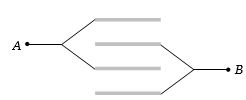
Four plates of the same area of cross-section are joined as shown in the figure. The distance between each plate is $d$. The equivalent capacity across $A$ and $B$ will be
Medium


Download our appand get started for free
Experience the future of education. Simply download our apps or reach out to us for more information. Let's shape the future of learning together!No signup needed.*
Similar Questions
- 1What is the area of the plates of a $3\,F$ parallel plate capacitor, if the separation between the plates is $5\,mm$View Solution
- 2If the electric potential at any point $(x, y, z) \,m$ in space is given by $V =3 x ^{2}$ volt. The electric field at the point $(1,0,3) \,m$ will be ............View Solution
- 3A $12\,pF$ capacitor is connected to a $50\,V$ battery. How much electrostatic energy is stored in the capacitorView Solution
- 4$A$ $2$ $\mu F$ capacitor is charged to a potential $=$ $10\,V$. Another $4$ $\mu F$ capacitor is charged to a potential $=$ $20\,V$. The two capacitors are then connected in a single loop, with the positive plate of one connected with negative plate of the other. What heat is evolved in the circuit?......$\mu J$View Solution
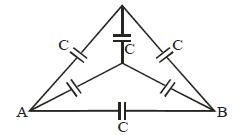
- 5Find net capacitance between $A$ and $B$View Solution
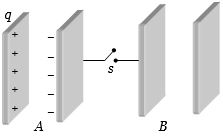
- 6Consider the situation shown in the figure. The capacitor $A$ has a charge $q$ on it whereas $B$ is uncharged. The charge appearing on the capacitor $B$ a long time after the switch is closed isView Solution
- 7Three capacitors of capacitance $1\ \mu F$, $2 \ \mu F$ and $3\ \mu F$ are connected in series and a potential difference of $11 V$ is applied across the combination. Then, the potential difference across the plates of $1\ \mu F$ capacitor is......$V$View Solution
- 8Two identical particles of mass m carry a charge $Q$ each. Initially one is at rest on a smooth horizontal plane and the other is projected along the plane directly towards first particle from a large distance with speed $v.$ The closest distance of approach beView Solution
- 9A cube of side $b$ has a charge $q$ at each of its vertices. Determine the potential and electric field due to this charge array at the centre of the cube.View Solution
- 10A small sphere of mass $m =\ 0.5\, kg$ carrying a positive charge $q = 110\ \mu C$ is connected with a light, flexible and inextensible string of length $r = 60 \ cm$ and whirled in a vertical circle. If a vertically upwards electric field of strength $E = 10^5 NC^{-1}$ exists in the space, The minimum velocity of sphere required at highest point so that it may just complete the circle........$m/s$ $(g = 10\, ms^{-2})$View Solution