Question
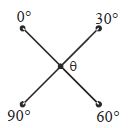
Four rods of same material and having the same cross section and length have been joined, as shown. The temperature of junction of four rods will be........ $^oC$
Answer

$\frac{{{\rm{KA}}(90 - \theta )}}{l} = \frac{{{\rm{KA}}(\theta  - 30)}}{l} + \frac{{{\rm{KA}}(\theta  - {\rm{0}})}}{l} + \frac{{{\rm{KA}}(\theta  - 60)}}{l}$

$90-\theta=3 \theta-90^{\circ}$

$\theta=45^{\circ}$ $C$

Need a full question paper?

Generate a complete, print-ready paper with questions like this in minutes — across 16+ boards, with answer keys.
Start Generating Free

Similar questions

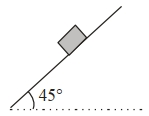
Consider a block kept on an inclined plane (inclined at $45^{\circ}$ ) as shown in the figure. If the force required to just push it up the incline is $2$ times the force required to just prevent it from sliding down, the coefficient of friction between the block and inclined plane $(\mu)$ is equal to
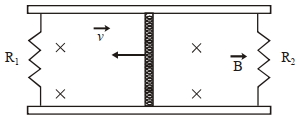
A conducting bar of length $L$ is free to slide on two parallel conducting rails as shown in the figure  Two resistors $R _{1}$ and $R _{2}$ are connected across the ends of the rails. There is a uniform magnetic field $\vec{B}$ pointing into the page. An external agent pulls the bar to the left at a constant speed $v$

The correct statement about the directions of induced currents $I _{1}$ and $I _{2}$ flowing through $R _{1}$ and $R _{2}$ respectively is
In saloons, there is always a characteristics smell due to the ammonia-based chemicals used in hair dyes and other products. Assume the initial concentration of ammonia molecules to be $1000 \,molecules/ m ^3$. Due to air ventilation, the number of molecules leaving in one minute is one tenth of the molecules present at the start of that minute. How long will it take for the concentration of ammonia molecules to reach $1 \,molecule / m ^3$ ?
In Young's double slit experiment, the two slits act as coherent sources of equal amplitudeAand wavelength $\lambda$ . In another experiment with the same setup the two slits are sources of equal amplitudeAand wavelength $\lambda$ but are incoherent. The ratio of the intensity of light at the midpoint of the screen in the first case to that in the second case is
Two metal spheres, one of radus $R$ and the other of radius $2 R$ respectively have the same surface charge density $\sigma$. They are brought in contact and separated. What will be the new surface charge densities on them?
If $x = a\sin \left( {\omega t + \frac{\pi }{6}} \right)$ and $x' = a\cos \omega t$, then what is the phase difference between the two waves
The threshold wavelength for photoelectric emission in tungsten is $400\  nm$. The wavelength of light that must be used in order to eject electrons with a maximum energy of $0.9\  eV$ to be is .............. $nm$
In Young's double slit experiment, the distance between slits and the screen is $1 .0\,\,m$ and monochromatic light of $600\,\,nm$  is being used. A person standing near the slits is looking at the fringe pattern. When the separation between the slits is varied, the interference pattern disappears for a particular distance $d_0$ between the slits . If the angular resolution of the eye is $\frac {1}{60}^o,$ the value of $d_0$  is close to......$mm$
The dimensional formula of wave number is
If $\frac{4}{3}$ and $\frac{3}{2}$ are the refractive indices of water and glass, respectively. A ray of light travelling in water is incident on the water-glass interface at $30^{\circ}$. The angle of refraction is given by