The motion of a charged particle can be used to distinguish between a magnetic field and electric field in a certain region by firing the charge
Easy
Download our app for free and get started
(c)
To distinguish between $\vec{E}$ and $\vec{B}$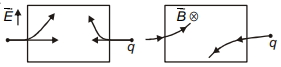

Download our appand get started for free
Experience the future of education. Simply download our apps or reach out to us for more information. Let's shape the future of learning together!No signup needed.*
Similar Questions
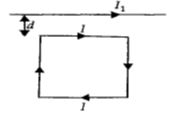
- 1A square loop, carrying a steady current $I,$ is placed in a horizontal plane near a long straight conductor carrying a steady current $I_1$ at a distance $d$ from the conductor as shown in figure. The loop will experienceView Solution
- 2Magnitude of magnetic field (in $SI$ units) at the centre of a hexagonal shape coil of side $10\, cm$, $50$ turns and carrying current $I$ (Ampere) in units of $\frac{\mu_{0} I}{\pi}$ isView Solution
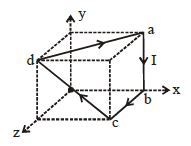
- 3In figure the cube is of $40\,\, cm$ edge. Four straight segment of wire $ab, bc, cd$ and $da$ form a closed loop that carries a current $I = 5\,A$. A uniform magnetic field $0.02\,\,T$ is in $+y\,-$ direction ratio of magnetic force on segement $ab$ and $bc$ isView Solution
- 4Two infinitely long parallel wires carry currents of magnitude $I_1$ and $I_2$ are at a distance $4 cm$ apart. The magnitude of the net magnetic field is found to reach a non-zero minimum value between the two wires and $1 \,cm$ away from the first wire. The ratio of the two currents and their mutual direction isView Solution
- 5A proton (or charged particle) moving with velocity $v$ is acted upon by electric field $E$ and magnetic field $B$. The proton will move undeflected ifView Solution
- 6$20\%$ of main current passes through the galvanometer. If the resistance of the galvanometer is $G$ , then the resistance of the shunt will beView Solution
- 7Two charged particles traverse identical helical paths in a completely opposite sense in a uniform magnetic field $B$ = $B_0\hat{k}$View Solution
- 8The magnitude of the magnetic field at the centre of an equilateral triangular loop of side $1\,m$ which is carrying a current of $10\,A$ is:......$\mu T$ [Take $\mu _0 = 4\pi \times 10^{-7}\,NA^{-2}$]View Solution
- 9View SolutionIf an ammeter is connected in parallel to a circuit, it is likely to be damaged due to excess
- 10What will be the resultant magnetic field at origin due to four infinite length wires. If each wire produces magnetic field '$B$' at originView Solution