Two particles of charges $+Q$ and $-Q$ are projected from the same point with a velocity $v$ in a region of uniform magnetic field $B$ such that the velocity vector makes an angle $q$ with the magnetic field. Their masses are $M$ and $2M,$ respectively. Then, they will meet again for the first time at a point whose distance from the point of projection is
Diffcult
Download our app for free and get started
$T_{1}=\frac{2 \pi M}{q B} T_{2}=\frac{2 \pi(2 M)}{q B} \Rightarrow T_{2}=\frac{4 \pi M}{q B}$
they will meet again when first will complete two revolution and second will complete one revoluation so direction
$d=v \cos \theta t=v \cos \theta .2 \frac{2 \pi M}{q B}=\frac{4 \pi M v \cos \theta}{q B}$

Download our appand get started for free
Experience the future of education. Simply download our apps or reach out to us for more information. Let's shape the future of learning together!No signup needed.*
Similar Questions
- 1A circuit to verify $Ohm's$ law uses ammeter and voltmeter in series or parallel connected correctly to the resistor. In the circuitView Solution
- 2A particle of mass $0.6\, g$ and having charge of $25\, nC$ is moving horizontally with a uniform velocity ${\rm{1}}{\rm{.2}} \times {\rm{1}}{{\rm{0}}^{\rm{4}}}\,m{s^{ - 1}}$ in a uniform magnetic field, then the value of the magnetic induction is $(g = 10\,m{s^{ - 2}})$View Solution
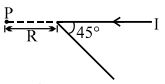
- 3A long straight wire, carrying current $I,$ is bent at its midpoint to from an angle of $45^o.$ Induction of magnetic field at point $P,$ distant $R$ from point of bending is equal to :View Solution
- 4A uniform conducting wire of length is $24 {a}$, and resistance ${R}$ is wound up as a current carrying coil in the shape of an equilateral triangle of side $'a'$ and then in the form of a square of side $'a'.$ The coil is connected to a voltage source ${V}_{0}$. The ratio of magnetic moment of the coils in case of equilateral triangle to that for square is $1: \sqrt{y}$ where $y$ is ..... .View Solution
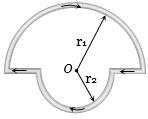
- 5In the figure shown there are two semicircles of radii ${r_1}$ and ${r_2}$ in which a current $i$ is flowing. The magnetic induction at the centre $O$ will beView Solution
- 6Two long current carrying conductors are placed parallel to each other at a distance of $8 \,cm$ between them. The magnitude of magnetic field produced at mid-point between the two conductors due to current flowing in them is $300 \,\mu T$. The equal current flowing in the two conductors is ...............View Solution
- 7View SolutionWhich of the following gives the value of magnetic field according to, Biot-Savart’s law’
- 8A galvanometer of resistance $40\,\Omega $ gives a deflection of $5\, divisions$ per $mA$. There are $50\, divisions$ on the scale. The maximum current that can pass through it when a shunt resistance of $2\,\Omega $ is connected is ................ $mA$View Solution
- 9A current $I$ flows along the length of a thin walled, long metallic hollow cylinder of radius $R$, distributed uniformly on its surface then pressure on the wall will beView Solution
- 10If an electron is going in the direction of magnetic field $\overrightarrow B $ with the velocity of $\overrightarrow {v\,} $ then the force on electron isView Solution