- A$\frac{{M{R^2}}}{{16\sqrt 2 \pi }}$
- ✓$\frac{{4M{R^2}}}{{9\sqrt 3 \pi }}$
- C$\;\frac{{4M{R^2}}}{{3\sqrt 3 \pi }}$
- D$\;\frac{{M{R^2}}}{{32\sqrt 2 \pi }}$
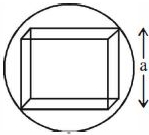
Moment of inertia of the cube about the given axis,
$I = \frac{{M'{a^2}}}{6} = \frac{{\frac{{2M}}{{\sqrt 3 \pi }} \times {{\left( {\frac{2}{{\sqrt R }}R} \right)}^2}}}{6} = \frac{{4M{R^2}}}{{9\sqrt 3 \pi }}$
Generate a complete, print-ready paper with questions like this in minutes — across 16+ boards, with answer keys.
[Given: The speed of sound in air is $324 ms ^{-1}$ ]
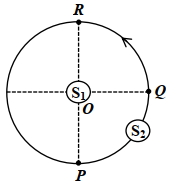
($1$) When only $S_2$ is emitting sound and it is $Q$, the frequency of sound measured by the detector in $Hz$ is. . . . . .
($2$) Consider both sources emitting sound. When $S_2$ is at $R$ and $S_1$ approaches the detector with a speed $4 ms ^{-1}$, the beat frequency measured by the detector is $\qquad$ $Hz$.

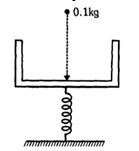
From what height should the particle be dropped to cause a compression of $0.04\; m$.