MCQ
Volume of gas become four times if
  • Temperature become four times at constant pressure
  • B
    Temperature become one fourth at constant pressure
  • C
    Temperature becomes two times at constant pressure
  • D
    Temperature becomes half at constant pressure

Answer

Correct option: A.
Temperature become four times at constant pressure
a
From ideal gas law, $PV = nRT$.

So, to increase the volume by $4$ times, temperature has to be increased by $4$ times at constant pressure.

This option $( A )$ is correct.

Need a full question paper?

Generate a complete, print-ready paper with questions like this in minutes — across 16+ boards, with answer keys.
Start Generating Free

Similar questions

To find the spring constant $(k)$ of a spring experimentally, a student commits $2 \%$ positive error in the measurement of time and $1 \%$ negative error in measurement of mass. The percentage error in determining value of $\mathrm{k}$ is :
The beats are produced by two sound sources of same amplitude and of nearly equal frequencies. The maximum intensity of beats will be ...... that of one source
Aboat having a speed of $5\,\, km/hr$. in still water, crosses a river of width $1\,\, km$ along the shortest possible path in $15 \,\,minutes$. The speed of the river in $Km/hr.$
A black body at a temperature of $1640 K$  has the wavelength corresponding to maximum emission equal to $1.75$ $\mu $. Assuming the moon to be a perfectly black body, the temperature of the moon, if the wavelength corresponding to maximum emission is $ 14.35$ $\mu $ is ...... $K$
The moment of inertia of a solid sphere of density $\rho $ and radius R about its diameter is
The diffusion current in a p-n junction is:
A $750 \,W$ motor drives a pump which lifts $300 \,L$ of water per minute to a height of $6 \,m$. The efficiency of the motor is nearly (Take, acceleration due to gravity to be $10 \,m / s ^2$ )
A steel rod of length $1m$ and radius $10mm$ is stretched by a force $100kN$ along its length. The stress produced in the rod is $Y_{steel} = 2 \times 10^{11}Nm^{-2}$.
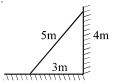
$A$ uniform ladder of length $5m$ is placed against the wall as shown in the figure. If coefficient of friction $\mu$ is the same for both the walls, what is the minimum value of $\mu$ for it not to slip?
A siren placed at a railway platform is emitting sound of frequency $5 kHz$. A passenger sitting in a moving train $A$ records a frequency of $5.5 kHz$ while the train approaches the siren. During his return journey in a different train $B$ he records a frequency of $6.0 kHz$ while approaching the same siren. The ratio of the velocity of train $B$ to that of train $A$ is