From a supply of identical capacitors rated $8\ \mu F$, $250\ V$, the minimum number of capacitors required to form a composite $16$ $\mu F$, $1000$ $V$ is :
Medium
Download our app for free and get started
$4$ times in series. Let each be $x$, then
$\frac{x}{4}=16 \mu F \Rightarrow x=4 \mu F$
Which is possible when $8$ are connected in parallel
$\Rightarrow 8 \times 4=32$

Download our appand get started for free
Experience the future of education. Simply download our apps or reach out to us for more information. Let's shape the future of learning together!No signup needed.*
Similar Questions
- 1The electrostatic potential inside a charged spherical ball is given by $\phi= a{r^2} + b$ where $r$ is the distance from the centre and $a, b$ are constants. Then the charge density inside the ball is:View Solution
- 2Two capacitors of capacitances $3\,\mu \,F$ and $6\,\mu F$ are charged to a potential of $12 \,V$ each. They are now connected to each other, with the positive plate of each joined to the negative plate of the other. The potential difference across each will be......$volt$View Solution
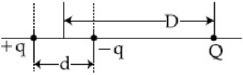
- 3A system of three charges are placed as shown in the figure.View Solution
If $D > > d,$ the potential energy of the system is best given $b$
- 4A capacitor of capacitance $C$ is charged to a potential difference $V_0$. The charging battery is removed and the capacitor is now connected to an uncharged capacitor of unknown capacity, the potential difference across the combination becomes $V$. The unknown capacitance isView Solution
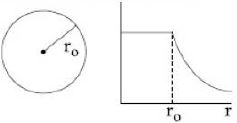
- 5The give graph shown variation (with distance $r$ from centre) ofView Solution
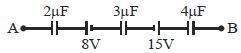
- 6The potential of the point $A$ is greater than that of $B$ by $19\, volt$. What is the potential difference in volts across the $3\,\mu F$ capacitor ?View Solution
- 7A conducting body $1$ has some initial charge $Q$, and its capacitance is $C$. There are two other conducting bodies, $2$ and $3$, having capacitances : $C_2 = 2C$ and $C_3 \rightarrow \infty$ . Bodies $2 $ and $3 $ are initially uncharged. "Body $2$ is touched with body $1$. Then, body $2$ is removed from body $1 $ and touched with body $3$, and then removed." This process is repeated $N$ times. Then, the charge on body $1$ at the end must beView Solution
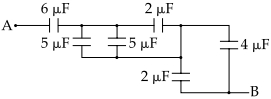
- 8The equivalent capacitance between $A$ and $B$ in the circuit given below is.....$μF$View Solution
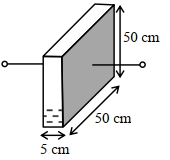
- 9A container has a base of $50 \mathrm{~cm} \times 5 \mathrm{~cm}$ and height $50 \mathrm{~cm}$, as shown in the figure. It has two parallel electrically conducting walls each of area $50 \mathrm{~cm} \times 50 \mathrm{~cm}$. The remaining walls of the container are thin and non-conducting. The container is being filled with a liquid of dielectric constant $3$ at a uniform rate of $250 \mathrm{~cm}^3 \mathrm{~s}^{-1}$. What is the value of the capacitance of the container after $10$ seconds? [Given: Permittivity of free space $\epsilon_0=9 \times 10^{-12} \mathrm{C}^2 \mathrm{~N}^{-1} \mathrm{~m}^{-2}$, the effects of the non-conducting walls on the capacitance are negligible]View Solution
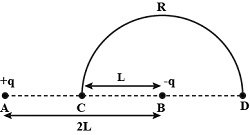
- 10Charges $+q$ and $-q$ are placed at points $A$ and $B$ respectively which are a distance $2\,L$ apart, $C$ is the midpoint between $A$ and $B.$ The work done in moving a charge $+Q$ along the semicircle $CRD$ isView Solution