Two capacitors of capacitances $3\,\mu \,F$ and $6\,\mu F$ are charged to a potential of $12 \,V$ each. They are now connected to each other, with the positive plate of each joined to the negative plate of the other. The potential difference across each will be......$volt$
Medium


Download our appand get started for free
Experience the future of education. Simply download our apps or reach out to us for more information. Let's shape the future of learning together!No signup needed.*
Similar Questions
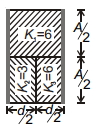
- 1View SolutionThree different dielectrics are filled in a parallel plate capacitor as shown. What should be the dielectric constant of a material, which when fully filled between the plates produces same capacitance?
- 2Three capacitors $2$ $\mu F$, $3$ $\mu F$ and $5$ $\mu F$ can withstand voltages to $3\,V, 2\,V$ and $1\,V$ respectively. Their series combination can withstand a maximum voltage equal to.....$Volts$View Solution
- 3Combination of two identical capacitors, a resistor $R$ and a $DC$ voltage source of voltage $6\; V$ is used in an experiment on $C-R$ circuit. It is found that for a parallel combination of the capacitor the time in which the voltage of the fully charged combination reduces to half its original voltage is $10\; s$. For series combination the time needed for reducing the voltage of the fully charged series combination by half isView Solution
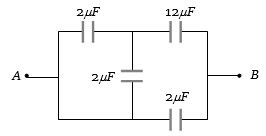
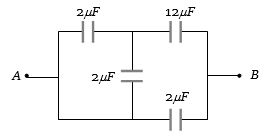
- 4Four capacitors are connected in a circuit as shown in the figure. The effective capacitance in $\mu F$ between points $A$ and $B$ will beView Solution
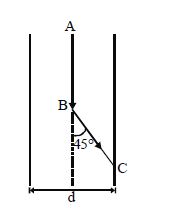
- 5A sphere carrying charge of $Q$ having weight $w$ falls under gravity between a pair of vertical plates at a distance of $d$ from each other. When a potential difference $V$ is applied between the plates the acceleration of sphere changes as shown in the figure, to along line $BC$. The value of $Q$ is :-View Solution
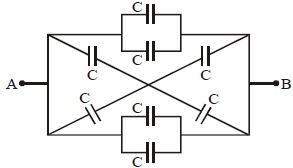
- 6Eight capacitors each of capacitance of $C$ are connected as shown in the figure. The effective capacitance between $A$ and $B$ isView Solution
- 7Two condensers of capacity $0.3\,\mu F$ and $0.6\,\mu F$ respectively are connected in series. The combination is connected across a potential of $6\,volts$. The ratio of energies stored by the condensers will beView Solution
- 8Four capacitors are connected in a circuit as shown in the figure. The effective capacitance in $\mu F$ between points $A$ and $B$ will beView Solution
- 9A hollow conducting sphere of radius $R$ has a charge $( + Q)$ on its surface. What is the electric potential within the sphere at a distance $r = \frac{R}{3}$ from its centreView Solution
- 10View SolutionIf a charge is shifted from a low potential region to high potential region, the electric potential energy