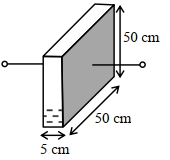
A container has a base of $50 \mathrm{~cm} \times 5 \mathrm{~cm}$ and height $50 \mathrm{~cm}$, as shown in the figure. It has two parallel electrically conducting walls each of area $50 \mathrm{~cm} \times 50 \mathrm{~cm}$. The remaining walls of the container are thin and non-conducting. The container is being filled with a liquid of dielectric constant $3$ at a uniform rate of $250 \mathrm{~cm}^3 \mathrm{~s}^{-1}$. What is the value of the capacitance of the container after $10$ seconds? [Given: Permittivity of free space $\epsilon_0=9 \times 10^{-12} \mathrm{C}^2 \mathrm{~N}^{-1} \mathrm{~m}^{-2}$, the effects of the non-conducting walls on the capacitance are negligible]
IIT 2023, Medium
Download our app for free and get started
$\text { In } \mathrm{t}=10 \mathrm{sec} \text { volume of liquid is }$
$\mathrm{V}=2500 \mathrm{cc}$
$\mathrm{h}=\frac{2500}{50 \times 5}=10 \mathrm{~cm}$
$\mathrm{C}_{\mathrm{d}}=\frac{\mathrm{A}_{\mathrm{d}} \varepsilon_0 \mathrm{k}}{\mathrm{d}}$
$=\frac{50 \times 10^{-2} \times 10 \times 10^{-2} \varepsilon_0 \times 3}{5 \times 10^{-2}}=3 \varepsilon_0$
$\mathrm{C}_{\mathrm{a}}=\frac{\mathrm{A}_{\mathrm{a}} \varepsilon_0}{\mathrm{~d}}=\frac{50 \times 10^{-2} \times 40 \times 10^{-2} \varepsilon_0}{5 \times 10^{-2}}=4 \varepsilon_0$
$\mathrm{C}=\mathrm{C}_{\mathrm{a}}+\mathrm{C}_{\mathrm{d}}=7 \varepsilon_0$
$=7 \times 9 \times 10^{-12}=63 \mathrm{Pf}$

Download our appand get started for free
Experience the future of education. Simply download our apps or reach out to us for more information. Let's shape the future of learning together!No signup needed.*
Similar Questions
- 1$27$ identical drops are charged at $22\, V\,\,each.$ They combine to form a bigger drop. The potential of the bigger drop will be............ $V.$View Solution
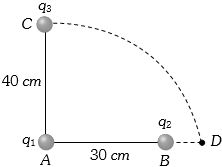
- 2Two charges ${q_1}$ and ${q_2}$ are placed $30\,\,cm$ apart, shown in the figure. A third charge ${q_3}$ is moved along the arc of a circle of radius $40\,cm$ from $C$ to $D$. The change in the potential energy of the system is $\frac{{{q_3}}}{{4\pi {\varepsilon _0}}}k$, where $k$ isView Solution
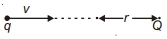
- 3The charge $q$ is fired towards another charged particle $Q$ which is fixed, with a speed $v$. It approaches $Q$ upto a closest distance $r$ and then returns. If $q$ were given a speed $2 v$, the closest distance of approach would beView Solution
- 4A parallel plate capacitor has potential $20\,kV$ and capacitance $2\times10^{-4}\,\mu F$. If area of plate is $0.01\,m^2$ and distance between the plates is $2\,mm$ then find dielectric constant of mediumView Solution
- 5Two identical charged spheres are suspended by strings of equal lengths. The strings make an angle $\theta$ with each other. When suspended in water the angle remains the same. If density of the material of the sphere is $1.5 \mathrm{~g} / \mathrm{cc}$, the dielectric constant of water will beView Solution
(Take density of water $=1 \mathrm{~g} / \mathrm{cc}$ )
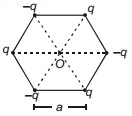
- 6Six point charges are placed at the vertices of a regular hexagon of side $a$ as shown. If $E$ represents electric field and $V$ represents electric potential at $O$, thenView Solution
- 7A particle has a mass $400$ times than that of the electron and charge is double than that of a electron. It is accelerated by $5\,V$ of potential difference. Initially the particle was at rest, then its final kinetic energy will be......$eV$View Solution
- 8A resistance $R$ and a capacitance $C$ are connected in series to a battery of negligible internal resistance through a key. The key is closed at $t = 0$. If after $t\, sec$ the voltage across the capacitance was seven times the voltage across $R$, the value of $t$ isView Solution
- 9If a charged spherical conductor of radius $10\,cm$ has potential $V$ at a point distant $5\,cm$ from its centre, then the potential at a point distant $15\,cm$ from the centre will beView Solution
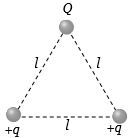
- 10Three charges $Q,( + q)$ and $( + q)$ are placed at the vertices of an equilateral triangle of side l as shown in the figure. If the net electrostatic energy of the system is zero, then $Q$ is equal toView Solution