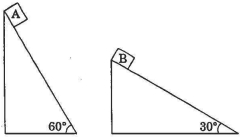
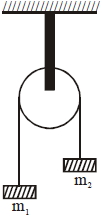
From the adjacent figure, the correct observation is
Easy
Download our app for free and get started
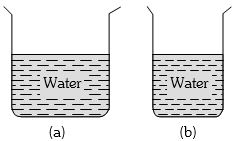
(d)Pressure = h$\rho$g i.e. pressure at the bottom is independent of the area of the bottom of the tank. It depends on the height of water upto which the tank is filled with water. As in both the tanks, the levels of water are the same, pressure at the bottom is also the same.
Download our app
and get started for free
Experience the future of education. Simply download our apps or reach out to us for more information. Let's shape the future of learning together!No signup needed.*
A boy carries a fish in one hand and a bucket(not full) of water in the other hand . If he places the fish in the bucket , the weight now carried by him (assume that water does not spill) :
Water flows in a streamlined manner through a capillary tube of radius $a$, the pressure difference being $P$ and the rate of flow $Q$. If the radius is reduced to $a/2$ and the pressure increased to $ 2P, $ the rate of flow becomes
For the situation shown in the figure, water flows on the surface of a fixed plate. The
velocity of water as a function of distance $'y'$ is given as : $u = \alpha \left[ {\frac{y}{h} - 2{{\left( {\frac{y}{h}} \right)}^2}} \right]$ . Determine the magnitude of the shear stress that the water applies at the base of the plate. Coefficient of viscosity is $\eta$
A liquid enter at point $A_{1}$ with speed $3.5 m / s$ and leaves at point $A _{2} .$ Then find out the height attained by the liquid above point $A _{2}$ (in $cm$)
Consider the wall of a dam to be straight with height $H$ and length $L$. It holds a lake of water of height $h (h < H)$ on one side. Let the density of water be $\rho_{ w }$. Denote the torque about the axis along the bottom length of the wall by $\tau_1$. Denote also a similar torque due to the water up to height $h / 2$ and wall length $L / 2$ by $\tau_2$. Then $\tau_1 / \tau_2$ (ignore atmospheric pressure) is
Two substances of densities ${\rho _1}$ and ${\rho _2}$ are mixed in equal volume and the relative density of mixture is $4$. When they are mixed in equal masses, the relative density of the mixture is $3$. The values of ${\rho _1}$ and ${\rho _2}$ are
Assume that, the drag force on a football depends only on the density of the air, velocity of the ball and the cross-sectional area of the ball. Balls of different sizes but the same density are dropped in an air column. The terminal velocity reached by balls of masses $250 \,g$ and $125 \,g$ are in the ratio