Question
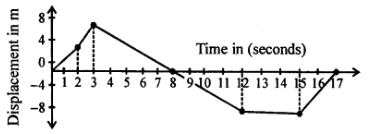
From the displacement - time graph shown given below calculate : -
1. Average velocity in first three seconds.
2. Displacement from initial position at the end of 13 s .
3. Time after which the body is at the initial position,
4. Average velocity after 8 s .
Image

Answer

(i) In first three seconds
Total displacement $=8 m$
Total time $=3 s$
Average velocity $=$ Total displacement $/$ Totaltime $=8 / 3$
$
=2.67 ms^{-1}
$
(ii) Displacement from initial position at the end of $13 s=-8 m$.
(iii) Body is at the initial position after 8 s and 17 s .
(iv) Average velocity after 8 s is zero because after 8 s , displacement is zero.

Need a full question paper?

Generate a complete, print-ready paper with questions like this in minutes — across 16+ boards, with answer keys.

Start Generating Free

Similar questions

Explain why a gas bubble released at the bottom of a lake grows in size as it rises to the surface of the lake.
State Newton's law of gravitation.
A body is moving along a circular path of radius r. What will be the distance and displacement of the body when it completes:
Two full revolutions
Why do you feel a backward jerk on your shoulder when you fire a gun?
Draw the speed-time graph of a body starting from some point P, gradually picking up speed, then running at a uniform speed and finally slowing down to stop at some point Q.
(a) When a piece of ice floating in water melts, the level of water inside the glass remains same. Explain.
(b) An inflated balloon is placed inside a big glass jar which is connected to an evacuating pump. What will you observe when the evacuating pump starts working? Give a reason for your answer.
At a given place, a mercury barometer records a pressure of $0.70$ m of Hg. What would be the height of water column if mercury in barometer is replaced by water? Take density of mercury to be $= 13.6 \times 10^3 kg m^{-3}.$
How are sound waves produced? How are sound waves transmitted from one place to the other?
The diagram shows a sketch graph showing a change in volume of a given mass of ice at -5°C to water at 15°C.
(i) Why does the temperature along BC remain constant?
(ii) When is the volume of water minimum?
(iii) At what temperature does water have maximum density? Explain.