Questions

[3 Mark Question Answer]

🎯

Test yourself on this topic

23 questions · timed · auto-graded

Question 13 Marks
A stone thrown vertically upwards, takes 4 s to return to thrower. Calculate
(i) initial velocity of the stone
(ii) maximum height attained by stone. (Take $g =10 ms^{-2}$ )
Answer
A stone thrown vertically upwards, takes 4 s to return to thrower, $\Rightarrow$ Time taken by the stone to reach maximum height $=t=\frac{4}{2}$
$
t=2 s
$
Initial velocity of stone $= u =$ ?
Maximum height attained by stone $=h=$ ?
Acceleration $=a=-g=-10 ms^{-2}$
(i) $v=u+a t$
Velocity of stone at heighest point $=v=0$
$\begin{array}{l}
0=u+(-10) 2 \\
u=10 \times 2=20 ms^{-1}=20 ms^{-1}
\end{array}$
$\begin{array}{l}(ii) \quad v^2-u^2=2 a S \\
(0)^2-(20)^2=2(-10) h \\
-20 h=-400 \\
h=\frac{400}{20}=20 m
\end{array}$
View full question & answer
Question 23 Marks
A stone thrown vertically upwards, takes 3 s to attain maximum height. Calcualte
1. initial velocity of the stone
2. maximum height attained by the stone. (Take $g =9.8 ms^{-2}$ )
View full question & answer
Question 33 Marks
A boy drops a stone from a cliff, reaches the ground in 8 seconds. Calculate
1. final velocity of stone
2. height of cliff. (Take $g=9.8 ms^{\prime} 2$ )
Answer
Initial velocity $=u=0$
Time $= t =8 s$
Final velocity $= v =$ ?
Height of cliff $= h =$ ?
A cceleration $=a=+g=+9.8 ms^{-1}$
(i)
$
\begin{array}{l}
v=u+a t \\
v=0+9.8(8) \\
v=78.4 ms^{-1}
\end{array}
$
(ii)
$
\begin{array}{l}
S=u t+\frac{1}{2} a t^2 \\
h=0(8)+\frac{1}{2}(9.8)(8)^2 \\
h=0+4.9 \times 64 \\
h=313.6 m
\end{array}
$
View full question & answer
Question 43 Marks
A packet is dropped from a stationary helicopter, hovering at a height ' $h$ ' from ground level, reaches ground in 12s. Calculate
1. value of $h$
2. final velocity of packet on reaching ground. (Take $g =9.8 ms 2$ )
Answer
$
\begin{array}{l}
\begin{array}{l}
\text { Height of the helicopter }=h=? \\
\text { Initial velocity }=u=0 \\
\text { Time }=t=12 s \\
\text { Acceleration }=a=+g=+9.8 ms^{-2} \\
S=u t+\frac{1}{2} a t^2 \\
h=0(12)+\frac{1}{2}(9.8)(12)^2 \\
h=0+4.9(144) \\
h=705.6 m
\end{array}\\
\text { Let } v=\text { velocity of the packet on reaching the ground. }\\
\begin{array}{l}
v=u+a t \\
v=0+(9.8) 12 \\
v=117.6 ms^{-1}
\end{array}
\end{array}
$

View full question & answer
Question 53 Marks
A cyclist driving at $36 kmh ^{-1}$ stops his motion in 2 s , by the application of brakes. Calculate
1. retardation
2. distance covered during the application of brakes.
View full question & answer
Question 63 Marks
A motor bike running at $5 ms^{-1}$, picks up a velocity of $30 ms^{-1}$ in 5s . Calculate
1. acceleration
2. distance covered during acceleration.
Answer
Initial velocity of motor bike $=u=5 ms^{-1}$
Final velocity of motor bike $=\nu=30 ms^{-1}$
Time $=t=5 s$
(i) Acceleration $=a=$ ?
$
\begin{array}{l}
v=u+a t \\
30=5+a(5) \\
5 a=30-5=25 \\
a=\frac{25}{5}=5 ms^{-2}
\end{array}
$
(ii) Distance covered $S =$ ?
$
\begin{array}{l}
S=u t+\frac{1}{2} a t^2 \\
S=5(5)+\frac{1}{2}(5)(5)^2 \\
S=25+\frac{125}{2}=25+62.5 \\
S=87.5 m
\end{array}
$
View full question & answer
Question 73 Marks
A racing car, initially at rest, picks up a velocity of $180 kmh ^{-1}$ in 4.5 s . Calculate
1. acceleration
2. distance covered by car.
View full question & answer
Question 83 Marks
A truck running at $90 kmh ^{-1}$, is brought to rest over a distance of 25 m . Calculate the retardation and time for which brakes are applied.
Answer
Initial velocity $=u=90 kmh ^{-1}=90 \times \frac{5}{18} ms^{-1}$
$
u=25 ms^{-1}
$
Final velocity $=\nu=0$
Distance $= S =25 m$
$
\begin{array}{l}
v^2-u^2=2 a S \\
(0)^2-(25)^2=2 a(25) \\
50 a=-625
\end{array}
$
$
\text { (retardation) } a=\frac{-625}{50}=-12.5 ms^{-2}
$
Now, $v=u+a t$
$
\begin{array}{l}
0=25+(-12.5) t \\
12.5 t=25
\end{array}
$
(Time) $t=\frac{25}{12.5}=2 s$
View full question & answer
Question 93 Marks
An aeroplane lands at $216 kmh ^{-1}$ and stops after covering a runway of 2 m . Calculate the acceleration and the time, in which it comes to rest.
Answer
Initial velocity $= u =216 kmh ^{-1}$
$
\begin{array}{l}
u=216 \times \frac{5}{18}=60 ms^{-1} \\
\text { Final velocity }=v=0 \\
\text { Distance }=S=2 km=2000 m \\
v^2-u^2=2 a S \\
(0)^2-(60)^2=2 a(2000) \\
4000 a=-3600
\end{array}
$
$
\text { (Acceleration) } \begin{aligned}
a & =\frac{-3600}{4000} \\
& =-0.9 ms^{-2}
\end{aligned}
$
Now, $v=u+a t$
$
\begin{array}{l}
0=60+(-0.9) t \\
0.9 t=60 \\
\text { (Time) } t=\frac{60}{0.9}=\frac{600}{9}=66.67 S
\end{array}
$
View full question & answer
Question 103 Marks
A cyclist driving at $5 mr ^{-1}$, picks a velocity of $10 ms^{-1}$, over a distance of 50 m . Calculate
1. acceleration
2. time in which the cyclist picks up above velocity.
Answer
$\begin{array}{l}\text { Initial velocity }= u =5 ms^{-1} \\ \text { Final velocity }= v =10 ms^{-1} \\ \text { Distance }= S =50 m \\ \text { (i) } v ^2- u =2 aS \\ (10)^2-(5)^2=2 a (50) \\ 100 a =100-25=75 \\ \qquad a=\frac{75}{100}=0.75 ms^{-2} \\ \begin{array}{l} \therefore \quad \text  { Acceleration }=a=0.75 ms^{-2} \\ \text { (ii) } v=u+a t \\ 10=5+0.75 t \\ 0.75 t=10-5=5\end{array} \\ \text { (Time) } t=\frac{5}{0.75}=6.67 S\end{array}$
View full question & answer
Question 113 Marks
A motor bike, initially at rest, picks up a velocity of $72 kmh ^{-1}$ over a distance of 40 m . Calculate
1. acceleration
2. time in which it picks up above velocity.
View full question & answer
Question 123 Marks
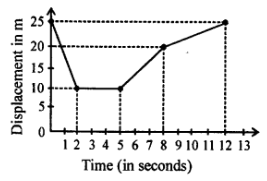
From the displacement - time graph shown given below calculate :
1. Velocity between $0-2 s$.
2. Velocity between $8 s-12 s$.
3. Average velocity between $5 s-12 s$.
Image
Answer
(i) Velocity between $0-2 s=\frac{-(25-10)}{2}$
[negative sign because slope is negative]
$
=-\frac{15}{2}=-7.5 ms^{-1}
$
(ii) Velocity between $8 s-12 s=\frac{25-20}{12-8}=\frac{5}{4}=1.25 ms^{-1}$
(iii) Average velocity between $5 s-12 s$
$
\begin{array}{l}
=\frac{\text { Total displacement from } 5 s \text { to } 12 s}{\text { Time }} \\
=\frac{25-10}{12-5}=\frac{15}{7}=2.1 ms^{-1}
\end{array}
$
View full question & answer
Question 133 Marks
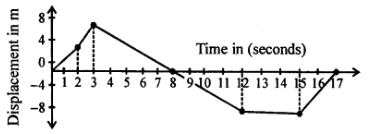
From the displacement - time graph shown given below calculate : -
1. Average velocity in first three seconds.
2. Displacement from initial position at the end of 13 s .
3. Time after which the body is at the initial position,
4. Average velocity after 8 s .
Image
Answer
(i) In first three seconds
Total displacement $=8 m$
Total time $=3 s$
Average velocity $=$ Total displacement $/$ Totaltime $=8 / 3$
$
=2.67 ms^{-1}
$
(ii) Displacement from initial position at the end of $13 s=-8 m$.
(iii) Body is at the initial position after 8 s and 17 s .
(iv) Average velocity after 8 s is zero because after 8 s , displacement is zero.
View full question & answer
Question 143 Marks
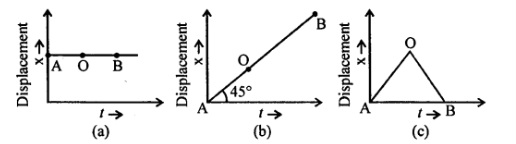
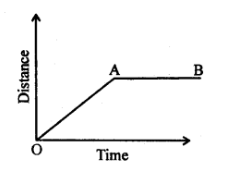
Write down the type of motion of a body along the AOB in each of the following distance - time graphs.
Image
Answer
1. Body is stationary.
2. Body is in uniform motion i.e. it covers equal distance in equal intervals of time.
3. From A to O, body is in uniform motion having positive slope and from O to B, body is in uniform motion having negative slope.
View full question & answer
Question 153 Marks
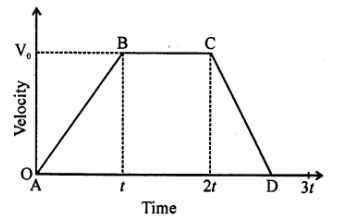
Diagram shows a velocity - time graph for a car starting from rest. The graph has three section AB, BC and CD.
Image
1. From a study of this graph, state how the distance travelled in any section is determined.
2. Compare the distance travelled in section BC with the distance travelled in section AB.
3. In which section, car has a zero acceleration?
4. Is the magnitude of acceleration higher or lower than that of retardation ? Give a reason.
View full question & answer
Question 163 Marks
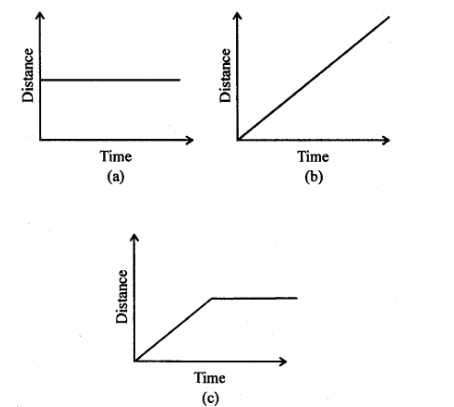
Can you suggest about the kind of motion of a body from the following distance - time graphs?
Image
Answer
(a) Distance time graph in figure (a) shows that body is stationary.
(b) Distance - time graph figure (b) shows that body is in uniform motion.
(c) Distance - time graph in figure (c) shows that initially body is in uniform motion i.e.
it covers equal distance in equal intervals of time.
From O to A, body is in uniform motion and from A to B, body is at rest.
Image
View full question & answer
Question 173 Marks
A speeding car changes its velocity from $108 kmhh ^{-1}$ to $36 kmh ^{-1}$ in 4 s . Calculate its deceleration in
1. $ms ^{-2}$
2. $kmh ^{-2}$.
Answer
$\begin{array}{l}
\text { Initial velocity }=u=108 kmh^{-1} \\
\qquad \begin{aligned}
u & =108 \times \frac{5}{18} m^{-1} \\
u & =30 ms^{-1} \\
\text { Final velocity } & =v=36 kmh^{-1} \\
v & =36 \times \frac{5}{18} ms^{-1} \\
v & =10 ms^{-1} \\
\text { Time } & =t=4 S \\
\text { Deceleration } & =a=\frac{v-u}{t} \\
a & =\frac{10-34}{4} \\
a & =-\frac{20}{4}=-5 ms^{-2} \\
a & =\frac{-5 \times 3600 \times 3600}{1000} kmh^{-2}=-64800 kmh^{-2}
\end{aligned}
\end{array}
$
View full question & answer
Question 183 Marks
The change in velocity of a motor bike is 54 kmlr 1 in one minute. Calculate its acceleration in (a) $ms ^{-2}$ (b) $kmh ^{-2}$.
Answer
$
\begin{array}{l}
\text { Change in velocity }=54 kmh^{-1}=54 \times \frac{1000}{3600} ms^{-1}=15 ms^{-1} \\
\qquad \begin{aligned}
\text { Time } & =1 \text { minute }=60 s \\
\text { Acceleration (a) } & =\frac{\text { Change in velocity }}{\text { Time }} \\
& =\frac{15}{60} ms^{-2} \\
a & =0.25 ms^{-2} \\
a & =0.25 \times \frac{1000}{3600} \times 3600 kmh^{-2}=3240 kmh^{-2}
\end{aligned}
\end{array}
$
View full question & answer
Question 193 Marks
A race horse runs straight towards north and covers 540 m in one minute. Calculate (i) displacement of horse, (ii) its velocity in (a) $ms ^{-1}$ (b) $kmh ^{-1}$.
Answer
A race horse runs straight towards north and covers 540 m in one minute.
1. Displacement $=540 m-$ north
$
\begin{array}{l}
\text { 2. } \text { Time }=1 \text { minute }=60 s\\
\begin{array}{l}
\text { Velocity }=\frac{\text { Displacement }}{\text { Time }} \\
v=\frac{540}{60}=9 ms^{-1} \\
v=\frac{9 \times 3600}{1000} km / h=\frac{324}{10} km / h \\
v=32.4 km / h \text { or } kmh^{-1}
\end{array}
\end{array}
$
View full question & answer
Question 203 Marks
A car covers 90 km in $11 / 2$ hours towards east. Calculate
(i) displacement of car,
(ii) its velocity in (a) kmh-1
(b) $ms ^{-1}$.
Answer
(i) A car covers 90 km in $1 \frac{1}{2}$ hour i.e. $\frac{3}{2}$ hour towards east.
$
\therefore \text { Displacement }=90 km-\text { east }
$
(ii) Time $=1 \frac{1}{2}$ hour $=\frac{3}{2}$ hour
$
\begin{aligned}
\text { Velocity } & =\frac{\text { Displacement }}{\text { Time }} \\
v & =\frac{90}{3 / 2} \\
v & =\frac{90 \times 2}{3}=60 km / h \\
v & =60 \times \frac{1000}{3600} m / s \\
v & =\frac{100}{6} m / s=16.67 ms^{-1}
\end{aligned}
$
View full question & answer
Question 213 Marks
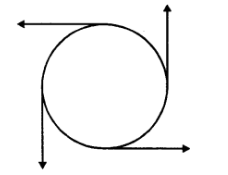
Draw a diagram to show the motion of a body whose speed remains constant, but velocity changes continuously.
Answer
A body moving in a circle with constant speed but variable velocity as the velocity of the body at any point is along the tangent to the circle at that point as shown in the figure.
Image
View full question & answer
Question 223 Marks
What do you understand by the term acceleration? When is the acceleration
1. positive
2. negative?
Answer
Acceleration: "Rate of change of velocity with respect to time" is called acceleration. S.I. unit of acceleration is m s-2.
Positive acceleration: When velocity of a body increases with time, then acceleration of the body is said to be positive acceleration.
Negative acceleration: When the velocity of a body decreases with time, then acceleration of the body is said to be negative acceleration.
View full question & answer
Question 233 Marks
What do you understand by the terms
1. rest
2. motion? Support your answer by giving two examples each
Answer
(i) Rest: A body is said to be at rest if it does not change its position with respect to its immediate surroundings.
For example:
(a) A chair lying in a room.
(b) A stone lying on the ground.
(ii) Motion: A body is said to be in motion if it changes its position with respect to its immediate surroundings.
For example:
(a) A car running on the road.
(b) A football moving on the ground.
View full question & answer