Question
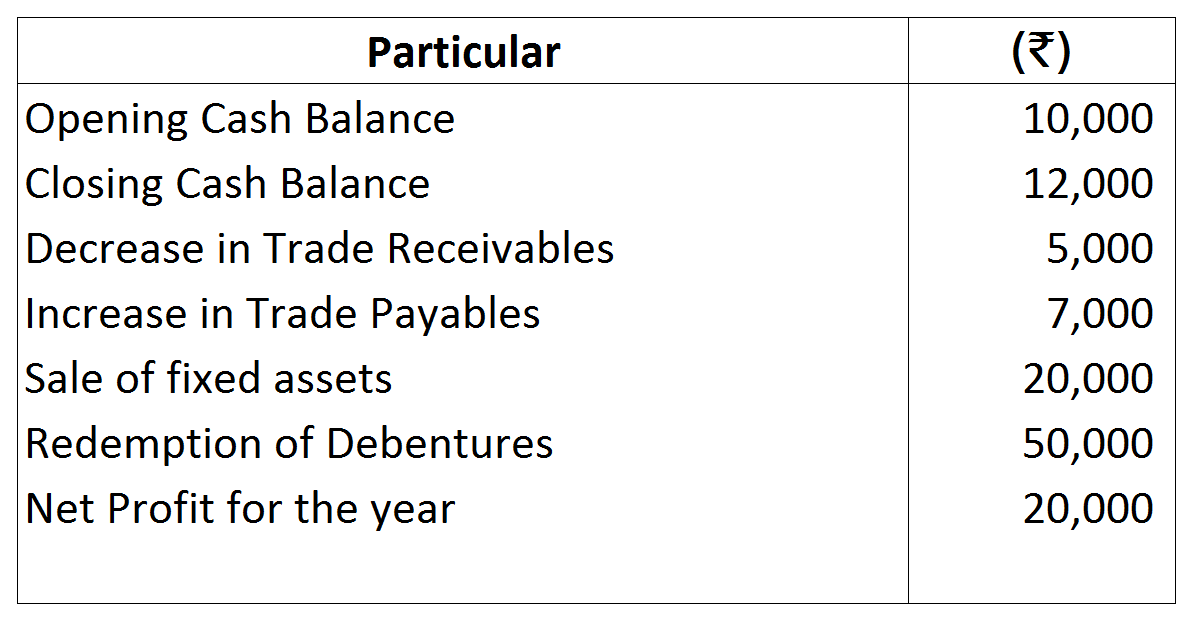
From the following information, prepare a Cash-Flow Statement:
Answer

Get the step-by-step solution for this question inside the Vidyadip app.

Get the answer in the app

Need a full question paper?

Generate a complete, print-ready paper with questions like this in minutes — across 16+ boards, with answer keys.

Start Generating Free

Similar questions

From the following information, calculate value of Opening Inventory:
 
 
Car Closing Inventory.
=
68,000
Total Sales
=
4,80,000 (including Cash Sales ₹ 1,20,000)
Purchases.
=
3,60,000 (including Credit Purchases ₹ 2,39,200)
Goods are sold at a profit of 25% on cost.
Under what heads the following are recorded in a Companies's Financial Statements?
  1. Computer Software.
  2. Bills Receivable.
  3. Interest Accrued and Due on Debentures.
  4. Interest Accrued on Investments
  5. Calls in Arrears.
  6. Discount on Issue of Debentures written off.
  7. Fees received for arranging loans.
  8. Telephone and Internet Exp.
How are the following items shown while preparing Balance Sheet of a company:
  1. Surplus, i.e., Balance in Statement of Profit and Loss (Dr.).
  2. Interest accrued and due on Debentures.
  3. Computer Software under development.
  4. Interest accrued on Investment?
What do you understand by analysis and interpretation of financial statements? Discuss their importance.
Under which major headings and sub-headings will the following items be shown in the Balance Sheet of a company as per Schedule VI Part I of the Companies Act, 1956:
  1. Net loss as shown by Statement of Profit and Loss.
  2. Capital redemption reserve.
  3. Bonds.
  4. Loans repayable on demand.
  5. Unpaid dividend.
  6. Buildings.
  7. Trademarks.
  8. Raw materials.
  1. The quick ratio of a company is 1.5 : 1. State with reason which of the following transactions would (i) increase; (ii) decrease or (iii) not change the ratio:
  1. Paid rent ₹ 3,000 in advance.
  2. Trade receivables included a debtor Shri Ashok who paid his entire amount due ₹ 9,700.
  1. From the following information compute ‘Proprietary Ratio’:
 
Long Term Borrowings
2,00,000
Long Term Provisions
1,00,000
Current Liabilities
50,000
Non-Current Assets
3,60,000
Current Assets
90,000
A trader carries an average inventory of ₹ 40,000. His inventory turnover Ratio is 8 times. Ifhe sells goods at a profit of 20% on revenue from operations, find out his profit.
Explain the process of preparing income statement and balance sheet.
From the following information calculate Operating Profit Ratio:
Opening Stock ₹ 10,000; Purchases ₹ 20,000; Revenue from operations ₹ 4,00,000; Purchase Returns ₹ 5,000; Return from Revenue from operations ₹ 15,000; Selling Expenses ₹ 70,000; Administrative Expenses ₹ 40,000; Closing Stock ₹ 60,000.
State any two items that are included in the following major heads under which liabilities of a company are shown:
  1. Reserves and Surplus.
  2. Long-term Borrowings.
  3. Short-term Borrowings.
  4. Other Current Liabilities.