MCQ
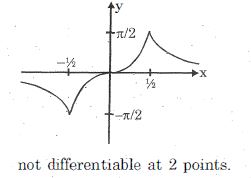
Function $f(x) = {\sin ^{ - 1}}\left( {3x - 4{x^3}} \right)$ is
  • A
    always difierentiable
  • not differentiable at $2$ points
  • C
    not continuous at $2$ points
  • D
    not differentiable at $3$ points

Answer

Correct option: B.
not differentiable at $2$ points
b

Need a full question paper?

Generate a complete, print-ready paper with questions like this in minutes — across 16+ boards, with answer keys.

Start Generating Free

Similar questions

$\int {\frac{{p{x^{p + 2q - 1}-qx^{q-1}}}}{{{x^{2p + 2q}} + 2{x^{p + q}} + 1}}dx} $ is equals :-
If the function $f(x)=\left\{\begin{array}{cl}\frac{1}{|x|} & ,|x| \geq 2 \\ a x^2+2 b, & |x|<2\end{array}\right.$ is differentiable on $R$, then $48(a+b)$ is equal to___________.
In a pack of playing cards there are 4 Ace, 4 King, 4 Queen and 4 Jack. Two cards are drawn. What is the probability getting at least one Ace?
A dice is rolled three times, the probability of getting a larger number than the previous number each time is
Using the factor theorem it is found that a + b, b + c and c + a are three factors of the determinant $\begin{vmatrix}-2\text{a}&\text{a}+\text{b}&\text{a}+\text{c}\\\text{b}+\text{a}&-2\text{b}&\text{b}+\text{c}\\\text{c}+\text{a}&\text{c}+\text{b}&-2\text{c}\end{vmatrix}$ the other factor in the value of the determinant is:
  1. 4
  2. 2
  3. a + b + c
  4. None of these.
If $A = \left[ {\begin{array}{*{20}{c}}
a&0&0\\
0&a&0\\
0&0&a
\end{array}} \right]$ ; then $|A| |adjA|$ is equal to
Let $\mathrm{A}$ and $\mathrm{B}$ be two square matrices of order $3$ such that $|A|=3$ and $|B|=2$. Then $\left|\mathrm{A}^{\mathrm{T}} \mathrm{A}(\operatorname{adj}(2 \mathrm{~A}))^{-1}(\operatorname{adj}(4 \mathrm{~B}))(\operatorname{adj}(\mathrm{AB}))^{-1} \mathrm{AA}^{\mathrm{T}}\right|$ is equal to :
The number of equivalence relations in the set $\{1,2,3\}$ containing the elements $(1,2)$ and $(2,1)$ is
If the lines $x + 2ay + a = 0, x + 3by + b = 0$ and $x + 4cy + c = 0$ are concurrent, then $a, b$  and $c$ are in :-
Evaluate: $\int\left(2^x+2^{-x}\right)^2 d x$