Question
Function $\text{f}(\text{x})=\log_\text{a}\text{x}$ is increasing on R, if:
  1. 0 < a < 1
  2. a > 1
  3. a < 1
  4. a > 0

Answer

  1. a > 1

Solution:

$\text{f}(\text{x})=\log_\text{a}\text{x}=\frac{\log\text{x}}{\log\text{a}}$

$\text{f}'(\text{x})=\frac{1}{\text{x}\log\text{a}}$

Given: f(x) is increasing on R.

$\Rightarrow\text{f}'(\text{x})>0,\forall\ \text{x}\in\text{R}$

$\Rightarrow\frac{1}{\text{x}\log\text{a}}>0,\forall\ \text{x}\in\text{R}$

$\Rightarrow\text{a}>1$

Need a full question paper?

Generate a complete, print-ready paper with questions like this in minutes — across 16+ boards, with answer keys.
Start Generating Free

Similar questions

The value of $\frac{0.76\times0.76\times0.76+0.24\times0.24\times0.24}{0.76\times0.76-0.76\times0.24+ 0.24+0.24}$is:
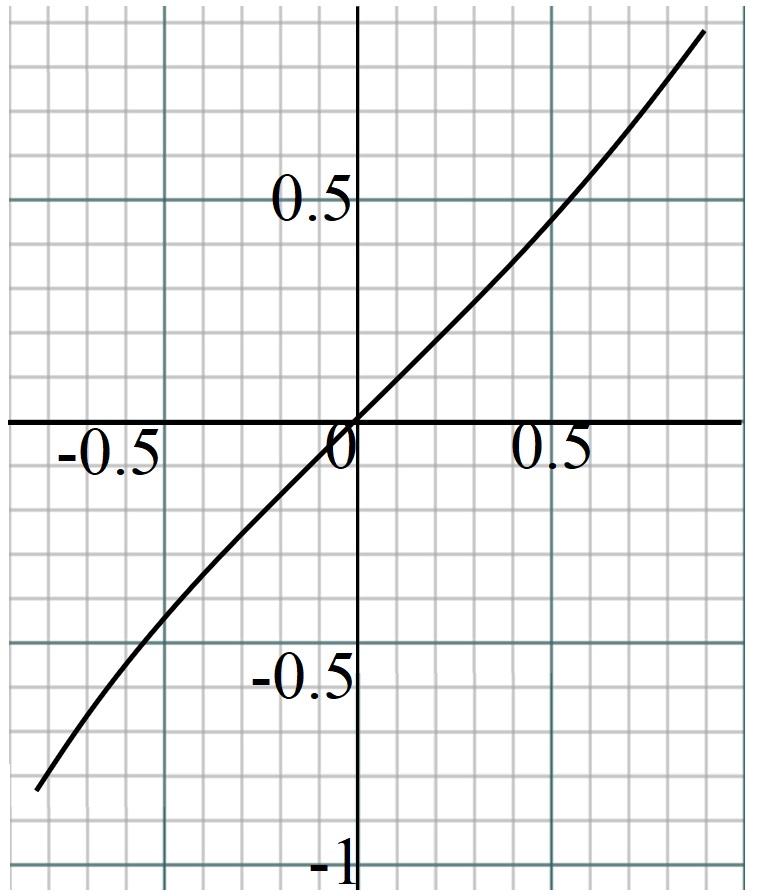
The given graph is for which equation?

  1. $\text{y}= \sin\text{x}$

  2. $\text{y} = \sin-1\text{x}$

  3. $\text{y} = \text{cosec }\text{x}$

  4. $\text{y} = \sec\text{x}$

For $x \in \left( {0,\frac{3}{2}} \right)$, let $f\left( x \right) = \sqrt x $, $g\left( x \right) = \tan \,x$ and $h\left( x \right) = \frac{{1 - {x^2}}}{{1 + {x^2}}}$. If $\phi \left( x \right) = \left( {\left( {hof} \right)og} \right)\left( x \right)$, then $\phi \left( {\frac{\pi }{3}} \right)$ is equal to
Consider the matrices : $\mathrm{A}=\left[\begin{array}{cc}2 & -5 \\ 3 & \mathrm{~m}\end{array}\right], \mathrm{B}=\left[\begin{array}{l}20 \\ \mathrm{~m}\end{array}\right]$ and $X=\left[\begin{array}{l}x \\ y\end{array}\right]$. Let the set of all $m$, for which the system of equations $\mathrm{AX}=\mathrm{B}$ has a negative solution (i.e., $\mathrm{x}<0$ and $\mathrm{y}<0$ ), be the interval ( $\mathrm{a}, \mathrm{b}$ ). Then $8 \int_a^b|\mathrm{~A}| \mathrm{dm}$ is equal to.............
The maximum value of function ${x^3} - 12{x^2} + 36x +  17$ in the interval $ [1, 10] $ is
A random variable $X$ has the following probability distribution

$X$ $1$ $2$ $3$ $4$ $5$
$P(X)$ $K^2$ $2K$ $K$ $2K$ $5K^2$

Then $\mathrm{P}(\mathrm{X}> 2)$ is equal to

The solution of the differential equation $\frac{{dy}}{{dx}} = \frac{{\left( {1 + x} \right)y}}{{\left( {y - 1} \right)x}}$ is (where $‘c’$ constant of integration)
The area bounded by curve ${y^2} = x,$ line $y = 4$ and $y -$ axis is
For any integer $n,$ the integral  $\int_0^\pi {{e^{{{\sin }^2}x}}{{\cos }^3}(2n + 1)x\,dx = } $
$\int\text{e}^{\text{x}}\Big(\frac{1-\sin\text{x}}{1-\cos\text{x}}\Big)\text{dx}=$
  1. $-\text{e}^{\text{x}}\tan\frac{\text{x}}{2}+\text{C}$
  2. $-\text{e}^{\text{x}}\cot\frac{\text{x}}{2}+\text{C}$
  3. $-\frac{1}{2}\text{e}^{\text{x}}\tan\frac{\text{x}}{2}+\text{C}$
  4. $-\frac{1}{2}\text{e}^{\text{x}}\cot\frac{\text{x}}{2}+\text{C}$