Question
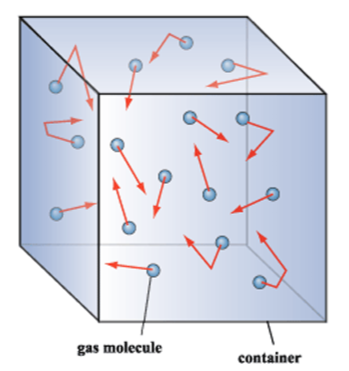
Gas molecules move in random motion inside the container. The pressure exerted by the gas is due to the continuous collision of the molecules against the walls of the container. Due to this continuous collision, the walls experience a continuous force which is equal to the total momentum imparted to the walls per second.
Image
1. If the mass of each molecule is halved and speed is doubled, find the ratio of initial and final pressure:
(a) $1: 16$ (b) $1: 4$ (c) $1: 8$ (d) $1: 2$
2. The pressure exerted by the gases is:
(a) inversely proportional to the density
(b) inversely proportional to the square of the density
(c) directly proportional to the density
(d) directly proportional to the square of the density
3. If the force of attraction between the molecules suddenly disappears, then what will be the change in pressure:
(a) pressure increase
(b) pressure decrease
(c) pressure remains constant
(d) pressure falls
4. If the pressure of a given gas is halved at a certain temperature. what will be its volume:
(a) becomes triple (b) becomes double (c) remains constant (d) becomes half
OR
Dimension formula for R ?
(a) $M ^1 L^2 T^2 K^{-1}$ (b) $M ^1 L^1 T^{-1}$
(c) $M ^{-1} L^0 T^1$ (d) $M ^1 L^2 T^{-2} K^{-1}$
Answer

1. (d) $1: 2$
Explanation: 1:2
2. (c) directly proportional to the density
Explanation: directly proportional to the density
3. (a) pressure increase
Explanation: pressure increase
4. (b) becomes double
Explanation: becomes double
OR
(d) $M ^1 L^2 T^{-2} K^{-1}$
Explanation: $M ^1 L^2 T^{-2} K^{-1}$

Need a full question paper?

Generate a complete, print-ready paper with questions like this in minutes — across 16+ boards, with answer keys.

Start Generating Free

Similar questions

Read the passage given below and answer the following questions from 1 to 5.
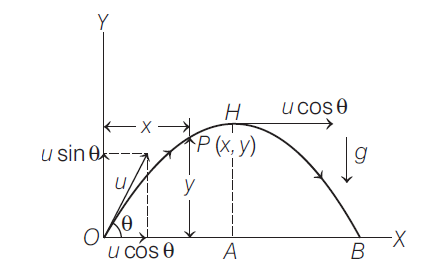
Projectile motion is a form of motion in which an object or particle is thrown with some initial velocity near the earth’s surface and it moves along a curved path under the action of gravity alone. The path followed by a projectile is called its trajectory, which is shown below. When a projectile is projected obliquely, then its trajectory is as shown in the figure below.

Here velocity u is resolved into two components, we get (a) u cosθ along OX and (b) u sinθ along OY.
  1. The example of such type of motion is:
  1. Motion of car on a banked road.
  2. Motion of boat in sea.
  3. A javelin thrown by an athlete.
  4. Motion of ball thrown vertically upward.
  1. The acceleration of the object in horizontal direction is:
  1. Constant
  2. Decreasing
  3. Increasing
  4. Zero
  1. The vertical component of velocity at point H is:
  1. Maximum
  2. Zero
  3. Double to that at O
  4. Equal to horizontal component
  1. A cricket ball is thrown at a speed of 28m/s in a direction 30° with the horizontal. The time taken by the ball to return to the same level will be:
  1. 2.0s
  2. 3.0s
  3. 4.0s
  4. 2.9s
  1. In above case, the distance from the thrower to the point where the ball returns to the same level will be:
  1. 39m
  2. 69m
  3. 68m
  4. 72m
TV signals broadcast by Delhi studio cannot be directly received at Patna which is about 1000km away. But the same signal goes some 36000km away to a satellite, gets reflected and is then received at Patna. Explain.
The weight Mg of an extended body is generally shown in a diagram to act through the centre of mass. Does it mean that the earth does not attract other particles?
Read the passage given below and answer the following questions from 1 to 5.

According to Hooke’s law, within the elastic limit, the stress applied to a body is directly proportional to the corresponding strain.

$\text{Stress}\propto\text{Strain}$ or Stress = E × Strain or $\frac{\text{Stress }}{\text{Strain}}=\text{E}$

Where E is the constant of proportionality and is known as coefficient of elasticity or modulus of elasticity. Hooke’s law is an empirical law and is found to be valid for most materials. However, there are some materials which do not exhibit this linear relationship.

  1. According to Hooke’s law of elasticity, if stress is increased, the ratio of stress to strain:
  1. Decreases
  2. Increases
  3. Becomes zero
  4. Remains constant
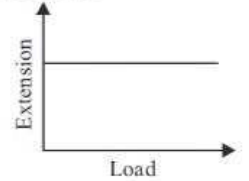
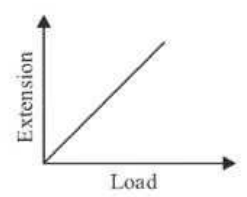
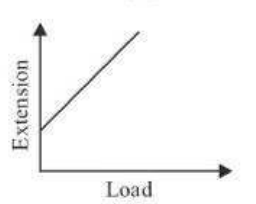
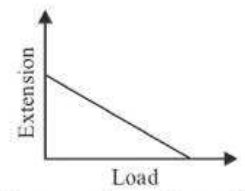
  1. Within elastic limit, which of the following graphs correctly represents the variation of extension in the length of a wire with the external load?


  1. According to Hooke’s law, ifstressis reduced to one-third, the ratio of stress to strain:
  1. Is increased to three time
  2. Is decreased
  3. Is zero
  4. Remains constant.
  1. Hooke’s law defines:
  1. Stress
  2. Strain
  3. Modulus of elasticity
  4. Elastic limit.
  1. Whenever a material is loaded with elasitic limits, stress is ......... strain.
  1. Equal to
  2. Directly proportional to
  3. Inxessely propotional to
  4. None of the above given remains constant.
At a prayer meeting, the disciples sing JAI-RAM JAI-RAM. The sound amplified by a loudspeaker comes back after reflection from a building at a distance of 80m from the meeting. What maximum time interval can be kept between one JAI-RAM and the next JAI-RAM so that the echo does not disturb a listener sitting in the meeting. Speed of sound in air is 320m/s.
A string of mass 2.50 kg is under a tension of 200 N. The length of the stretched string is 20.0 m. If the transverse jerk is struck at one end of the string, how long does the disturbance take to reach the other end?
Read the passage given below and answer the following questions from 1 to 5.
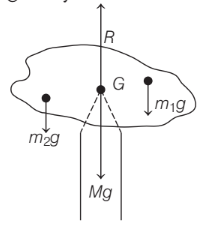
Torque and Centre of Gravity Torque is also known as moment of force or couple. When a force acts on a particle, the particle does not merely move in the direction of the force but it also turns about some point. So, we can define the torque for a particle about a point as the vector product of position vector of the point where the force acts and with the force itself. In the given figure, balancing of a cardboard on the tip of a pencil is done. The point of support, G is the centre of gravity.

  1. If the Fnet, ext is zero on the cardboard, it means:
  1. R = Mg
  2. m1 g = Mg
  3. mg = Mg
  4. $ \text{R}=\frac{\text{m}_1}{\text{g}}$
  1. Choose the correct option.
  1. $\tau \text{Mg about CG =0}$
  2. $\tau \text{Rabout CG =0}$
  3. Net $\tau$ due to m1 g, m2 g...., mg about CG = 0
  4. All of the above
  1. The centre of gravity and the centre of mass of a body coincide, when:
  1. g is negligible
  2. g is variable
  3. g is constant
  4. g is zero
  1. If value of g varies, the centre of gravity and the centre of mass will:
  1. coincide
  2. not coincide
  3. become same physical quantities
  4. None of the above
  1. A body lying in a gravitational field is in stable equilibrium, if:
  1. vertical line through CG passes from top
  2. horizontal line through CG passes from top
  3. vertical line through CG passes from base
  4. horizontal line through CG passes from base
A bar magnet makes 40 oscillations per minute in an oscillation magnetometer. An identical magnet is demagnetized completely and is placed over the magnet in the magnetometer. Find the time taken for 40 oscillations by this combination. Neglect any induced magnetism.
When a tyre bursts, the air coming out is cooler than the surrounding air. Explain.