Question
Need a full question paper?
Generate a complete, print-ready paper with questions like this in minutes — across 16+ boards, with answer keys.
Explore more
Similar questions
The oxygen molecule has a mass of 5.30 × $10^{-28} kg$ and a moment of inertia of $1.94 \times 10^{-46} kg m ^2$ about an axis through its centre perpendicular to the lines joining the two atoms. Suppose the mean speed of such a molecule in a gas is $500 m / s$ and that its kinetic energy of rotation is two thirds of its kinetic energy of translation. Find the average angular velocity of the molecule.
→Read the passage given below and answer the following questions from (i) to (v). There are no physical examples of absolutely pure simple harmonic motion. In practice we come across systems that execute simple harmonic motion approximately under certain conditions. Oscillations due to a spring: The simplest observable example of simple harmonic motion is the small oscillations of a block of mass m fixed to a spring, which in turn is fixed to a rigid wall. The block is placed on a frictionless horizontal surface. If the block is pulled on one side and is released, it then executes a to and fro motion about the mean position. Let x = 0, indicate the position of the centre of the block when the spring is in equilibrium. The positions marked as –A and +A indicate the maximum displacements to the left and the right of the mean position. We have already learnt that springs have special properties, which were first discovered by the English physicist Robert Hooke. He had shown that such a system when deformed is subject to a restoring force, the magnitude of which is proportional to the deformation or the displacement and acts in opposite direction. This is known as Hooke’s law. It holds good for displacements small in comparison to the length of the spring. At any time t, if the displacement of the block from its mean position is x, the restoring force F acting on the block is, F(x) = –k x The constant of proportionality, k, is called the spring constant, its value is governed by the elastic properties of the spring. A stiff spring has large k and a soft spring has small k. Equation is same as the force law for SHM and therefore the system executes a simple harmonic motion.
Damped oscillations
We know that the motion of a simple pendulum, swinging in air, dies out eventually. Why does it happen? This is because the air drag and the friction at the support oppose the motion of the pendulum and dissipate its energy gradually. The pendulum is said to execute damped oscillations. In damped oscillations, the energy of the system is dissipated continuously; but, for small damping, the oscillations remain approximately periodic. The dissipating forces are generally the frictional forces. The damping force is generally proportional to velocity of the bob and acts opposite to the direction of velocity. If the damping force is denoted by Fd, we have Fd = –bv where the positive constant b depends on characteristics of the medium (viscosity, for example) and the size and shape of the block, is usually valid only for small velocity.- Damping force is directly proportional to:
- Velocity
- Area
- Acceleration
- None of these
- Oscillations due to spring performs SHM for:
- Only small oscillations of spring
- Only for large oscillations of spring
- Both large as well as small oscillations of spring
- None of these
- Give expression for restoring force in spring while performing small SHM oscillations.
- Explain damped oscillations.
- Explain oscillations due to spring.
A sample contains a mixture of 108Ag and 110Ag isotopes each having an activity of 8.0 × 10⁸ disintegration per second. 110Ag is known to have larger half-life than 108Ag. The activity A is measured as a function of time and the following data are obtained.
→| Time (s) | Activity (A) (108 disinte- grations s-1) | Time (s) | Activity (A) (108 disinte-grations s-1) |
| 20 | 11.799 | 200 | 3.0828 |
| 40 | 9.1680 | 300 | 1.8899 |
| 60 | 7.4492 | 400 | 1.1671 |
| 80 | 6.2684 | 500 | 0.7212 |
| 100 | 5.4115 |
- Plot ln $\Big(\frac{\text{A}}{\text{A}_0}\Big)$ versus time.
- See that for large values of time, the plot is nearly linear. Deduce the half-life of 110Ag from this portion of the plot.
- Use the half-life of 110Ag to calculate the activity corresponding to 108Ag in the first 50s.
- Plot In $\Big(\frac{\text{A}}{\text{A}_0}\Big)$ versus time for 108Ag for the first 50s.
- Find the half-life of 108Ag.
Read the passage given below and answer the following questions from 1 to 5.
What happens if a pulse or a wave meets a boundary? If the boundary is rigid, pulse travelling along a stretched string and being reflected by the boundary. Assuming there is no absorption of energy by the boundary, the reflected wave has the same shape as the incident pulse i.e. crest is reflected as crest and trough as trough but it suffers a phase change of π or 1800 on reflection. This is because the boundary is rigid and the disturbance must have zero displacement at all times at the boundary. By the principle of superposition, this is possible only if the reflected and incident waves differ by a phase of π, so that the resultant displacement is zero. This reasoning is based on boundary condition on a rigid wall. If on the other hand, the boundary point is not rigid but completely free to move (such as in the case of a string tied to a freely moving ring on a rod), the reflected pulse has the same phase and amplitude (assuming no energy dissipation) as the incident pulse. The net maximum displacement at the boundary is then twice the amplitude of each pulse. An example of non- rigid boundary is the open end of an organ pipe. To summaries, a travelling wave or pulse suffers a phase change of π on reflection at a rigid boundary and no phase change on reflection at an open boundary. We considered above reflection at one boundary. But there are familiar situations (a string fixed at either end or an air column in a pipe with either end closed) in which reflection takes place at two or more boundaries. In a string, for example, a wave travelling in one direction will get reflected at one end, which in turn will travel and get reflected from the other end. This will go on until there is a steady wave pattern set up on the string. Such wave patterns are called standing waves or stationary waves.
What happens if a pulse or a wave meets a boundary? If the boundary is rigid, pulse travelling along a stretched string and being reflected by the boundary. Assuming there is no absorption of energy by the boundary, the reflected wave has the same shape as the incident pulse i.e. crest is reflected as crest and trough as trough but it suffers a phase change of π or 1800 on reflection. This is because the boundary is rigid and the disturbance must have zero displacement at all times at the boundary. By the principle of superposition, this is possible only if the reflected and incident waves differ by a phase of π, so that the resultant displacement is zero. This reasoning is based on boundary condition on a rigid wall. If on the other hand, the boundary point is not rigid but completely free to move (such as in the case of a string tied to a freely moving ring on a rod), the reflected pulse has the same phase and amplitude (assuming no energy dissipation) as the incident pulse. The net maximum displacement at the boundary is then twice the amplitude of each pulse. An example of non- rigid boundary is the open end of an organ pipe. To summaries, a travelling wave or pulse suffers a phase change of π on reflection at a rigid boundary and no phase change on reflection at an open boundary. We considered above reflection at one boundary. But there are familiar situations (a string fixed at either end or an air column in a pipe with either end closed) in which reflection takes place at two or more boundaries. In a string, for example, a wave travelling in one direction will get reflected at one end, which in turn will travel and get reflected from the other end. This will go on until there is a steady wave pattern set up on the string. Such wave patterns are called standing waves or stationary waves.
- A travelling wave or pulse suffers a phase change of π on reflection at:
- A rigid boundary
- Open boundary
- A travelling wave or pulse suffers no phase change on reflection at:
- A rigid boundary
- Open boundary
- What are stationary waves?
- Write a note on reflection of travelling wave from rigid boundary.
- Write a note on reflection of travelling wave from open boundary.
The figure shows two identical triode tubes connected in parallel. The anodes are connected together and the cathodes are connected together. Show that the equivalent plate resistance is half the individual plate resistance, the equivalent mutual conductance is double the
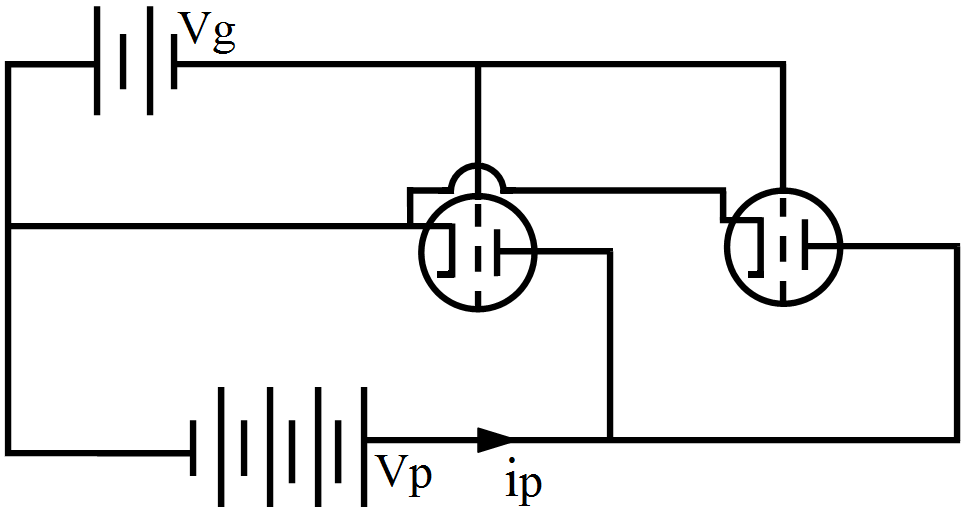
individual mutual conductance and the equivalent amplification factor is the same as the individual amplification factor.
individual mutual conductance and the equivalent amplification factor is the same as the individual amplification factor.
An air bubble, whose volume is $1.0 cm^3$ rises from the bottom of a 40 m deep lake where the temperature is $12^{\circ} C$ and comes to the surface where the temperature is $35^{\circ} C$. Now what will be its volume?
→A person's skin is more severely burnt when put in contact with 1g of steam at 100°C than when put in contact with 1g of water at 100°C. Explain.
A short magnet oscillates in an oscillation magnetometern with a time period of 0.10s where the earth's horizontal magnetic field is $24\mu\text{T}.$ A downward current of 18 A is established in a vertical wire placed 20cm east of the magnet. Find the new time period.
→Read the passage given below and answer the following questions from (i) to (v).
All engineering phenomena deal with definite and measured quantities and so depend on the making of the measurement. We must be
clear and precise in making these measurements. To make a measurement, magnitude of the physical quantity (unknown) is compared.
The record of a measurement consists of three parts, i.e. the dimension of the quantity, the unit which represents a standard quantity and a number which is the ratio of the measured quantity to the standard quantity.
All engineering phenomena deal with definite and measured quantities and so depend on the making of the measurement. We must be
clear and precise in making these measurements. To make a measurement, magnitude of the physical quantity (unknown) is compared.
The record of a measurement consists of three parts, i.e. the dimension of the quantity, the unit which represents a standard quantity and a number which is the ratio of the measured quantity to the standard quantity.
- A device which is used for measurement of length to an accuracy of about 10-5m, is:
- Screw gauge
- Spherometer
- Vernier callipers
- Either (a) or (b)
- Which of the technique is not used for measuring time intervals?
- Electrical oscillator
- Atomic clock
- Spring oscillator
- Decay of elementary particles
- The mean length of an object is 5cm. Which of the following measurements is most accurate?
- 4.9cm
- 4.805cm
- 5.25cm
- 5.4cm
- If the length of rectangle l = 10.5cm, breadth b = 2.1cm and minimum possible measurement by scale = 0.1cm, then the area is:
- 22.0cm2
- 21.0cm2
- 22.5cm2
- 21.5cm2
- Age of the universe is about 1010 yr, whereas the mankind has existed for 106 yr. For how many seconds would the man have existed, if age of universe were 1 day?
- 9.2s
- 10.2s
- 8.6s
- 10.5s
If you are walking on the moon, can you hear the sound of stones cracking behind you? Can you hear the sound of your own footsteps?