MCQ
Which one of the following statement is false:
  • Work is a state finction.
  • B
    Temperature is a state function.
  • C
    Change in the state is completely defined when the initial and final states are specified.
  • D
    Work appears at the boundary of the system.
Answer

Correct option: A.
Work is a state finction.

Majority carrier in a $n −$ type semiconductor are holes. This statement is false.
Since, in $n−$type semiconductor, the pentavalent impurity atoms donate electrons o the host crystal and the semiconductor doped with donars $($pentavalent impurity$)$ is called $n −$ type semiconductor.
Therefore majority carrier in a $n−$type semiconductor are electrons.

Need a full question paper?

Generate a complete, print-ready paper with questions like this in minutes — across 16+ boards, with answer keys.

Start Generating Free

Similar questions

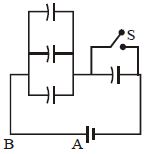
Four capacitors of capacitance $10\,mF$ and a battery of $200\,V$ are arranged as shown. How much charge will flow through $AB$ after the switch $S$ is closed .....$\mu C$
Fusion reactions take place at high temperature because:
The electric potential inside a conducting sphere:
An element $A$ decays into element $C$ by a two step process :

$A \to B + {\;_2}H{e^4}$

$B \to C + \;2{e^ - }$

Then

An observer looks at a distant tree of height $10\ m$ with a telescope of magnifying power of $20$. To the observer the tree appears :
When a 12 Ω resistor is connected with a moving coil galvanometer then its deflection reduces from 50 divisions to 10 divisions. The resistance of the galvanometer is
In a medium, the force of attraction between two point charges, distance $d$ apart, is $F$. What distance apart should these point charges be kept in the same medium, so that the force between them becomes $16\, F$ ?
Two metal spheres, one of radus $R$ and the other of radius $2 R$ respectively have the same surface charge density $\sigma$. They are brought in contact and separated. What will be the new surface charge densities on them?
Parallel rays are incident on a thick plano-convex lens having radius of curvature $R$, refractive index $μ$ and thickness $t$. When rays are incident on plane surface they converge at a distance $x$ from plane surface. When rays are incident on curved surface then rays converge at $y$ distance from curved surface. Then
A capacitor with air as the dielectric is charged to a potential of 100 volts. If the space between the plates is now filled with a dielectric of dielectric constant 10, the potential difference between the plates will be