Electric Charges and Fields — Physics STD 12 Science — Question
Rajasthan BoardEnglish MediumSTD 12 SciencePhysicsElectric Charges and Fields3 Marks
Question
Get the electric field due to a uniformly charged thin spherical shell.
✓
Answer
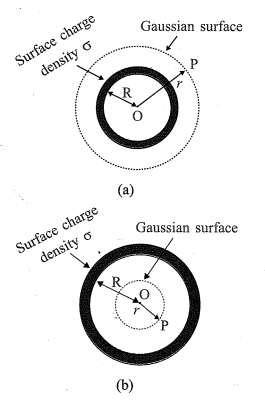
$►$Let $\sigma$ be the uniform surface charge density of a thin spherical shell of radius $R ($Fig.$).$
$(i)$ Field outside the shell :
$►$Consider a point $P$ outside the shell with radius vector $r$ Fig. $(a).$
$►$To calculate $E$ at $P$ , we take the Gaussian surface to be a sphere of radius $r$ and with centre $O$, passing through $P$ . All points on this sphere are equivalent relative to the given charged configuration.
$►$According to Gauss's law,
$\overrightarrow{ E } \cdot \overrightarrow{ S }=\frac{q}{\varepsilon_0}$
$\therefore E \cdot S \cos 0=\frac{q}{\varepsilon_0}$
$\therefore ES =\frac{q}{\varepsilon_0}$
$\text { But } S = 4 \pi r^2 \text { (area of Gaussian surface) }$
$\text { and } q= \sigma A (\text { Where } A \text { - area of spherical shell) }$
$= \sigma\left(4 \pi R ^2\right)$
But $S =4 \pi r^2 ($area of Gaussian surface$)$
and $q=\sigma A ($Where $A -$ area of spherical shell$)$
$($Total charge on spherical shell.$)$
$►$From equation $(1),$
$\therefore E \left(4 \pi r^2\right)=\frac{\sigma\left(4 \pi R ^2\right)}{\varepsilon_0}$
$\therefore E =\frac{\sigma R ^2}{\varepsilon_0 r^2}$
$►$But $\sigma=\frac{q}{A}=\frac{q}{4 \pi R ^2}$,
$\therefore E =\frac{1}{4 \pi \varepsilon_0} \cdot \frac{q}{r^2} ($From Eq. $(2))$
$►$The electric field is directed outward if $q>0$ and inward if $q<0$. This, however, is exactly the field produced by a charge q placed at the centre $O .$
Thus for points outside the shell, the field due to a uniformaly charged shell is as if the entire charge of the shell is concentrated at its centre.
$(ii)$ Field inside the shell :
$►$In Fig. $(b),$ the point $P$ is inside the shell. The Gaussian surface is again a sphere through $P$ centred at $O$ .
$►$Gaussian surface encloses no charge. From Gauss's law then gives the field due to a uniformly charged thin shell is zero at all points inside the shell.
Need a full question paper?
Generate a complete, print-ready paper with questions like this in minutes — across 16+ boards, with answer keys.