Question
Give an example of disproportionation reaction.

Answer

Chlorine is getting oxidised as well as reduced.
$\therefore$ It is disproportionation reaction.
$\text{Cl}_2+2\text{NaOH}\xrightarrow{ \ \ \ \ \ \ \ }\text{NaCl}+\text{NaClO}+\text{H}_2\text{O}\\ \ 0 \ \ \ \ \ \ \ \ \ \ \ \ \ \ \ \ \ \ \ \ \ \ \ \ \ \ \ \ \ \ \ {-1}\ \ \ \ \ \ \ \ \ \ \ {+1}$

Need a full question paper?

Generate a complete, print-ready paper with questions like this in minutes — across 16+ boards, with answer keys.

Start Generating Free

Similar questions

Empirical formula of a compound X (molar mass 78g mol-1) is CH. Write its molecular formula.
Define limiting reagent.

OR

What is limiting reactant in a reaction?

$\text{CaCl}_2(\text{s})+\text{aq}\rightleftharpoons\text{CaCl}_2(\text{aq})+\text{Heat}$
Discuss the solubility if temperature is increased.
In a container of 5 L volume, in a vessel at 1250 K temperature following reaction takes place :
$
CO(g)+H_2 O(g) \rightleftharpoons CO_2(g)+H_2(g)
$
Initially one-one mole of CO and $H _2 O$ is taken and at equilibrium 0.4 mole $H _2 O$ remains then calculate equilibrium constant.
Calculate the heat of combustion of glucose from the following data:

$\text{C(graphite)}+\text{O}_2(\text{g})\overrightarrow{\ \ \ \ \ }\text{CO}_2(\text{g});$ $\Delta\text{H}=-395.0\text{kJ mol}^{-1}$

$\text{H}_2(\text{g})+\frac{1}{2}\text{O}_2(\text{g})\overrightarrow{\ \ \ \ \ \ \ }\text{H}_2\text{O(l)};$ $\Delta\text{H}=-269.4\text{kJ mol}^{-1}$

$6\text{C(graphite)}+6\text{H}_2(\text{g})+\text{O}_2(\text{g})\overrightarrow{\ \ \ \ \ \ }\text{C}_6\text{H}_{12}\text{O}_6(\text{s});$ $\Delta\text{H}=-1169.8\text{kJ mol}^{-1}$
Calculate the wavelength, frequency and wavenumber of a light wave whose period is $2.0 \times$ $10^{-10} s$.
What are the atomic numbers of elements whose outermost electrons are represented by
  1. 3s1
  2. 2p3
  3. 3p5?
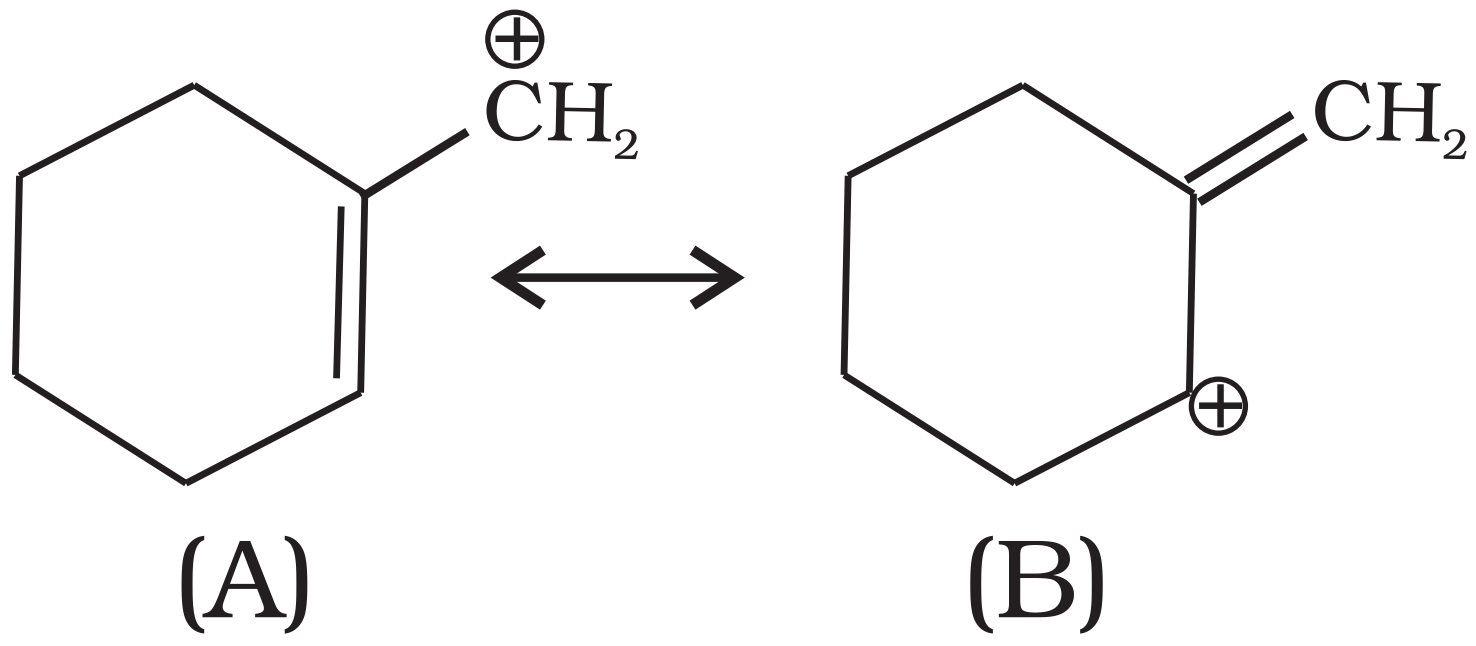
“Stability of carbocations depends upon the electron releasing inductive effect of groups adjacent to positively charged carbon atom involvement of neighbouring groups in hyperconjugation and resonance.”
Which of the following ions is more stable? Use resonance to explain your answer.

What is the effect of increasing pressure on the equilibrium?
$\text{N}_2(\text{g})+3\text{H}_2(\text{g})\rightleftharpoons2\text{NH}_3(\text{g})$
Equilibrium constant, $K_c$ for the reaction $N _2(g)+3 H _2(g) \rightleftharpoons 2 NH _3(g)$ at 500 K is 0.061
At a particular time, the analysis shows that composition of the reaction mixture is $3.0 mol L ^{-1} N_2$, $2.0 mol L ^{-1} H _2$ and $0.5 mol L ^{-1} NH _3$. Is the reaction at equilibrium? If not in which direction does the reaction tend to proceed to reach equilibrium?