Question
Give brief explanation of modern solid state semi-conductor electronics.

Answer

The seed of the development of the modern solid-state semiconductor electronics goes back to 1930 's.
Then it was realized that some solid state semiconductors and their junctions offer the possibility of controlling the number and the direction of flow of charge carriers through them.
Simple excitations like light, heat or small applied voltage can change the number of mobile charges in a semiconductor, and hence can control the current. which means they act as a catalyst.
Note that the supply and flow of charge carriers in the semiconductor devices are within the solid itself.
Unlike the vacuum tubes/valves, no external heating or large evacuated space is required by the semi-conductor devices.
They are small in size, consume low power, operate at low voltages and have long life and high reliability.
Even the Cathode Ray Tubes (CRT) used in television and computer monitors which work on the principle of vacuum tubes are being replaced by Liquid Crystal Display (LCD) monitors with supporting solid state electronics.
Much before the full implications of the semiconductor devices were formally understood, a naturally occurring crystal of galena (lead sulphide, PbS ) with a metal point contact attached to it was used as a detector of radio waves.
Need a full question paper?

Generate a complete, print-ready paper with questions like this in minutes — across 16+ boards, with answer keys.

Start Generating Free

Similar questions

Sketch the magnetic field lines for a current-carrying circular loop near its centre. Replace the loop by an equivalent magnetic dipole and sketch the magnetic field lines near the centre of the dipole. Identify the difference.
Compare the direction of the magnetic field inside a solenoid with that of the field there if the solenoid is replaced by its equivalent combination of north pole and south pole.
A metallic rod of 'L' length is rotated with angular frequency of '$\omega$' with one end hinged at the centre and the other end at the circumference of a circular metallic ring of radius L, about an axis passing through the centre and perpendicular to the plane of the ring. A constant and uniform magnetic field B parallel to the axis is present everywhere. Deduce the expression for the emf between the centre and the metallic ring.
Explain the excited states for the hydrogen atom.
In some old texts it is mentioned that $4\pi$ lines of force originate from each unit positive charge. Comment on the statement in view of the fact that $4\pi$ is not an integer.
The fundamental frequency of a closed pipe is 293Hz when the air in it is at a temperature of $20^\circ C$. What will be its fundamental frequency when the temperature changes to $22^\circ C?$
Write applications of the resonance phenomenon in the $L - C - R$ series circuit.
When rubber sheets are used in a shock absorber, what happens to the energy of vibration?
What will be the effect on inductive reactance XL and capacitive reactance XC if frequency of ac source is increased?
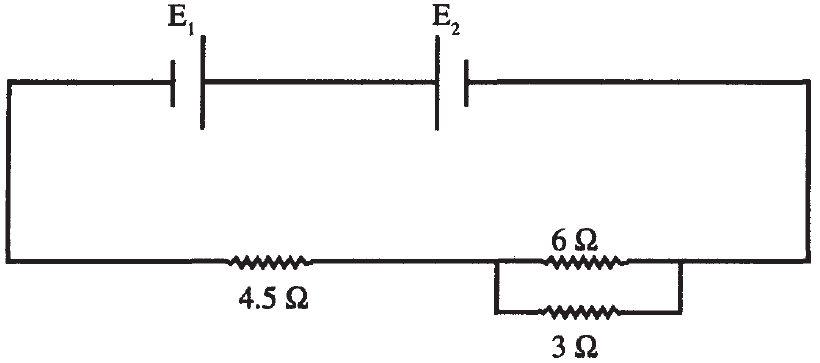
Two cells $E_1$ and $E_2$ in the given circuit diagram have an emf of 5 V and 9 V and internal resistance of 0.3 $\Omega$ and 1.2 $\Omega$ respectively.
Calculate the value of current flowing through the resistance of 3 $\Omega$.