→When we drop a small stone on a calm pool of water, waves spread out from the point of impact. Every point on the surface starts oscillating with time.
→At any instant the photograph of the surface would show circular rings, on which the disturbance is maximum. Clearly, all points on such a circle are oscillating in phase, because they are at the same distance from the source.
→Such a locus of points, which oscillate in phase is called a wave front.
→Thus, a wave front is defined as a surface of constant phase.
[In other words, "an imaginary surface passing through all the points oscillating in phase is called a wave front."
→The speed with which the wave front moves outwards from the source is called the speed of the wave. The energy of the wave travels in a direction perpendicular to the wave front.
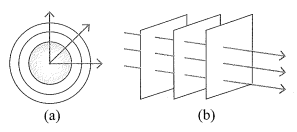 →
→If we have a point source emitting waves uniformly in all directions, then the locus of points which have the same amplitude and vibrate in the same phase are spheres, and we will have what is known as a spherical wave as shown in fig. (a).
→At a large distance from the source, a small portion of the sphere can be considered as a plane, and we will have what is known as a plane wave. [fig.(b)]