Question 13 Marks
Write Huygen's principle and explain how a new spherical wave front is formed after a very small time interval.
Answer
View full question & answer→• Huygen's principle :
"Every point or particle of a wavefront behaves as an independent secondary source, emits by itself secondary spherical waves. After a very small time interval the surface tangential to all such secondary spherical wavelets gives the position and shape of the new wavefront."
→[Alternatively, "Each point of the wavefront is the source of a secondary disturbance and the wavelets emanating from these points spread out in all directions with the speed of the wave. These wavelets emanating from the wavefront are usually referred to as secondary wavelets and if we draw a common tangent to all these spheres, we obtain the new position of the wave front at a later time."]
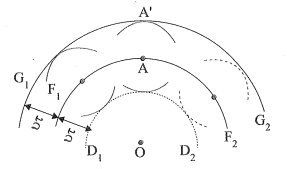
→As shown in the Fig, $F _1 F_2$ represents the spherical wave front (with O as Centre) at $t=0$.
→As per Huygen's principle each point on the wavefront behaves as a secondary source and the waves emanating from these point spread equally in all directions at the speed of wave. If we wish to determine the shape of the wave front at $t=\tau$, we draw spheres of radius $v \tau$ from each point on the spherical wave front where $v$ represents the speed of the waves in the medium.
→If we now draw a common tangent to all these spheres, we obtain the new position of the wave front at $t =\tau$.
→The new wavefront is shown in the Fig. as $G _1 G _2$, which is again a spherical with point ' O ' as centre.
"Every point or particle of a wavefront behaves as an independent secondary source, emits by itself secondary spherical waves. After a very small time interval the surface tangential to all such secondary spherical wavelets gives the position and shape of the new wavefront."
→[Alternatively, "Each point of the wavefront is the source of a secondary disturbance and the wavelets emanating from these points spread out in all directions with the speed of the wave. These wavelets emanating from the wavefront are usually referred to as secondary wavelets and if we draw a common tangent to all these spheres, we obtain the new position of the wave front at a later time."]
→As shown in the Fig, $F _1 F_2$ represents the spherical wave front (with O as Centre) at $t=0$.
→As per Huygen's principle each point on the wavefront behaves as a secondary source and the waves emanating from these point spread equally in all directions at the speed of wave. If we wish to determine the shape of the wave front at $t=\tau$, we draw spheres of radius $v \tau$ from each point on the spherical wave front where $v$ represents the speed of the waves in the medium.
→If we now draw a common tangent to all these spheres, we obtain the new position of the wave front at $t =\tau$.
→The new wavefront is shown in the Fig. as $G _1 G _2$, which is again a spherical with point ' O ' as centre.