Question
Give four differences between a Bill of Exchange and a Promissory Note.

Answer

Differences between a Bill of Exchange and a Promissory Note.
 
Basis
Bill of Exchange
Promissory Note
1.
Drawer
Creditor is the Drawer.
Debtor is the Drawer.
2.
Orther/ Promise
It is an order to pay.
It is a promise to pay.
3.
acceptance
It needs acceptance by the Drawee.
It does not need acceptance by the Drawee.
4.
Parties
It has three paeties namely-Drawer, Drawee and Payee.
It has two parties namely-Promisor and Payee.
5.
Liability
Liability of the drawer arises only if the acceptor does not pay.
Promisor has the primary liability to pay.
6.
Copies
In case of foreign bills, three copies are made but otherwise only one copy is prepared.
Only one copy is prepared whether it is foreign or local.
7.
Stamp
Bill payable on demand need not to be stamped but otherwise stamps would be necessary.
It has to be stamped in any case.

Need a full question paper?

Generate a complete, print-ready paper with questions like this in minutes — across 16+ boards, with answer keys.
Start Generating Free

Similar questions

On 31st December, 2014 my Cash Book showed a credit balance of ₹ 8,800. I had paid into Bank three cheques amounting to ₹ 6,000 on 24th December of which I found ₹ 3,200 have been credited in the Pass Book under date 5th January 2015. I had issued cheques amounting to ₹ 8,000 before 31st December of which I found ₹ 2,500 have been debited in the Pass Book after 1st January 2015. I find a debit of ₹ 50 in respect of bank charges in the Pass Book which I have adjusted in the Cash Book on 31st Dec. There is a credit of ₹ 360 for interest on securities in the Pass Book which remains to be adjusted. A cheque of ₹ 1,200 deposited into bank has been dishonoured.
Prepare Bank Reconciliation Statement as on 31st Dec. 2014.
On 31st March, 2015 the Pass Book of Mr. Janaki Dass showed a credit balance of ₹ 20,600. Prepare a Bank Reconciliation Statement from the following information:
  1. Cheques amounting to ₹ 15,000 were drawn in March 2015, out of which cheques for ₹ 5,500 were presented for payment on 3rd April.
  2. A cheque for ₹ 5,475 was deposited into the bank, but wrongly entered in the Cash Book as ₹ 5,745.
  3. A cheque of ₹ 5,000 which was received from a customer was entered in the cash column of the Cash Book in March 2015 but was omitted to be banked in the month of March.
  4. A B/P of ₹ 10,000 was retired by the bank under a rebate of ₹ 100 but the full amount of the bill was credited in the Cash Book.
  5. Bank charges entered in the Cash Book twice ₹ 200.
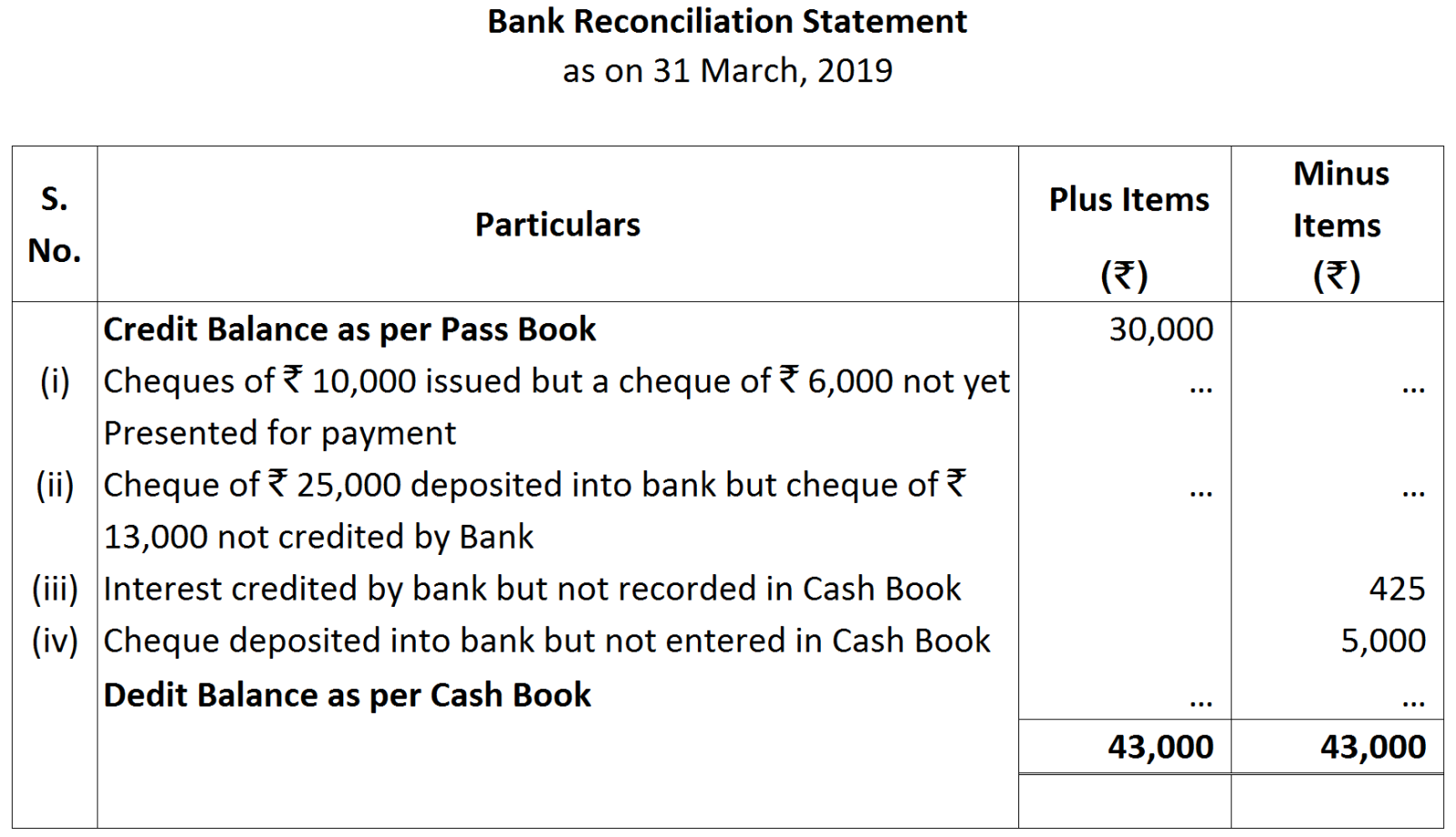
In the following Bank Reconciliation Statement. determine the missing amounts:
Define depreciation. State any two reasons for providing depreciation.
How does a Cash Book serve 'Dual Purpose?
From the following particulars, prepare a, bank reconciliation statement as at March 31, 2017.
  1. Balance as per cash book ₹ 3,200
  2. Cheque issued but not presented for payment₹ 1,800
  3. Cheque deposited but not collected upto March 31, 2014 ₹ 2000
  4. Bank charges debited by bank ₹ 150
On 10th January, 2017, A sells goods to B for ₹ 12,000. On that date, B accepted a bill drawn upon him by A at two months for ₹ 12,000. A retains the bill till due date and on due date sends the bill to the Banker for collection. In due course, A receives the information from the Bank that the bill has been duly met.
Pass Journal Entries in the books of A and B.
“Only financial transactions are recorded in Accountancy.” Explain the statement.
Prepare Accounting Equation on the basis of the following transactions:
  1. Started business with cash ₹ 70,000.
  2. Credit purchase of goods ₹ 18,000.
  3. Payment made to creditors in full settlement ₹ 17,500.
  4. Purchase of machinery for cash ₹ 20,000.
From the following ledger balances prepare trial balance:Capital ₹ 20,800, Rent outstanding ₹ 1,420, Amount due to Param, ₹ 15,000, Drawing ₹ 2,800, Goodwill ₹ 12,000, Interest received ₹ 2,000, Discount received ₹ 1,580, Amount due from Deepan ₹ 26,000.