Question types

Bills of Exchange question types

170 questions across 7 question groups — pick any mix to generate a Account paper with step-by-step answer keys.

170
Questions
7
Question groups
5
Question types
Sample Questions

Bills of Exchange questions

One sample from each question group in this chapter. Select any group above to see the full set with answer keys.

Under what circumstances the drawer and the payee is the same person, with reference to a bill of exchange?
  • A
    When the drawer discounts the bill with the banker.
  • B
    When the drawer endorses the bill to a third party.
  • When the drawer holds the bill till the date of maturity.
  • D
    When the drawee dishonour the bill.

Answer: C.

View full solution
Sohan draws a 40 days bill on Rohan on 20th January, 2010. The bill matures on
  • March 4, 2010
  • B
    February 28, 2010
  • C
    March 1, 2010
  • D
    None of these.

Answer: A.

View full solution
If a bill is accepted and the payment is made before the due date of maturity, the difference between the paid amount and the bill amount will be called as ..........
  • A
    Interest.
  • B
    Discount.
  • Rebate.
  • D
    Commission.

Answer: C.

View full solution
A draws a bill on B for ₹ 30,000. A endorses it to C in settlement of ₹ 35,000 at 2% discount with the help of B’s acceptance and the balance in cash. If the bill is dishonoured on the due date, by what amount will C debit A?
  • A
    ₹ 30,000
  • B
    ₹ 35,000
  • C
    ₹ 34,300
  • ₹ 30,700

Answer: D.

View full solution
Bill is drawn on 20th January, 2010 for 2 months. After sight date of acceptance is 29th January, 2010. The maturity date of bill will be:
  • 1 April, 2010
  • B
    23 March, 2010
  • C
    20 March, 2010
  • D
    29 March, 2010

Answer: A.

View full solution
State the account to bre debites or credited in the following situation:
Books of Drawer:-
When noting charges are paid by the bank at the time of dishonour of the bill, the drawee credits ____________ account.
View full solution
Q 223 Marks Question3 Marks
On Feb. 6, 2017 A sold goods for ₹ 1,00,000 to B. B paid 40% immediately on which Aallowed a cash discount of ₹ 500. For the balance A drew a bill on B payable after 30 days. Due date of bill was a public holiday and the bill was met as per the provisions of Negotiable Instrument Act. Journalise the above transactions in the books of A and B.
View full solution
Q 243 Marks Question3 Marks
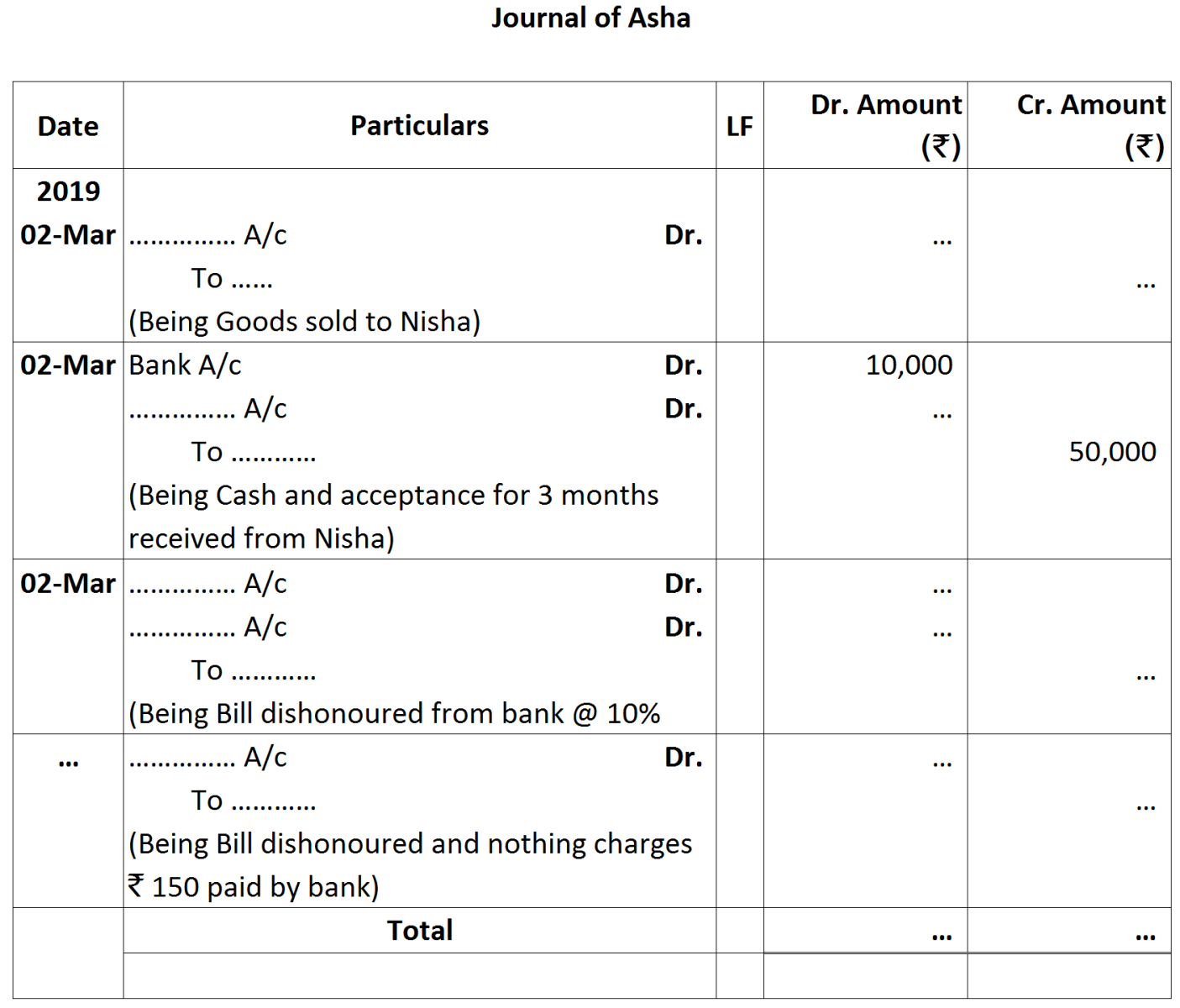
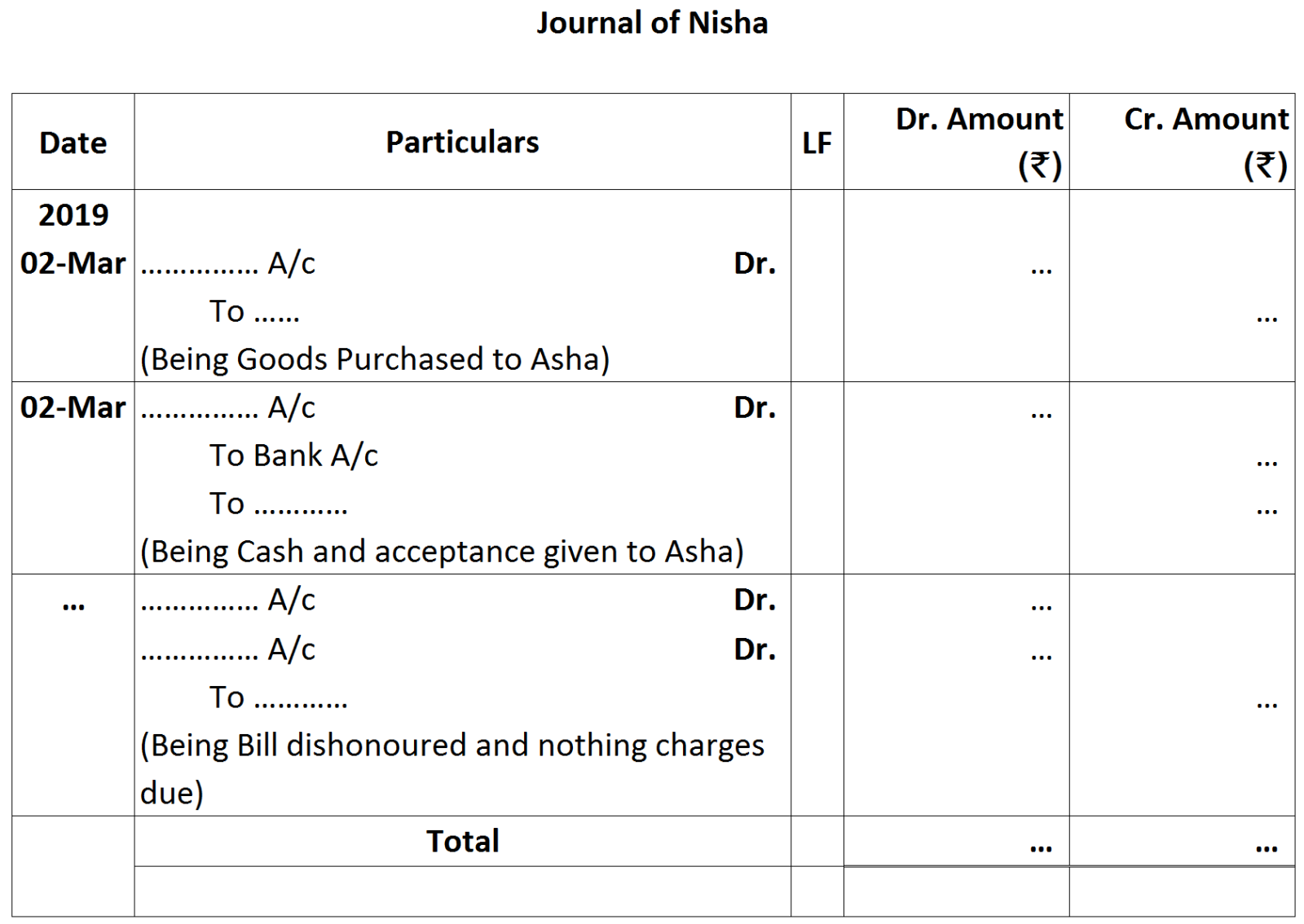
Asha sold goods worth ₹ 19,000 to Nisha on March 2, 2016. ₹ 4,000 were paid by Nisha immediately and for the balance she accepted a bill of exchange drawn upon her by Asha payable after three months. Asha discounted the bill immediately with her bank @ 10% p.a. On the due date Nisha dishonoured the bill and the bank paid ₹ 30 as noting charges.
On 5th June, Nisha paid ₹ 3,030 (including noting charges) in cash and accepted a new bill at one month for the amount due to Asha together with interest @ 15% p.a. Record the necessary journal entries in the books of Asha and Nisha.
View full solution
Q 253 Marks Question3 Marks
Calculate the due dates of the bills in the following cases:
 
Date of the Bills
Period
I.
1st February, 2017
2 months
II.
31st January, 2017
3 months
III.
30th September, 2017
2 months
IV.
30th September, 2017
3 months
V.
29th December, 2017
2 months
VI.
31st December, 2017
2 months
VII.
15th July, 2017
30 days
VIII.
27th January, 2016
1 month
View full solution
Q 264 Marks Question4 Marks
Explain any three of the following:
  1. Retiring of a bill of exchange.
  2. Discounting of a bill of exchange.
  3. Bill sent to bank for collection.
  4. Noting Charges.
View full solution
Q 304 Marks Question4 Marks
On 10th January, 2017, A sells goods to B for ₹ 12,000. On that date, B accepted a bill drawn upon him by A at two months for ₹ 12,000. A retains the bill till due date and on due date sends the bill to the Banker for collection. In due course, A receives the information from the Bank that the bill has been duly met.
Pass Journal Entries in the books of A and B.
View full solution
Q 316 Marks Question6 Marks
X sold goods to Y on 1.3.2017 for ₹ 12,000 and drew upon Y a bill of exchange for the same amount payable after two months. X immediately discounted the bill with his bank at 9% p.a. The maturity date of the bill was a non business day (holiday), therefore, X had to present the bill as per the provisions of the Indian Instruments Act, 1881. The bill was dishonoured by Y and X paid ₹ 45 as noting charges. Y settled the claim of X five days after the dishonour of the bill by a cheque which included interest @ 12% for the term of the bill.
Journalise the above transactions in the books of X and Y and prepare Y's account in the books of X and X's account in the books of Y.
View full solution
Q 336 Marks Question6 Marks
On Feb. 01, 2017, Mohan sold goods worth ₹ 25,000 to Naresh and drew upon him a bill payable after 90 days. Naresh accepted the bill and Mohan endorsed the bill immediately in favour of his creditor Raja in full settlement of his account of ₹ 25,300. One week before the maturity of the bill Naresh requested Mohan to cancel the bill and draw upon him a new bill including interest of ₹ 400. Mohan agreed to it. Mohan immediately took the bill from Raja by making the payment to him and then drew upon Naresh a new bill for 30 days which was duly met by Naresh on due date.
Pass necessary entries in the books of Mohan.
View full solution
Q 346 Marks Question6 Marks
On 21st Sept. 2017, Radhika sold goods for ₹ 2,00,000 to Parvati and drew upon later a bill for the same amount payable after 3 months. The bill was accepted by Parvati, Radhika discounted the bill from bank at a discount of 15% p.a. on 21st Oct., 2017. On maturity, the bill was dishonoured. Parvati agreed to pay ₹ 1,20,000 in cash including ₹ 3,000 interest and accepted a new bill for 3 months. The new bill was endorsed to Gayatri in full settlement of his account ₹ 85,000. It was duly met on maturity. Pass entries in the books of Radhika.
View full solution
Q 356 Marks Question6 Marks
On 17th April, 2016, X sold goods to Y for ₹ 80,000 and draws a bill for 2 months upon Y for the amount due. Y accepted the bill and returned it to X. On due date the bill became dishonoured and X paid ₹ 400 as Noting Charges. Fifteen days later Y pays the amount due to X. Pass Journal entries in the books of both the parties.
View full solution

Generate a Bills of Exchange paper free

Pick question groups from the list above, set marks and difficulty, and export a branded PDF with step-by-step answer keys. First 3 chapters free — no signup.

Download App