Question
Give four differences between organic and inorganic cornpounds.

Answer

S.No.Organic CompoundsInorganic Compounds
1.Occurs in living matter i.e. animals and plants. Found from Non-living matter i.e. Minerals.
2.They have low melting and boiling points.They have high melting and boiling points.
3.Insoluble in waterSoluble in water
4.They are generally nonvolatile
and inflammable.
They are generally non-volatile and non-combustible.

Need a full question paper?

Generate a complete, print-ready paper with questions like this in minutes — across 16+ boards, with answer keys.
Start Generating Free

Similar questions


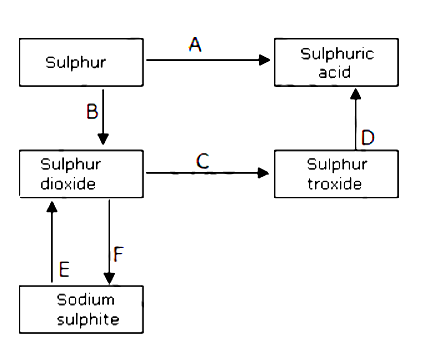
(i) Name the catalyst which helps in the conversion of sulphur dioxide to sulphur trioxide in step $C.$
(ii) In the contact process for the manufacture of sulphuric acid, sulphur trioxide is not converted to sulphuric acid by reacting it with water. Instead a two-step procedure is used. Write the equations for the two steps involved in $D.$
(iii) What type of substance will liberate sulphur dioxide from sodium sulphite in step $E?$​​​​​​​
(iv) Write the equation for the reaction by which sulphur dioxide is converted to sodium sulphite in step $F ?$
How an ore is concentrated by froth floatation process?
M is a metal above hydrogen in the activity series and its oxide has the formula $M_2O$. The oxide when dissolved in water forms the corresponding hydroxide which is a good conductor of electricity. In the above context answer the following:
(i) What kind of combination exists between $M$ and $O$?
(ii) How many electrons and there in the outermost shell of $M$?
(iii) Name the group to which M belongs
(iv) State the reaction taking place in the cathode
(v) Name the product at the anode
How many atoms of each kind are present in the following molecules: calcium oxide, chlorine, water, carbon tetrachloride?
How many electrons are required by each atom mentioned in (a) to attain the nearest noble gas configuration?
Give the trivial (common) names and IUPAC names of the following:
(a) $C_3H_6$
(b) $C_2H_4$
(c) $C_2H_2$
(d) $CH_3OH$
(e) $C_2H_5OH$
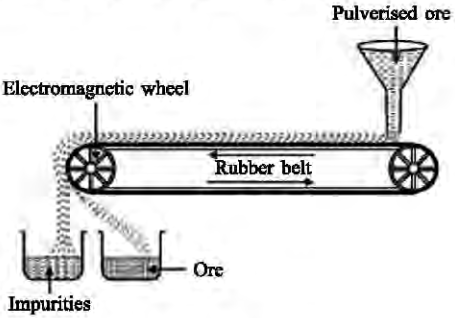
Look at the given picture carefully and answer the related questions:
Image
(i) Which step of metallurgy is performed by this method?
(ii) Give two examples of ores related to this method.
(iii) Write the property of ore and the principle of this process.
(iv) Name two other processes that come under the step of metallurgy in (i).
How would you prepare :
zinc sulphate crystals from zinc dust (powdered zinc and zinc oxide).
The following is an extract from metals in the service of man, Alexander and street /Pelican $1976$: Alumina (aluminium oxide) has a very high melting point over $2000^oC$ so that I cannot readily be liquefied. However, conversion of alumina to aluminium and oxygen, by electrolysis, an occur when it is dissolved in some other substance.
(a) Which solution is used to react with bauxite as first step in obtaining pure aluminium oxide?
(b) The aluminium oxide for the electrolytic extraction of aluminium is obtained by heating aluminium hydroxide. Write the equation for this reaction.
(c) Name the element which serves both as the anode and the cathode in the extraction of aluminium.
(d) Write the equation for the reaction that occurs at the cathode during the extraction of aluminium.
(e) Write the equation for the reaction that occurs at the cathode during extraction of aluminium by electrolysis.
(f) Give the equation for the reaction that occurs at the anode when aluminium is purified by electrolysis.
Define or explain chain isomerism and position isomerism with examples in each case.
How is an aqueous solution of ammonia prepared? Stage two advantages of method used.