Question
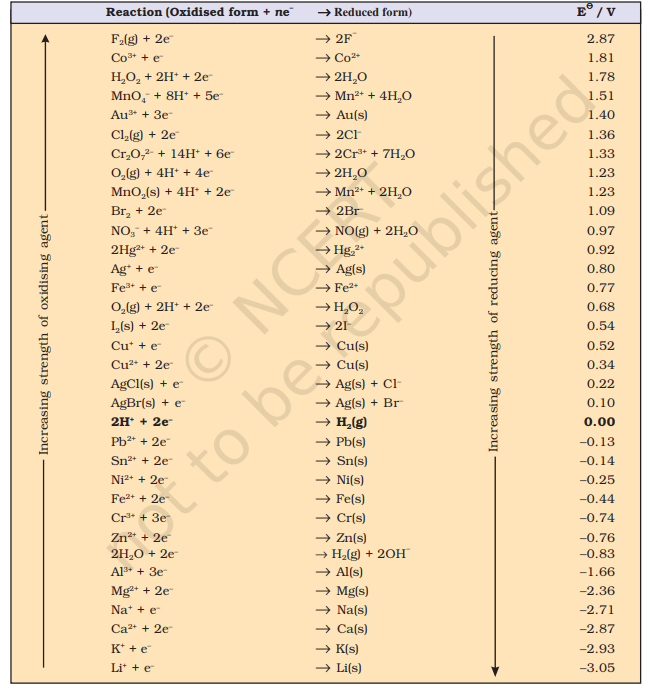
Using the standard electrode potentials given in the Table, predict if the reaction between the following is feasible:
$\mathrm{Ag}^{+}(\mathrm{aq})$ and $\mathrm{Cu}(\mathrm{s})$.
Answer

The possible reaction between $\mathrm{Ag}^{+}(\mathrm{aq})$ and $\mathrm{Cu}(\mathrm{s})$. is given by,$2\text{Ag}^+_{(\text{aq})}+\text{Cu}_{(\text{s})}\rightarrow2\text{Ag}_{(\text{s})}+\text{Cu}^{2+}_{(\text{aq})}$
$\text{Oxidation half equation:}\ \ \ \ \ \ \ \ \text{Cu}_{(\text{s})}\xrightarrow{\ \ \ \ \ }\text{Cu}^{2+}_{(\text{aq})}+2\text{e}^-;\ \ \text{E}^\circ=-0.34\text{V}\\\text{Reduction half equation:}\ \ [\text{Ag}^+_{(\text{aq})}+\text{e}^-\xrightarrow{\ \ \ \ \ }\text{Ag}_{(\text{s})}]\times2;\ \ \ \text{E}^\circ=+0.80\text{V}\\\overline{\ \ \ \ \ \ \ \ \ \ \ \ \ \ \ \ \ \ \ \ \ \ \ \ \ \ \ \ \ \ \ \ \ \ \ \ \ \ \ \ \ \ \ \ \ \ \ \ \ \ \ \ \ \ \ \ \ \ \ \ \ \ \ \ \ \ \ \ \ \ \ \ \ \ \ \ \ \ \ \ \ \ \ \ \ \ \ \ \ \ \ \ \ \ \ \ \ \ \ \ \ \ \ \ \ \ \ \ \ \ \ \ \ \ \ \ \ \ }\\\ \ \ \ \ \ \ \ \ \ \ \ \ \ \ \ \ \ \ \ \ \ \ \ \ \ \ \ \ \ \ \ 2\text{Ag}^+_{(\text{aq})}+\text{Cu}_{(\text{s})}\xrightarrow{\ \ \ \ \ }2\text{Ag}_{(\text{s})}+\text{Cu}^{2+};\ \ \ \text{E}^\circ=+0.46\text{V}$
E° positive for the overall reaction is positive. Hence, the reaction between $\mathrm{Ag}^{+}(\mathrm{aq})$ and $\mathrm{Cu}(\mathrm{s})$. is feasible.

Need a full question paper?

Generate a complete, print-ready paper with questions like this in minutes — across 16+ boards, with answer keys.

Start Generating Free

Similar questions

Complete the following reactions:
  1. $\text{CH}_3-\text{CH}=\text{CH}_2+\text{HBr}\xrightarrow{\text{Peroxide}}?$
  2. $\text{CH}_3-\text{Cl}+\text{Na}\xrightarrow{\text{Dry ether}}?$
  3. $\text{CH}_3-\text{CH}-\text{CH}_2-\text{CH}_3\xrightarrow[\Delta]{\text{alc. KOH}}\\ \ \ \ \ \ \ \ \ \ \ \ \ \ |\\ \ \ \ \ \ \ \ \ \ \ \ \ \text{Cl}$
  1. An orbital has n = 2, what are possible values of I and $m_l$?
  2. List the quantum numbers $m_l$ and I of electrons for 3d-orbital?
  3. Which of the following orbitals are possible?
2d, 1s, 2p, 3f
If 1 kg of a hard water sample contains 12 mg of $\mathrm{CaCl}_2$ and 12 mg of $\mathrm{MgCl}_2$, then what will be the total hardness in terms of $\mathrm{CaCO}_3$ per $10^6$ parts by mass of water sample.
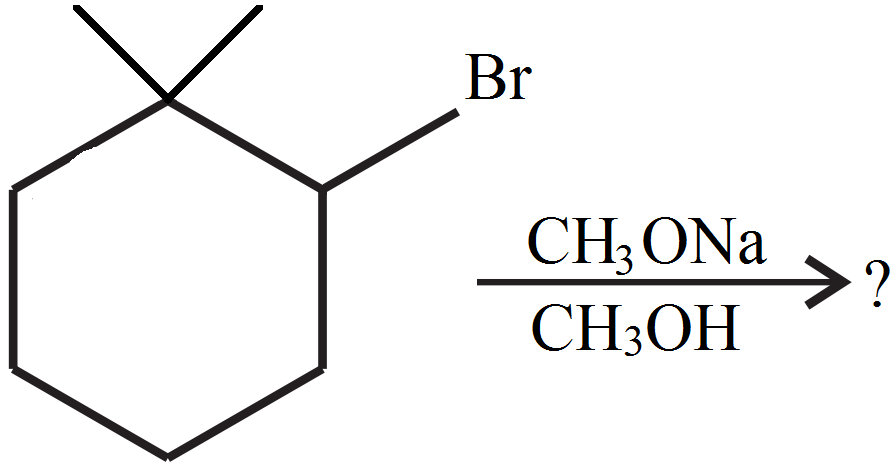
  1. Write the major product of the following reaction.
  1. Arrange the following in increasing order of acidic character.
$\ \ \ \ \ \ \ \ \ \ \ \ \text{CH}_3\ \text{O} \ \ \ \ \ \ \ \ \ \ \ \ \ \ \ \ \ \ \ \ \ \ \ \ \ \ \text{O}\\ \ \ \ \ \ \ \ \ \ \ \ \ \ | \ \ \ \ \ \ \ || \ \ \ \ \ \ \ \ \ \ \ \ \ \ \ \ \ \ \ \ \ \ \ \ \ \ \ ||\\\text{CH}_3-\text{C}-\text{C}-\text{OH},\ \text{CH}_3-\text{C}-\text{OH},\\ \ \ \ \ \ \ \ \ \ \ \ \ \ |\\ \ \ \ \ \ \ \ \ \ \ \ \ \text{CH}_3$ $ \ \ \ \ \ \ \ \ \ \ \ \ \ \ \ \ \ \ \ \ \ \ \ \ \ \text{O}\ \ \ \ \ \ \ \ \ \ \ \ \ \ \ \ \ \ \ \ \ \ \ \ \ \ \text{O}\\ \ \ \ \ \ \ \ \ \ \ \ \ \ \ \ \ \ \ \ \ \ \ \ \ \ || \ \ \ \ \ \ \ \ \ \ \ \ \ \ \ \ \ \ \ \ \ \ \ \ \ \ \ ||\\\text{CH}_3-\text{CH}_2-\text{C}-\text{OH},\ \text{CH}_3-\text{C}-\text{COOH}$
  1. What is the product obtained when but-2-ene reacts with $Br_2$​​​​​​​?
Complete the following reactions:
  1. $8\text{LiH}+\text{AlCl}_6\xrightarrow{\ \ \ \ \ \ \ \ \ }$
  2. $2\text{LiH}+\text{B}_2\text{H}_6\xrightarrow{\ \ \ \ \ \ \ \ \ }$
  3. $2\text{NaH}+\text{B}_2\text{H}_6\xrightarrow{\ \ \ \ \ \ \ \ \ }$
  1. Which orbitals are filled with electrons in third period?
  2. Which of the lanthanoids is man-made element?
  3. To which series do man-made elements belong?
Convert:
  1. Ethylene to Nitrobenzene.
  2. Write short note on Markovnikov's Rule.
For following reaction calculate change in standard free energy change :
$
C_2 H_2(g)+2 H_2(g) \rightarrow C_2 H_6(g)
$
For $C _2 H _2(g)$ and $C _2 H _6(g)$ value of $\Delta G _{ f }{ }^0$ is 209.2 $kJ mol ^{-1}$ and $-32.9 kJ mol ^{-1}$ respectively.
Find energy of each of the photons which,
Have wavelength of 0.50 $\mathring{\text{A}}.$
What do you understand by,
  1. Inert pair effect.
  2. Allotropy.
  3. Catenation.