Question
Give the physical explanation for the difference between musical sounds and noises.

Answer

Sounds can be roughly divided into two categories: (i) music, and (ii) noise.
Regularity, contrivity and rapidity make musical sounds different from a noise. The distinction between music and noise is not very sharp; it is subjective.
Music Noise
1. It is pleasant, smooth and agreeable to the ear. 1. It is harsh, discordant and displeasing to the ear.
2. It is produced by the vibrations which are periodic. 2. It is produced by an irregular succession of disturbances.
3. All the component waves are similar without any sudden change in their wavelength and amplitude 3. The component wave chanqes their character suddenly and they are of short duration..
4. The sound level is low (below 30 dB). 4. The sound level is hiah (above 120 dB).

Need a full question paper?

Generate a complete, print-ready paper with questions like this in minutes — across 16+ boards, with answer keys.
Start Generating Free

Similar questions

A machine is driven by a $50$ kg mass falling at a rate of $10.0$ m in $5 s$ . It lifts n load of 250 kgf . Taking the force of gravity on 1 kg mass as 10 N . Calculate the power input to the machine. If the efficiency of the machine is $60 \%$, find the height to which the load is raised in $5 s $.
What are damped vibrations? How do they differ from free vibrations? Give one example of each.
Three resistances, of which two are equal when connected in series have an effective resistance of $30$ ohms. When the three resistances are connected in parallel, the effective resistances is $3$ ohms. Find the values of the individual resistances.
A block and tackle system has the velocity ratio 3. Draw a labelled diagram of the system indicating the points of application and the directions of load and effort. A man can exert a pull of 200 kgf. What is the maximum load he can raise with this pulley system is its efficiency is 60%?
A house is provided with 15 bulbs of 40W, 5 bulbs of 100W, 5 fans of 80 W, and one heater of 1.0 kW. Each day bulbs are used for 4h, fans for lOh, and heater for 2h. The voltage of mains is 220 V. Calculate:
(i) Maximum power of the circuit in the house,
(ii) maximum current capacity of the main fuse in the house,
(iii) the electrical energy consumed in a week,
(iv) cost of electricity consumed at 1.25 Rs. per kWh.
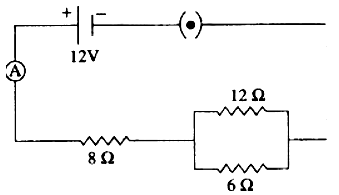
Three resistors are connected to a $12 \ V$ battery as shown in the figure given below:

(i) What is the current through the $8$ ohm resistor?
(ii) What is the potential difference across the parallel combination of $6$ ohm and $12$ ohm resistor?
(iii) What is the current through the $6$ ohm resistor?
The diagram in Fig. 9.27 shows a three pin plug. Label the three pins.
(a) why if the top pin thicker and longer than the other two?
(b) why are the pins splitted at the ends?
QUESTION If there is no Heat loss to the surroundings, the heat released by the condensation of $m_1 g$ of steam at $100^{\circ} C$ into water at $100^{\circ} C$ can be used to convert $m _2 g$ of ice at $0^{\circ} C$ into water at $0^{\circ} C$.
(i) Find:
(a) The heat lost by steam in terms of $m_1$
(b) The heat gained by ice in terms of $m _2$
(ii) Form a heat equation find the ratio of $m _2: m _1$
Specific latent heat of vaporization of steam $=2268 kJ / kg$
Specific latent heat of fusion of ice $=336 kJ / kg$
Specific heat capacity of water $=4200 J / kg ^{\circ} C$
State the reason why, in a three pin plug, the earth pin is longer and thicker than the other two.
State two dis-similarities and one similarity between a d.c. motor and an a.c. generator.