the human eye and the colourful world — Science STD 10 — Question
Gujarat BoardEnglish MediumSTD 10Sciencethe human eye and the colourful world3 Marks
Question
Give the reason for the advanced sunrise and delayed sunset.
✓
Answer
As the altitude (height) from the earth’s surface gradually increases, the earth’s atmosphere becomes rarer.
Hence, the refractive index of the air decreases continuously.
So a ray of light coming from the Sun towards an observer continuously passes from an optically rarer to optically denser medium and bends towards the normal.
Thus, its direction of propagation changes continuously.
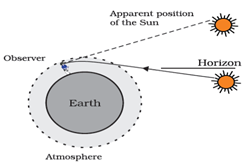
[Actual and apparent position of the Sun at sunrise / sunset]
The actual sunrise or sunset begins when the Sun reaches the horizon.
In figure, $S_1$ is the actual position of the Sun a little below the horizon.
In this case, the light rays coming from $S _1$, continuously get refracted in the earth's atmosphere (atmospheric refraction) and reach the observer as shown in the figure.
The tangent drawn to the curved path of the ray at point $P$ passes through $S_2$, above the horizon.
$S_2$ is the apparent position of the Sun.
Thus, during the sunrise, the Sun is seen even though it is little below the horizon.
Similarly, during the sunset it is seen for sometime even though it is little below the horizon.
Taking the refractive index of air as $1.00029$ the apparent angular shift in the position of the Sun is found to be approximately $\left(\frac{1}{2}\right)^{\circ}$
Now, for angular displacement of $180^{\circ}$ of the Sun, time required is $12$ hours. Hence for angular displacement of $\left(\frac{1}{2}\right)^{\circ}$ of the Sun, time required is