Question
Give the structures of A and B.

Answer

(B) and (C) are $\mathrm{CH}_3 \mathrm{CH}_2 \mathrm{CHO}$ (propanal) and $\mathrm{CH}_3 \mathrm{COCH}_3$ (propanone). Hence, A is
$\ \ \ \ \ \ \ \ \ \ \ \ \ \ \ \ \ \ \ \ \text{H}\\ \ \ \ \ \ \ \ \ \ \ \ \ \ \ \ \ \ \ \ \ \ |\\\text{CH}_3\text{CH}_2-\text{C}=\text{O}+\text{O}=\text{C}-\text{CH}_3\rightarrow\\ \ \ \ \ \ \ \ \ \ \ \ \ \ \ \ \ \ \ \ \ \ \ \ \ \ \ \ \ \ \ \ \ \ \ \ \ \ \ \ \ \ \ \ \ \ \ |\\ \ \ \ \ \ \ \ \ \ \ \ \ \ \ \ \ \ \ \ \ \ \ \ \ \ \ \ \ \ \ \ \ \ \ \ \ \ \ \ \ \ \ \ \ \ \text{CH}_3\\ \ \ \ \ \ \ \ \ \ \ \ \ \ \ \ \ \ \ \ \ \ \ \ \ \ \ \text{CH}_3\\ \ \ \ \ \ \ \ \ \ \ \ \ \ \ \ \ \ \ \ \ \ \ \ \ \ \ \ |\\\text{CH}_3\text{CH}_2\text{CH}=\text{C}-\text{CH}_3\\ \ \ \ \ _{2-\text{methyl pent-2ene}}$
$ \ \ \ \ \ \ \ \ \ \ \ \ \ \ \ \ \ \ \ \ \ \ \ \ \ \ \ \ \ \ \ \ \ \ \ \ \ \ \ \ \ \ \ \ \ \ \ \ \ \ \ \ \ \ \ \ \ \ \ \ \ \ \ \ \ \ \ \ \ \ \ \ \ \ \ \ \ \ \ \ \ \ \ \ \ \ \ \ \ \ \ \ \ \text{CH}_3\\ \ \ \ \ \ \ \ \ \ \ \ \ \ \ \ \ \ \ \ \ \ \ \ \ \ \ \ \ \ \ \ \ \ \ \ \ \ \ \ \ \ \ \ \ \ \ \ \ \ \ \ \ \ \ \ \ \ \ \ \ \ \ \ \ \ \ \ \ \ \ \ \ \ \ \ \ \ \ \ \ \ \ \ \ \ \ \ \ \ \ \ \ \ \ |\\\text{CH}_3\text{CH}_2\text{CHO}+\text{CH}_3\text{COCH}_3\xleftarrow{\text{Ozonolysis}}\text{CH}_3\text{CH}_2\text{CH}=\text{C}-\text{CH}_3\\ \ \ \ \ \ \ \ \ (\text{B}) \ \ \ \ \ \ \ \ \ \ \ \ \ \ \ \ \ \ \ \ \ \ \ (\text{C}) \ \ \ \ \ \ \ \ \ \ \ \ \ \ \ \ \ \ \ \ \ \ \ \ \ \ \ \ \ \ \ \ \ (\text{A})$
$ \ \ \ \ \ \ \ \ \ \ \ \ \ \ \ \ \ \ \ \ \ \ \ \ \ \ \text{CH}_3\\ \ \ \ \ \ \ \ \ \ \ \ \ \ \ \ \ \ \ \ \ \ \ \ \ \ \ \ |\\\text{CH}_3\text{CH}_2\text{CH}=\text{C}-\text{CH}_3\xrightarrow{\text{Hot KMnO}_4}\\ \ \ \ \ \ (\text{A})\\ \ \ \ \ \ \ \ \ \ \ \ \ \ \ \ \ \ \ \ \ \ \ \ \ \ \ \ \ \ \ \ \ \ \ \ \ \ \ \ \ \ \ \ \ \text{CH}_3\\ \ \ \ \ \ \ \ \ \ \ \ \ \ \ \ \ \ \ \ \ \ \ \ \ \ \ \ \ \ \ \ \ \ \ \ \ \ \ \ \ \ \ \ \ \ |\\\text{CH}_3\text{CH}_2\text{COOH}+\text{CH}_3-\text{C}=\text{O}\\ \ \ \ \ \ \ \ \ \ (\text{D}) \ \ \ \ \ \ \ \ \ \ \ \ \ \ \ \ \ \ \ \ \ \ \ \ \ \ \ (\text{C})$

Need a full question paper?

Generate a complete, print-ready paper with questions like this in minutes — across 16+ boards, with answer keys.

Start Generating Free

Similar questions

The first (IE) and second (IER) ionization enthalpy: $\left( KJ mol ^{-1}\right)$ of three elements $A , B$ and C are given below:
 ABC
$IE _1$4035491142
$IE _2$264010602080
Identify the element which is likely to be
i. a non-metal
ii. an alkali metal
iii. an alkaline earth metal
Match Cloumn I with Column II.
S. No
Cloumn I
S. No
Cloumn II
1.
88g of $CO_2$
(i)
0.25mol
2.
$6.022 \times 10^{23}$​​​​​​​ molecules of $H_2O$
(ii)
2mol
3.
5.6 litres of $O_2​​​​​​​$ at STP
(iii)
1mol
4.
96g of $O_2​​​​​​​$
(iv)
$6.022 \times 10^{23}​​​​​​​$ molecules
5.
1mol of any gas
(v)
3mol
0.5 mole each of $\mathrm{H}_2 \mathrm{~S}$ and $\mathrm{SO}_2$ mixed together in a reaction Flask, react according to equation:
$2 \mathrm{H}_2 \mathrm{~S}+\mathrm{SO}_2 \rightarrow 2 \mathrm{H}_2+3 \mathrm{~S}$
Calculate the number of moles of 'S' formed.
Write four characteristic properties of p-block elements.
  1. Write IUPAC name of the following:
$\text{CH}_3\text{CHCH}\equiv\text{CH}\\\ \ \ \ \ \ \ \ \ |\\ \ \ \ \ \ \ \ \ \text{CH}=\text{CH}_2$
  1. Draw the structure of Pent-4-en-2-ol.
  2. What is nucleophile? Give one example.
If a liquid compound decomposes at its boiling point, which method (s) can you choose for its purification. It is known that the compound is stable at low pressure, steam volatile and insoluble in water.
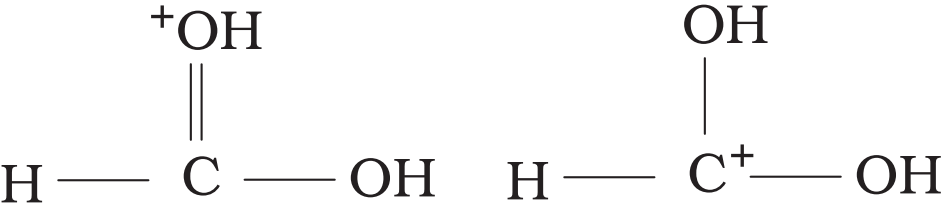
What is the relationship between the members of following pairs of structures? Are they structural or geometrical isomers or resonance contributors?
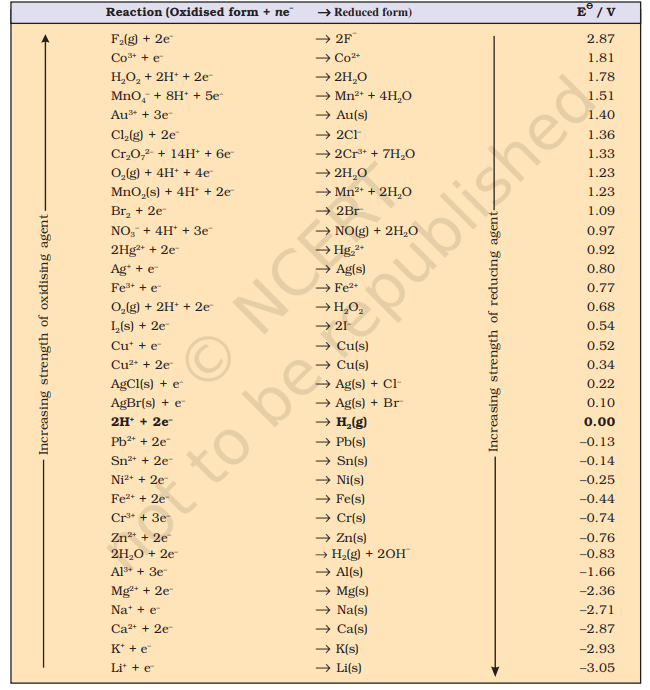
Using the standard electrode potentials given in the Table, predict if the reaction between the following is feasible:
$\mathrm{Ag}^{+}(\mathrm{aq})$ and $\mathrm{Cu}(\mathrm{s})$.
When 3 grams of substance is burnt in a bomb calorimeter at a temperature of 298 K , an increase of 2 degree is observed in the temperature. If the calorimeter and heat capacity of water are $20.5 kJ K ^{-1}$ then calculate $\Delta U$. Molar mass of substance $=27$.
  1. State Hess's Law of constant heat summation. How does it follow from the first law of thermodynamics.
  2. Determine $\Delta_\text{r}\text{H}^\circ,$ at 298K for reaction:
$\text{C(graphite)}+2\text{H}_2(\text{g})\overrightarrow{\ \ \ \ \ \ \ \ }\ \text{CH}_4(\text{g});\ \Delta_\text{r}\text{H}^\circ=?$
You are given:
  1. $\text{C(graphite)}+\text{O}_2(\text{g})\overrightarrow{\ \ \ \ \ \ \ }\ \text{CO}_2(\text{g});$ $\Delta_\text{r}\text{H}^\circ=-393.51\text{kJ/ mol}$
  2. $\text{H}_2\text{(g)}+\frac{1}{2}\text{O}_2(\text{g})\overrightarrow{ \ \ \ \ \ \ \ }\ \text{H}_2\text{O(l)};$ $\Delta_\text{r}\text{H}^\circ=-285.8\text{kJ/ mol}$
  3. $\text{CO}_2(\text{g})+2\text{H}_2\text{O(l)}\overrightarrow{\ \ \ \ \ \ \ \ \ }\ \text{CH}_4(\text{g})+2\text{O}_2(\text{g});$ $\Delta_\text{r}\text{H}=+890.3\text{kJ/ mol}$