Question
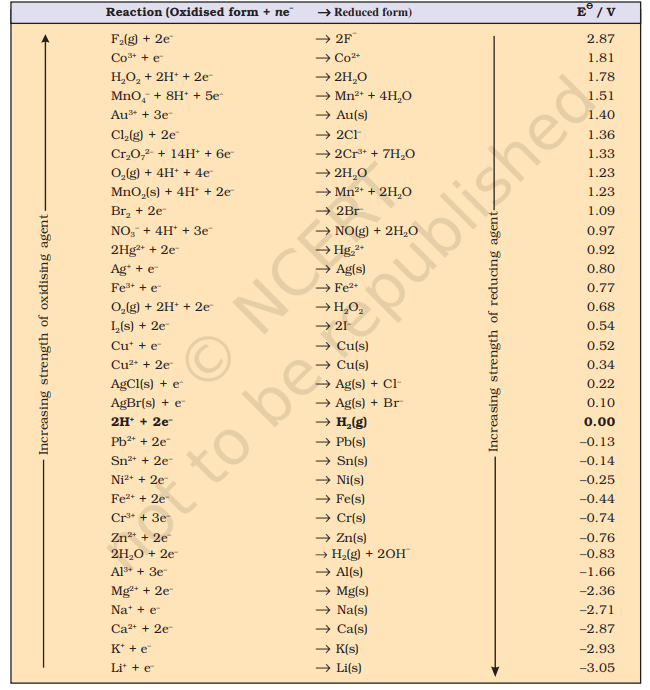
Using the standard electrode potentials given in the Table, predict if the reaction between the following is feasible:
$\mathrm{Ag}^{+}(\mathrm{aq})$ and $\mathrm{Cu}(\mathrm{s})$.
Answer

The possible reaction between $\mathrm{Ag}^{+}(\mathrm{aq})$ + $\mathrm{Cu}(\mathrm{s})$. is given by,$2\text{Ag}^+_{(\text{aq})}+\text{Cu}_{(\text{s})}\rightarrow2\text{Ag}_{(\text{s})}+\text{Cu}^{2+}_{(\text{aq})}$
$\text{Oxidation half equation:}\ \ \ \ \ \ \ \ \text{Cu}_{(\text{s})}\xrightarrow{\ \ \ \ \ }\text{Cu}^{2+}_{(\text{aq})}+2\text{e}^-;\ \ \text{E}^\circ=-0.34\text{V}\\\text{Reduction half equation:}\ \ [\text{Ag}^+_{(\text{aq})}+\text{e}^-\xrightarrow{\ \ \ \ \ }\text{Ag}_{(\text{s})}]\times2;\ \ \ \text{E}^\circ=+0.80\text{V}\\\overline{\ \ \ \ \ \ \ \ \ \ \ \ \ \ \ \ \ \ \ \ \ \ \ \ \ \ \ \ \ \ \ \ \ \ \ \ \ \ \ \ \ \ \ \ \ \ \ \ \ \ \ \ \ \ \ \ \ \ \ \ \ \ \ \ \ \ \ \ \ \ \ \ \ \ \ \ \ \ \ \ \ \ \ \ \ \ \ \ \ \ \ \ \ \ \ \ \ \ \ \ \ \ \ \ \ \ \ \ \ \ \ \ \ \ \ \ \ \ }\\\ \ \ \ \ \ \ \ \ \ \ \ \ \ \ \ \ \ \ \ \ \ \ \ \ \ \ \ \ \ \ \ 2\text{Ag}^+_{(\text{aq})}+\text{Cu}_{(\text{s})}\xrightarrow{\ \ \ \ \ }2\text{Ag}_{(\text{s})}+\text{Cu}^{2+};\ \ \ \text{E}^\circ=+0.46\text{V}$
E° positive for the overall reaction is positive. Hence, the reaction between $\mathrm{Ag}^{+}(\mathrm{aq})$ and $\mathrm{Cu}(\mathrm{s})$. is feasible.

Need a full question paper?

Generate a complete, print-ready paper with questions like this in minutes — across 16+ boards, with answer keys.

Start Generating Free

Similar questions

Depict the galvanic cell in which the reaction $Zn ( s )+2 Ag ^{+}( aq ) \longrightarrow Zn ^{2+}( aq )+2 Ag ( s )$ takes place, Further show:
i. which of the electrode is negatively charged,
ii. the carriers of the current in the cell, and
iii. individual reaction at each electrode.
How many grams of $Cl _2$, are required to completely react with 0.4 g of H, to yield HCl ? Also, calculate the amount of HCl formed.
How many litres of oxygen are required for complete combustion of 6.0 gram of ethane at standard temperature and pressure.
With the help of molecular orbital theory, predict which of the following species is diamagnetic $\text{H}^+_2,\text{O}_2,\text{O}^{2+}_2?$
Use Lewis symbols to show electron transfer between the following atoms to form cations and anions: K and S.
Among the elements $B , AI , C$ and Si
1. Which has the highest first ionization enthalpy?
2. Which has the most negative electron gain enthalpy?
3. Which has the largest atomic radius?
4. Which has the most metallic character?
1. Use the following reactions to arrange the elements $A , B , C$ and D in order of their redox reactivity
a. $A + B ^{+} \rightarrow A ^{+}+ B$
b. $B + D ^{+} \rightarrow B ^{+}+ D$
c. $C ^{+}+ D \rightarrow$ No reaction
d. $B + C ^{+} \rightarrow B ^{+}+ C$
2. On the basis of above redox activity series, predict which of the following reactions would you expect to occur?
a. $A ^{+}+ C \rightarrow A + C ^{+}$
b. $A ^{+}+ D \rightarrow A + D ^{+}$
What is the relationship between the members of following pairs of structures? Are they structural or geometrical isomers or resonance contributors?
Which of the compounds in pair of compounds has higher dipole moment?
i. $\mathrm{BCl}_3$ and $\mathrm{BF}_3$
ii. $\mathrm{SO}_2$ and $\mathrm{SO}_3$
iii. $\mathrm{H}_2 \mathrm{O}$ and $\mathrm{H}_2 \mathrm{S}$
Draw the shape of the following hybrid orbitals $\mathrm{sp}$,  $\mathrm{sp}^2$ and $\mathrm{sp}^3$.