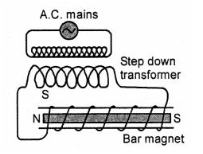
1. A magnet can be damagnetised by any of the following methods:Electrical Method : An insulated copper coil is wound around a card board tube and inside it is placed a permanent bar magnet. The coil is placed in East-West direction and its ends are connected to a step-down transformer. The alternating current is switched on for one minute, then the bar magnet gets demagnetised.
 Reason :
 When the current rapidly changes the direction in the insulated copper coil, the polarity set up in the coil also rapidly changes. This in turn acts inductively on the bar magnet, whose molecular magnets rapidly try to align themselves with the changing magnetic polarity. Thus, molecular magnets form closed chains and hence, the bar magnet gets demagnetised.
2. By Rough Handling: When a magnet is rough-handled (i.e. it is allowed to drop repeatedly) or hammered, it gets completely demagnetised.
Reason: In a bar magnet the molecular magnets are arranged in straight line chains. On hammering or rough handling, they gain kinetic energy and vibrate rapidly about their mean positions. In doing so they form closed magnetic chains and hence, the magnetism is lost.
3. By Heating: When a magnet is heated to red hot temperature and then allowed to cool, it loses its magnetism. Reason: Due to heat energy, the kinetic energy of the molecules increases. Thus, from straight line molecular chains, they form closed molecular chains and hence, the magnetism is lost.
4. By Induction : When a given magnet is placed in contact with another similar magnet (i.e., the other magnet should be of same strength), such that their similar poles are facing each others then both the magnets get demagnetised in a couple of days.
Reason: It is because both the magnets will induce opposite polarity in each other. In doing so the molecular magnets in each magnet form closed molecular chains and hence, they get demagnetised.
5. By Self-Induction : A single bar magnet has a tendency to lose its magnetism. Reason : In a bar magnet the molecular magnets (dipoles) are arranged in straight line chains. However, two or more parallel chains have their north and south poles facing each other. Thus, dipoles act inductively on each other and hence, turn to form closed molecular chains. Thus, single bar magnet gets demagnetised.